Article Updated Nov 04, 2026
 12 min read
AI Tools for Recruitment in Service Businesses: How to Choose the Right Fit
Updated Nov 04, 202612 min read Updated Nov 04, 202612 min read
Choose AI tools for recruitment by identifying the work your hiring process cannot handle well. Lost applications call for better candidate tracking. Repetitive conversations may justify conversational intake. Interview coordination may need calendar automation rather than another recruiting platform.
For a service business hiring across different sites and shifts, the right tool must work with the actual vacancy, candidate record, communication channel, and interviewer’s calendar. An AI feature is useful only if it improves that process without creating unacceptable errors or extra administrative work.
This comparison examines CogniAgent, Paradox, Manatal, Breezy HR, and Workable using their public product information. It is published by CogniAgent, which is included in the comparison. It is not a hands-on test or a ranking.
Describe the bottleneck before selecting software. “We need AI” is less useful than “we cannot tell which applicants have supplied their availability.”
|
Problem |
Type of solution to consider |
What to verify |
|---|---|---|
|
Applications are scattered across channels |
ATS or candidate-tracking system |
Supported application sources, duplicate handling, and status tracking |
|
First contact takes too long |
Communication tools or a conversational assistant |
Channel availability, messaging permissions, and human handoff |
|
Staff repeatedly ask the same intake questions |
Structured application forms or conversational intake |
Editable questions, missing answers, and review of exceptions |
|
Interviews require repeated coordination |
Scheduling automation |
Calendar availability, interviewer assignment, and booking confirmation |
|
Candidate information must move between systems |
Workflow platform or supported integration |
Exact read/write operations, field mapping, and failure handling |
Check what your existing software already provides. A questionnaire, scheduling link, or configured reminder may solve the problem without introducing a language model.
For the broader operational context, see benefits of AI in HR for service businesses. This guide concentrates on choosing the tool rather than covering every HR use case.
Recruitment software can combine several categories, but the distinctions help explain what you are buying.
An ATS may contain conversational features, and an assistant may work alongside an ATS. Neither a product category nor an “AI-powered” label proves that a particular integration, channel, or action is included.
Use the following cards to build a shortlist. Suitability depends on your current systems and required workflow, not simply company size.
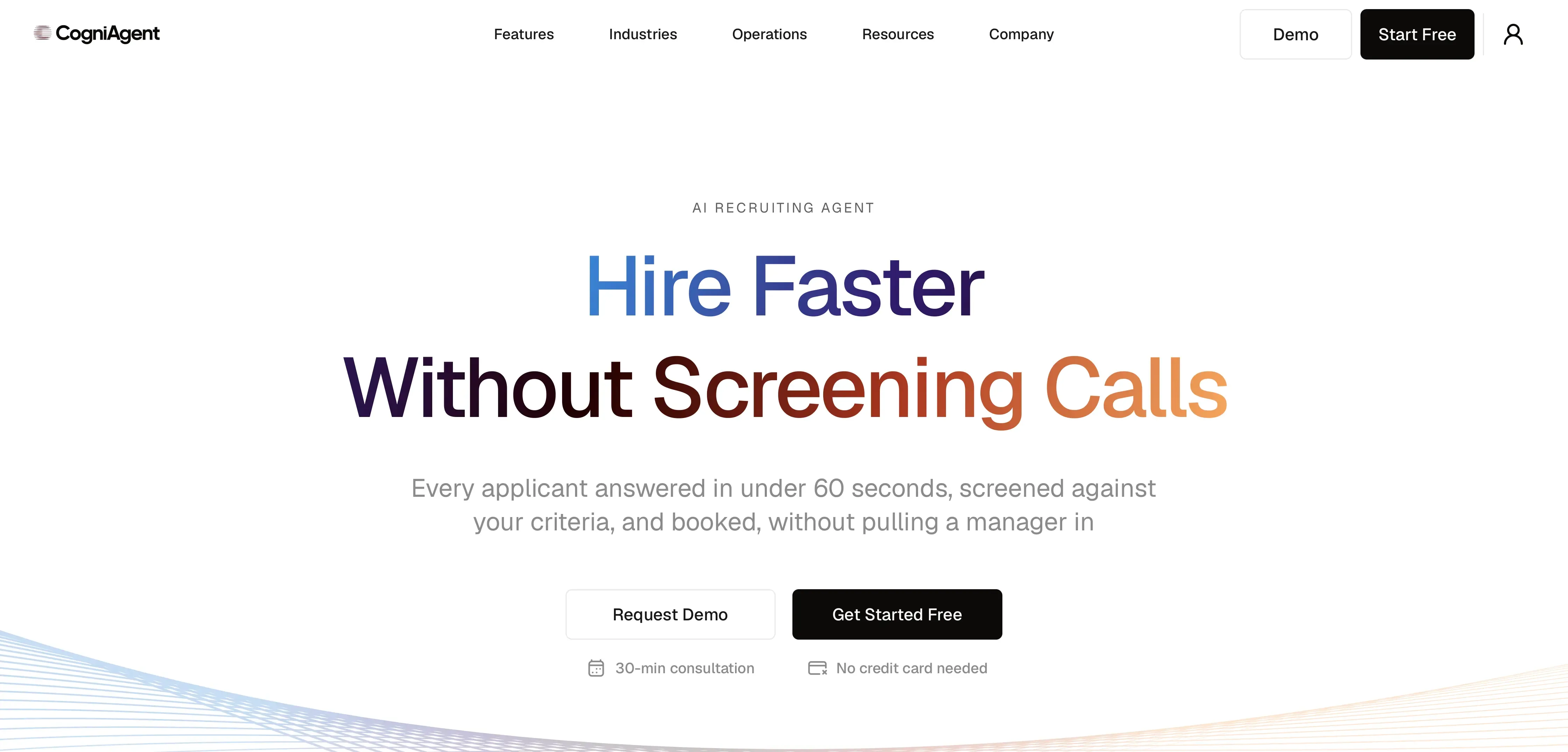
CogniAgent’s workflow builder. The application shown is Invoice Processing Flow, not a configured recruiting workflow.
Task and fit. Consider CogniAgent when you need to configure candidate conversations and connect their outcomes to other tools, rather than only maintain a hiring pipeline.
Confirmed offering. The AI recruiting agent page describes role-specific questions, candidate information capture, interview coordination, and follow-up.
Connections and setup. Prepare approved vacancy information, intake fields, review rules, and destination mappings. Verify each required operation. The pricing and channel information specifies connected provider accounts; phone and SMS currently use Twilio.
Small-business limitation. Configurable workflows still need someone to maintain questions, inspect failed actions, and handle exceptions. Do not assume any advertised connector supports every operation you need.
Cost. Published credit packages include US$10 for 5,000 credits and US$100 for 100,000 credits—not fixed application allowances. Pay-as-you-go LLM usage carries a 12.5% markup over the underlying provider rate. Enterprise customers using their own LLM API keys skip that markup. Connected channel-provider charges remain separate.
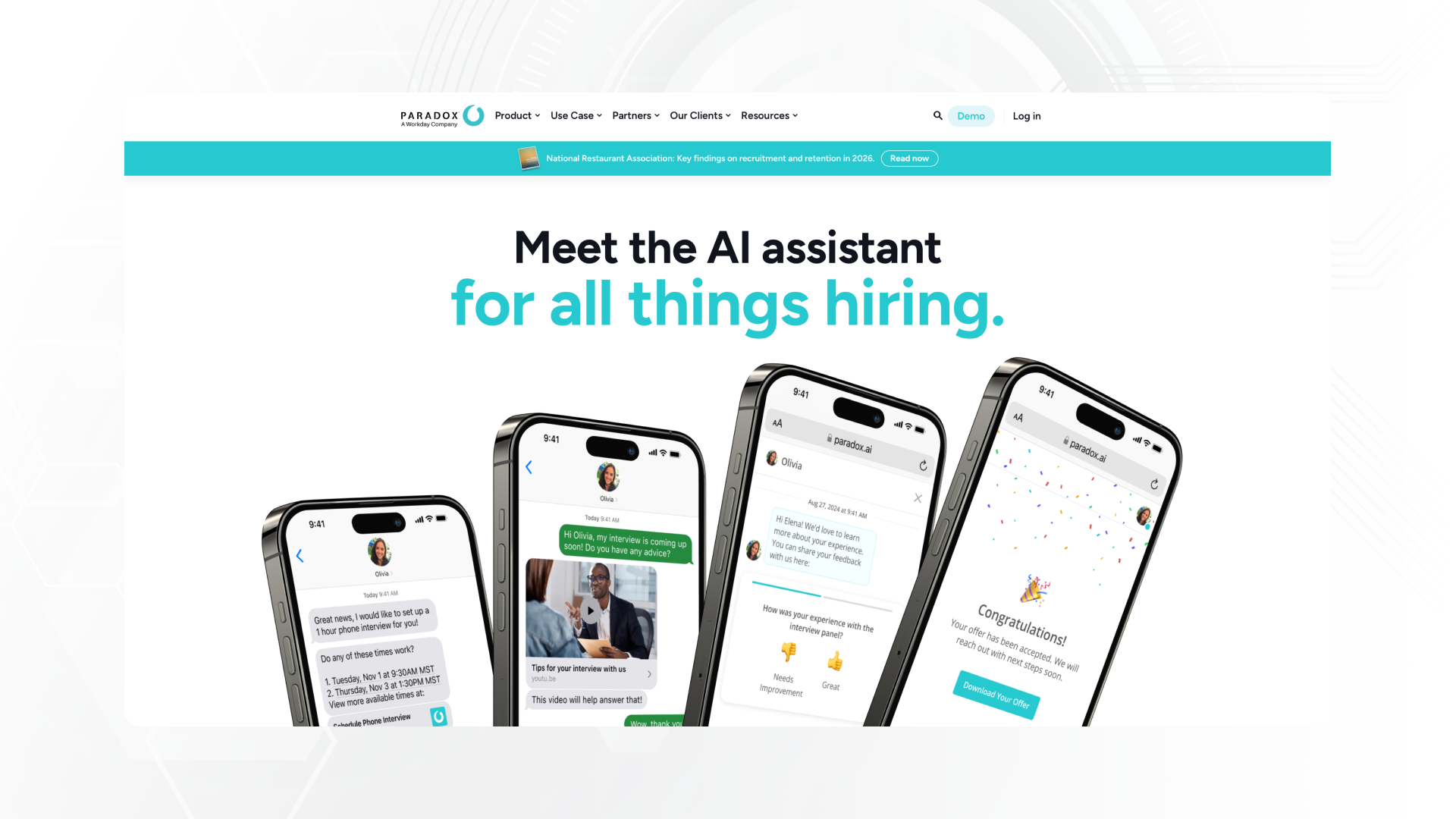
Paradox’s product presentation showing candidate conversations and hiring-related interactions.
Task and fit. Consider Paradox when conversational applications and interview coordination are central to the requirement, particularly across multiple locations.
Confirmed offering. Its text-to-apply product describes text-based applications and configurable screening requirements. Its conversational scheduling product describes coordination involving calendars, interviewers, rooms, and locations.
Connections and setup. Establish whether you need its Conversational ATS or an assistant connected to your existing system. The current product portfolio includes both approaches.
Small-business limitation. Request a demonstration using your actual hiring structure. Confirm supported messaging channels in your country, application sources, escalation, implementation responsibilities, and any minimum commitment. Do not infer these details from an enterprise customer example.
Cost. No public numeric price was established from the reviewed product pages. Obtain a written proposal covering modules, connections, implementation, messaging, and support.
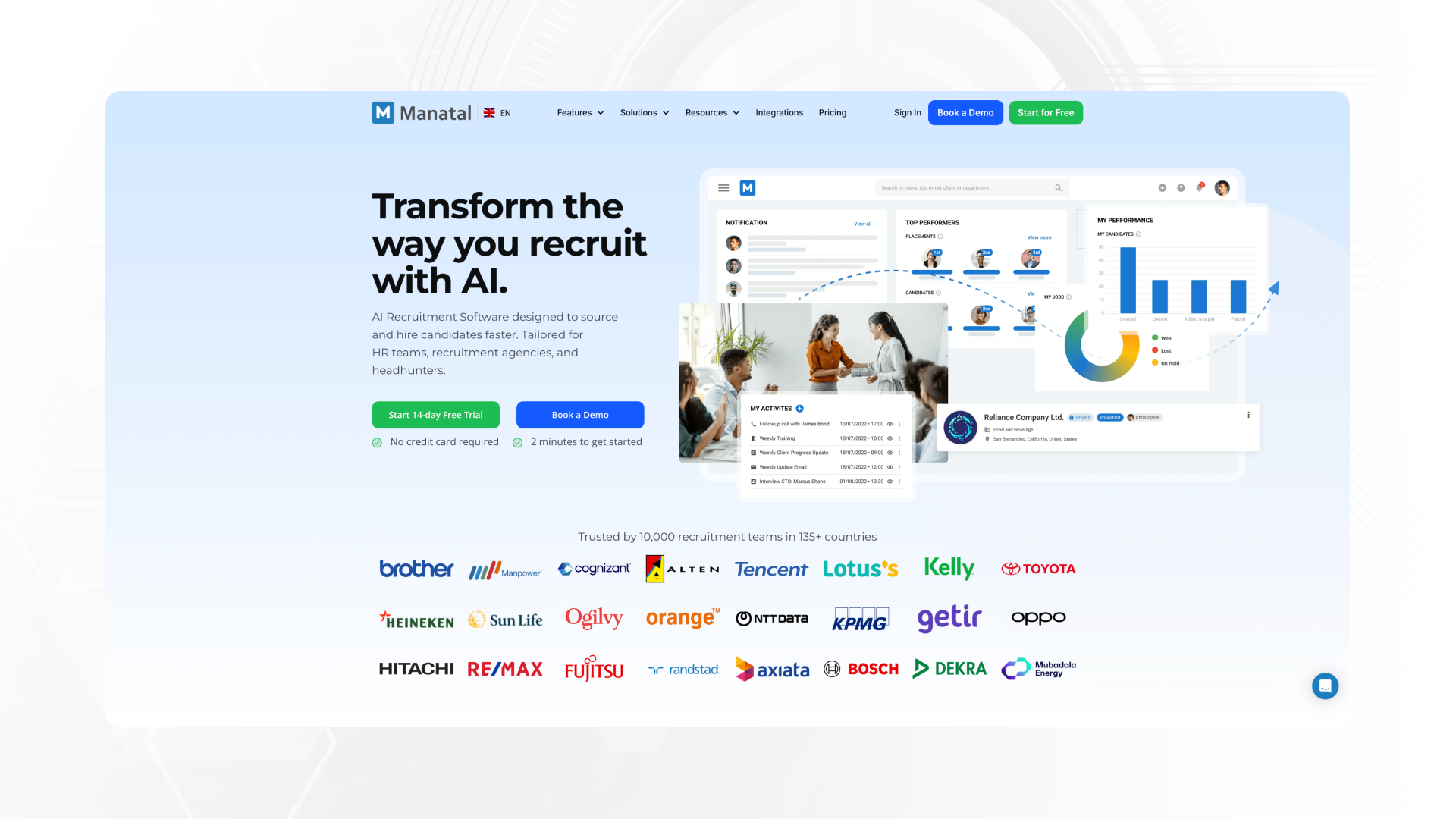
Manatal’s product presentation showing candidate records, recruitment reporting, and collaboration.
Task and fit. Consider Manatal when candidate records, a recruitment pipeline, and database-based matching are the main gaps.
Confirmed offering. Manatal describes applicant tracking, AI candidate recommendations, career pages, and mailbox/calendar connections. Its AI Interviewer announcement identifies that feature as beta with access by request; do not assume it is included in a standard subscription.
Connections and setup. Configure application sources, job requirements, pipeline stages, and account permissions. Ask which messaging connection supports the candidate conversation you need.
Small-business limitation. Plan boundaries matter. Workflow automation starts with Enterprise, while Open API access is listed under Enterprise Plus. Confirm the precise SMS integration, charges, and regional availability instead of treating SMS as absent or universally included.
Cost. The pricing page lists Professional at US$15 per user/month billed annually, or US$19 on monthly billing. Professional includes up to 15 jobs and 10,000 candidates per account. Price the required plan and any additional services—not just the entry subscription.
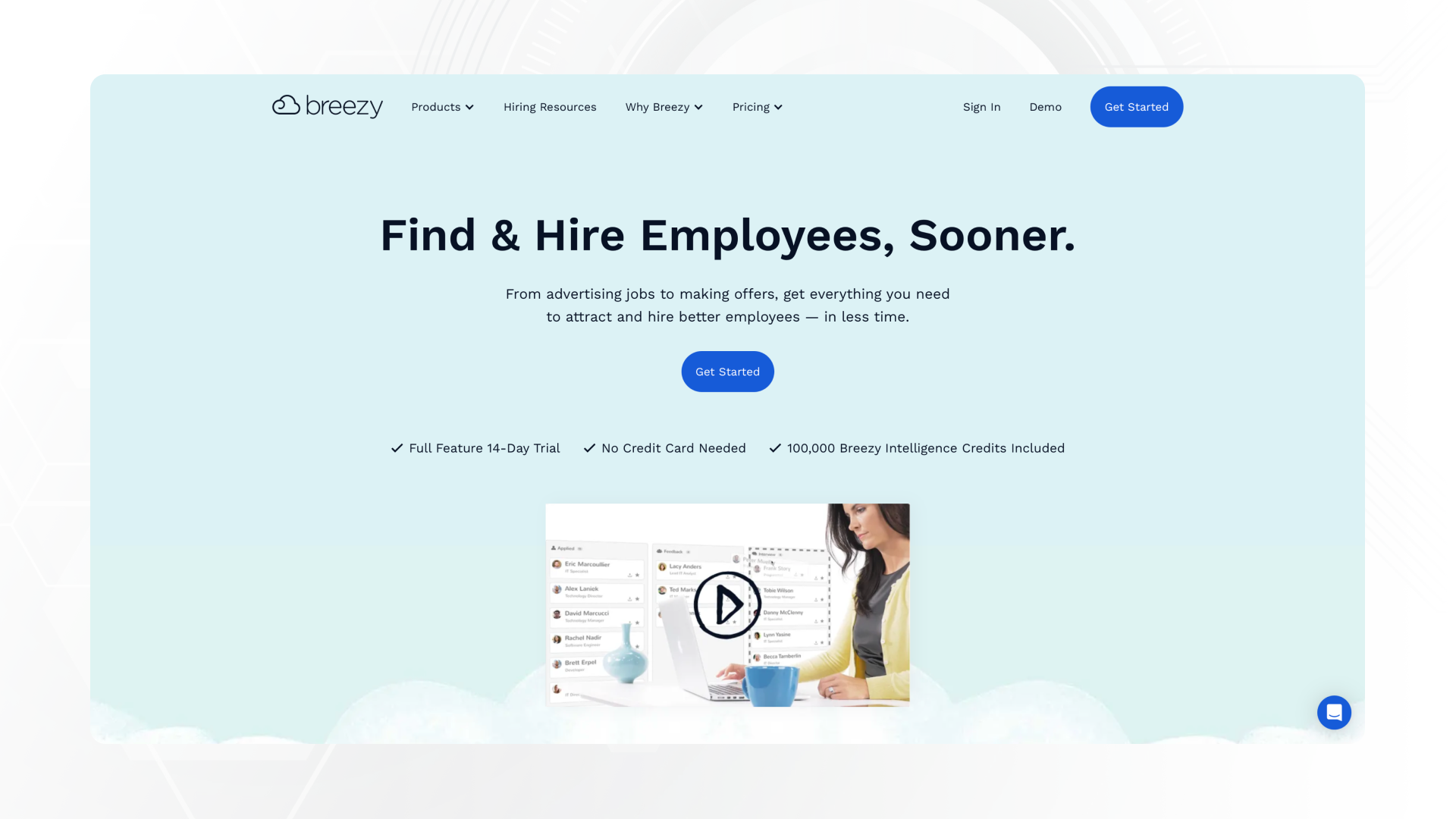
Breezy HR’s product presentation. Check current plan and trial terms before purchasing.
Task and fit. Consider Breezy HR when you need applicant tracking with configurable hiring stages, questionnaires, and scheduling.
Confirmed offering. Its plan comparison lists candidate automations, questionnaires, and self-scheduling in Startup. Breezy Intelligence and SMS are separately listed add-ons; SMS is not accurately described by a vague rating such as “weak.”
Connections and setup. Configure the career portal, application questions, stages, and calendars. Check whether the integrations and permissions required for your process are included in the selected plan.
Small-business limitation. Free Bootstrap supports one active position or candidate pool, with access restrictions for older candidate records. That may matter if several shifts or locations need separate active vacancies.
Cost. Bootstrap is free. Paid plans use a subscription model, with separate costs for optional features such as SMS and AI credits. Obtain the total for the selected billing term and required add-ons.
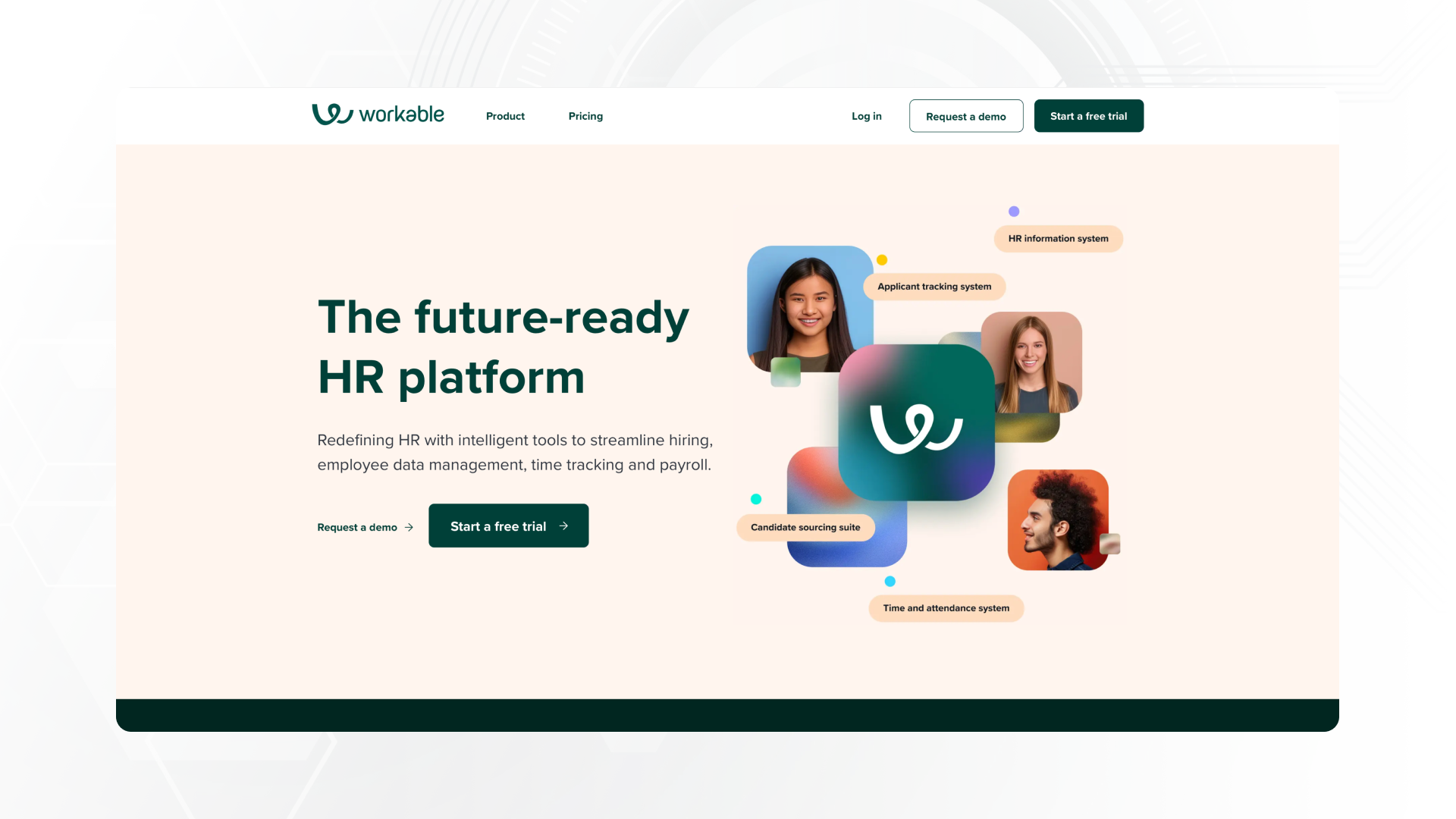
Workable’s product presentation showing recruiting and HR components.
Task and fit. Consider Workable when you are evaluating applicant tracking and sourcing alongside employee administration, rather than adding only a conversational intake layer.
Confirmed offering. The current plan comparison lists an ATS, sourcing tools, and HR functionality. It also distinguishes AI-credit-based Sourcing, Screening, and Engagement Agents from the base subscription.
Connections and setup. Configure vacancies, hiring stages, users, and the relevant communication and calendar connections. Confirm whether you are buying recruiting, HR, or a bundle, and which actions your existing systems support.
Small-business limitation. Texting is an add-on under Standard and included under Premier in the reviewed comparison. AI usage has its own credit conditions. Neither should be assumed unlimited because the subscription includes recruiting functionality.
Cost. Pricing depends on the selected package, company headcount, and billing term, with additional feature and AI-credit costs where applicable. Generate a quote for your own configuration; do not treat an entry figure for one headcount band as a universal price.
The workflow column below is an editorial starting point, not a tested performance ranking.
|
Tool |
Category |
Suitable workflow to evaluate |
Communication channels |
Integration requirements |
Pricing basis |
|---|---|---|---|---|---|
|
CogniAgent |
Configurable agent/workflow platform |
Candidate intake connected to other tools |
Web, email, WhatsApp, phone/SMS through configured channels |
Provider accounts, permitted actions, field mappings |
Usage credits, LLM usage, external provider costs |
|
Paradox |
Conversational recruiting products; ATS options |
Conversational applications and scheduling |
Text-based applications; confirm other channels by configuration |
Select ATS or connected-assistant approach |
Written proposal required |
|
Manatal |
ATS with AI features |
Candidate tracking and matching |
Mailbox connections; verify SMS arrangement |
Plan-dependent automation/API access |
Per-user subscription and any extras |
|
Breezy HR |
ATS with automation and AI add-ons |
Pipeline, questionnaires, scheduling |
Candidate messaging; SMS add-on |
Selected plan, calendars, supported integrations |
Free entry tier or subscription plus add-ons |
|
Workable |
Recruiting and HR platform with AI agents |
Recruiting records with sourcing and optional HR |
Texting conditions depend on plan |
Package, account connections, permissions |
Headcount/package-based subscription plus applicable extras |
Do not compare a credit purchase, a per-user subscription, and a configured enterprise proposal as equivalent monthly expenses. Ask each supplier to price the same application volume, channels, users, and required outcomes.
Consider an illustrative cleaning company hiring for several sites and morning and evening shifts. It needs to track applications, collect availability and relevant experience, answer approved vacancy questions, prepare coordinator summaries, arrange interviews, and send agreed reminders.
The starting point changes the shortlist.
If applications are not reliably tracked, first establish a candidate record, application source, owner, and status. Evaluate an ATS before adding another conversation channel that produces more unorganized information.
If an ATS already works, identify the missing function. A scheduling feature or questionnaire in the existing subscription may be enough. A replacement ATS needs a reason beyond having a newer AI label.
If repetitive conversations are the bottleneck, evaluate conversational intake. Ask suppliers to demonstrate a candidate who can work evenings but cannot reach one of the advertised sites. The expected output is a clear summary and an unresolved question for review—not an invented assessment of reliability.
If several systems must work together, list the operations individually: find an existing applicant, update availability, create an interview event, and record its outcome. Check each operation, its permissions, and its failure path.
CogniAgent’s AI recruiting agent for cleaning companies provides sector-specific product context. Use the same demonstration requirements for it as for any other candidate.
For a separate explanation of hiring stages, see how to use AI in recruitment. Keep the buying decision focused on the stage that currently needs improvement.
Give every shortlisted supplier the same scenarios. Use synthetic applicants and controlled destinations rather than real identity documents or employee records.
|
Scenario |
Expected result to verify |
|---|---|
|
Candidate provides a complete answer |
Agreed fields reflect the candidate’s statements accurately; no additional experience or availability is invented |
|
Candidate skips a question |
Missing information stays identifiable; the system asks appropriately or routes it for review |
|
Candidate changes availability or interview time |
Latest confirmed details replace outdated ones; any booking change is checked in the scheduling system |
|
Candidate asks something absent from approved sources |
The system acknowledges the gap and offers the defined human route |
|
Candidate returns through another channel |
Identity is verified appropriately before records are connected; another applicant’s information is not exposed |
|
Candidate requests a person |
The request reaches the designated employee with sufficient context and a clear pending status |
|
Calendar or candidate system is unavailable |
No false booking or save confirmation; the failure or uncertain outcome is visible |
|
A duplicate application arrives |
The configured matching process prevents unintended duplicate records or flags uncertainty for review |
Separate three scheduling states: a time was proposed, a booking was requested, and an event was confirmed. An assistant’s success message is not sufficient evidence of the final state.
Inspect the candidate record and calendar after the interaction. Check the owner, destination, current fields, interview details, and duplicate behavior.
The guide to testing an AI agent before launch explains how to evaluate responses, execution, and external results. Ask what remains untested when a demonstration cannot exercise a real connection.
Assign responsibility before activating the process:
Do not score personality, honesty, reliability, or “culture fit” from voice, emotional tone, or writing style. Repeating the same questions does not establish that the questions or their interpretation are fair.
Collect only the information needed at the current stage. Availability, preferred work area, relevant experience, and a contact method may support initial coordination. Do not direct applicants to submit identity documents, bank details, or medical information through an ordinary chat.
Ask suppliers to explain access controls, retention, deletion, and who receives candidate information. Verify requirements for your jurisdiction separately; a vendor’s privacy statement or an approval checkbox does not establish that your hiring process complies with every applicable rule.
Compare the shortlisted process with your baseline under reasonably comparable hiring conditions.
|
Measure |
Definition for the comparison |
|---|---|
|
Time to first substantive response |
Time until a useful role-related reply or intake question, excluding a receipt acknowledgment alone |
|
Applications with sufficient information |
Share containing the agreed fields at the review checkpoint—not a measure of candidate suitability |
|
Staff handling time per application |
Employee time spent processing, correcting, reviewing, and following up |
|
Confirmed interview rate |
Share of booking attempts producing a verified, correct appointment; attendance measured separately |
|
Errors and human requests |
Incorrect records or answers, failed actions, and requested or mandatory handoffs, tracked separately |
|
Cost per processed application |
Allocated subscription, usage, messaging, setup, and review costs divided by applications processed under the agreed completion definition |
Include unresolved applications and failed operations in the report. State the sample size, observation period, and completion criteria.
A quick reply is not a quality hire. Reduced coordination time does not prove improved retention, and a required human handoff is not necessarily a failure.
Choose one recruitment process, test it through to its actual record or calendar outcome, and expand only after the evidence supports the next responsibility.