Functional Capabilities
The Lead-to-Booking Workflow Your HVAC AI Agent Handles From Day One
Every separate process in the lead lifecycle (from first ring to post-service review) automated on a single canvas, with live access to your dispatch software, calendar, and CRM across every channel.

First Contact and Missed Call Recovery
Live voice pickup on the first ring, missed-call text-back inside 60 seconds, web-chat and email intake from the same canvas

Service Request Intake
Problem description capture, system type and age, brand and model, photo or video upload, indoor temperature read, urgency tagging

Lead Qualification
Homeowner-versus-renter check, service-area validation, warranty status lookup, financing-interest flag, repeat-customer recognition, residential or commercial routing

Quote and Estimate Coordination
Diagnostic-fee disclosure, flat-rate menu pricing for common repairs, tune-up package selection, replacement-quote handoff, financing options surfaced

Appointment Scheduling and Dispatch
Live technician availability, skill-and-zone matching, time-window selection, calendar block, customer and dispatcher confirmation, route-density optimization

Confirmation and Reminders
24-hour and 1-hour reminders, technician-en-route alert with ETA, photo-and-name introduction, real-time reschedule, no-show recovery

After-Hours Emergency Triage
No-heat and no-cool prioritization, gas-leak and CO escalation script, on-call dispatcher alert, customer holding-pattern guidance until tech arrives

Quote Follow-Up and Re-Engagement
Open-quote reminders at day 1, 3, and 7, objection capture, financing reminder, seasonal pre-summer and pre-winter outreach, dormant-customer reactivation

Maintenance Plan and Membership Sales
Tune-up cadence offers, two-visit annual plan upsell, payment-on-file capture, auto-renewal reminders, priority-service member recognition

Post-Service Follow-Up
Job completion check-in, technician rating capture, review-platform routing, repair-versus-replace next-step prompt, referral-program invitation
Built for Every HVAC Operation Same Agent, Every Service Line You Run
Every HVAC business handles a different mix of work. The agent runs the same intake, qualification, booking, and follow-up logic across every service line you bill - configured once, applied across the board.
Heating
furnace, boiler, heat pump install, repair, replacement
Cooling
central air, ductless, mini-split, rooftop, chillers
Indoor Air Quality
duct cleaning, air purifiers, humidifiers, UV systems
Refrigeration
commercial walk-in, reach-in, ice machines, restaurant equipment
Residential HVAC
single-family, condo, townhome service
Light Commercial
offices, retail, restaurants, dental and medical practices
Multi-Family Property
apartment complexes, HOAs, REITs
Heavy Commercial
warehouses, schools, hospitals, mechanical contracting
Every Missed Call Is a Job Going to Your Competitor
The Challenge
Your HVAC AI Agent


The phone rings while techs are on a roof
HVAC operators miss roughly 27% of inbound calls on a normal day, and as many as 62% during peak season or when crews are stacked at job sites (AgentZap, 2026). Each missed call represents $350-$1,200 in lost revenue depending on job type.

Sub-minute pickup on every channel
The agent answers voice calls live, texts back missed callers within seconds, and runs the same intake on web chat and email. Same response speed at 11 p.m. as 11 a.m. - no voicemail, no after-hours queue.
Speed-to-lead is slower than it has ever been
The average HVAC company takes over 2 hours to respond to a new lead, and only 3% reply within a minute (Hatch, 2025). The first business to respond wins the job 78% of the time (LeadConnect, cited Hatch 2025) - and a 5-minute response is 9x more likely to convert than a 30-minute one.
First-touch in seconds, not hours
The agent qualifies the request, captures the system type and urgency, and books the appointment before the homeowner has time to call the next listing on Google.
Quotes go cold and never get a follow-up
Estimators send a price, the customer "thinks about it," and the quote disappears into the inbox. Office staff don't have time to chase every open ticket.
Automatic multi-touch quote follow-up
The agent runs day-1, day-3, and day-7 nudges across the customer's preferred channel, capturing objections, surfacing financing, and routing live questions to the estimator without dropping context.
Emergency calls and routine tune-ups get the same response
A no-heat call at 2 a.m. is treated the same as an "I'd like to schedule a maintenance visit" message. Triage happens later - when it should happen first.
Built-in triage logic
The agent flags no-heat, no-cool, gas, and CO incidents at first contact, escalates to the on-call dispatcher, and gives the customer a holding pattern (safety steps, ETA) until the truck rolls.
Maintenance plans don't get sold or renewed
Tune-up reminders, two-visit memberships, and renewal prompts all live in someone's head or in a spreadsheet. Recurring revenue leaks every season.
Always-on membership desk
A Virtual Employee tracks tune-up cadence per customer, runs seasonal pre-summer and pre-winter outreach, captures payment-on-file, and renews memberships before the term lapses.
The dispatcher is the bottleneck
One person juggles inbound calls, technician routing, parts ordering, and angry-customer recovery. The phone backs up every time something goes off-script.
The dispatcher gets hours back
The agent handles every routine intake, books to the live calendar, and only escalates when the situation actually needs a human. Your dispatcher works on the exceptions, not the queue.
From Your Service Process to a Live AI Agent in Days
You don't need a developer or an automation specialist. Most HVAC operators have a working agent live within a week.
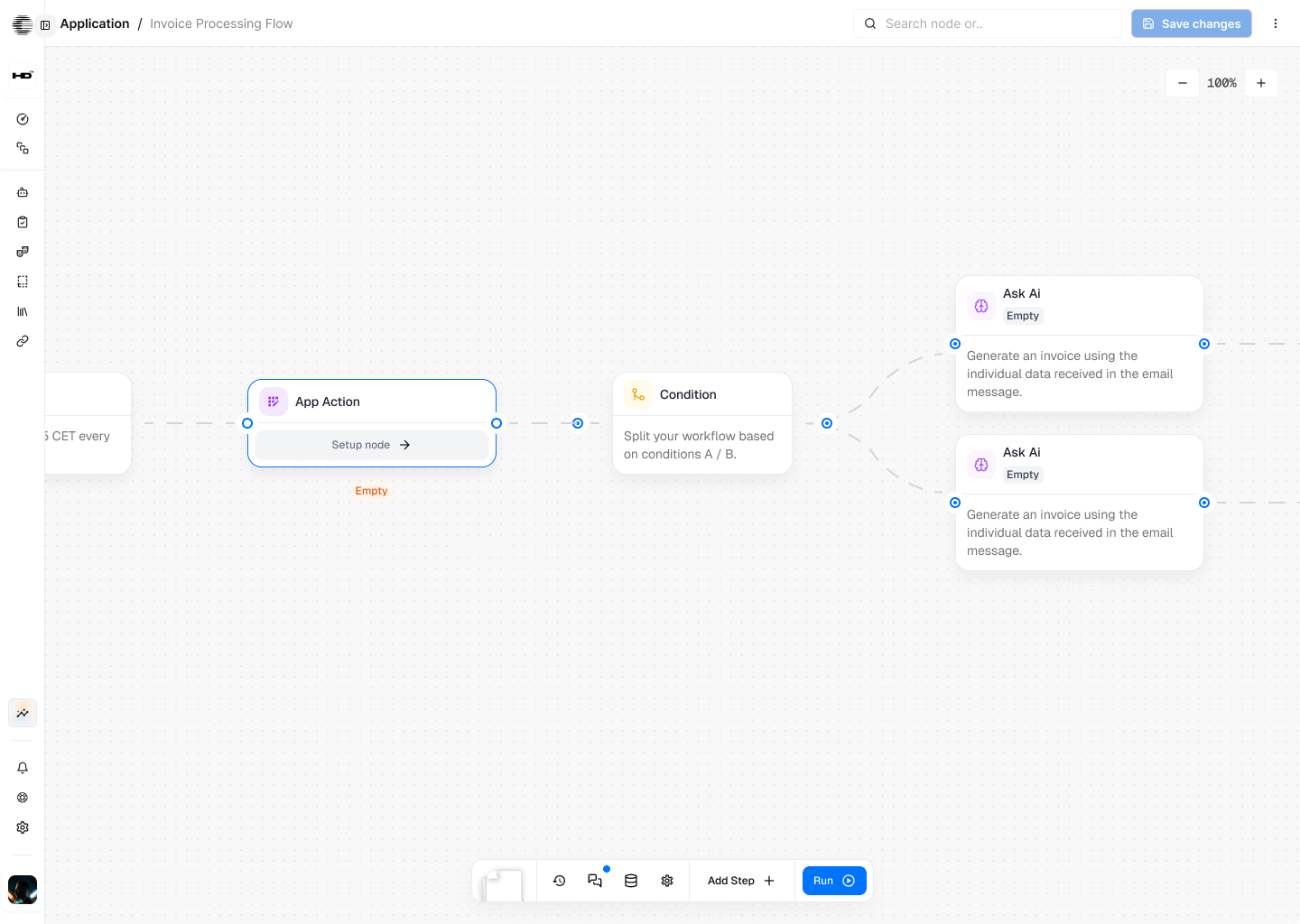
Your HVAC AI Agent in Action
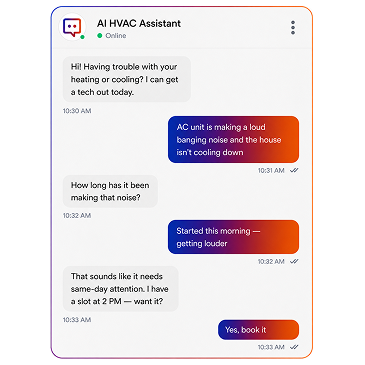
Single canvas, voice intake, emergency triage, live dispatch booking - no/low code.
One AI Agent. Every Channel Your HVAC Customers Use
HVAC customers don't all reach out the same way. Homeowners with a no-heat emergency call. Property managers email. Younger customers expect a text-back. The agent meets every one of them where they are.
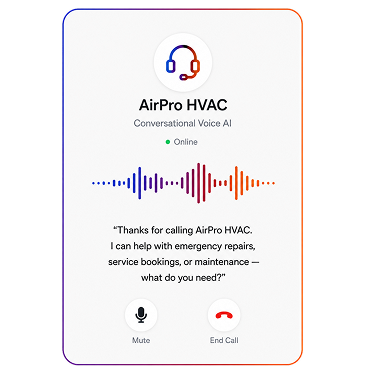
Voice
Inbound voice line that answers on the first ring, captures the problem, and books the appointment. Outbound voice for high-priority quote follow-up and missed-call recovery for callers who don't read texts. No menus, no hold music.
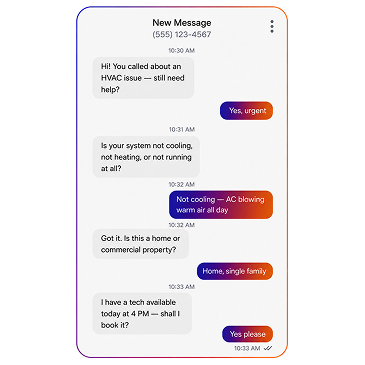
SMS
The recovery channel for every missed call - text-back inside 60 seconds with "we just missed your call, what's going on with your system?" and a booking link. Also the default for tune-up reminders, technician-en-route alerts, and post-service review requests.
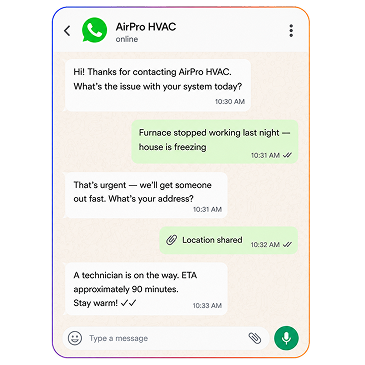
For markets with WhatsApp-first customers - photo and video upload of the unit nameplate, error code on the thermostat, or visible damage right inside the conversation thread.
Web Chat
Engages site visitors directly on your service area, pricing, or tune-up pages. Pre-qualification starts before the form-fill, and the booking happens without a callback.
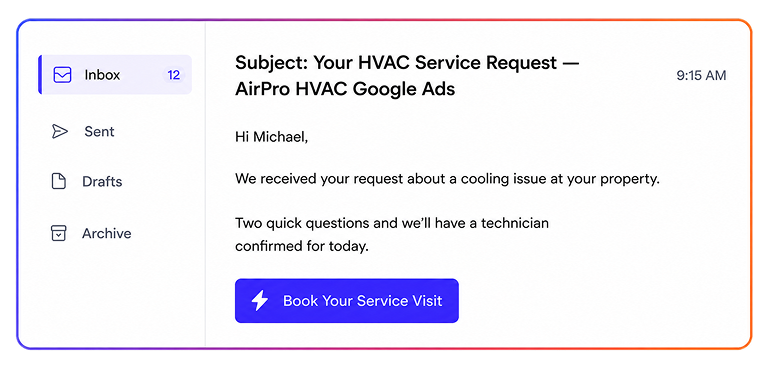
Covers property managers, multi-site commercial accounts, and lead-gen platforms (Angi, Thumbtack, HomeAdvisor) where the request arrives by email. Intake, quote, and confirmation handled by the agent.
The Platform Behind Your Agent Five Capabilities That Make This Work for HVAC Lead Handling
Behind every customer conversation, the platform is doing structured work - reasoning about urgency, writing to your dispatch software, switching between voice and SMS, all while keeping the customer's profile intact. Here's what powers that.
Integrations
Connects to Your Entire HVAC Stack
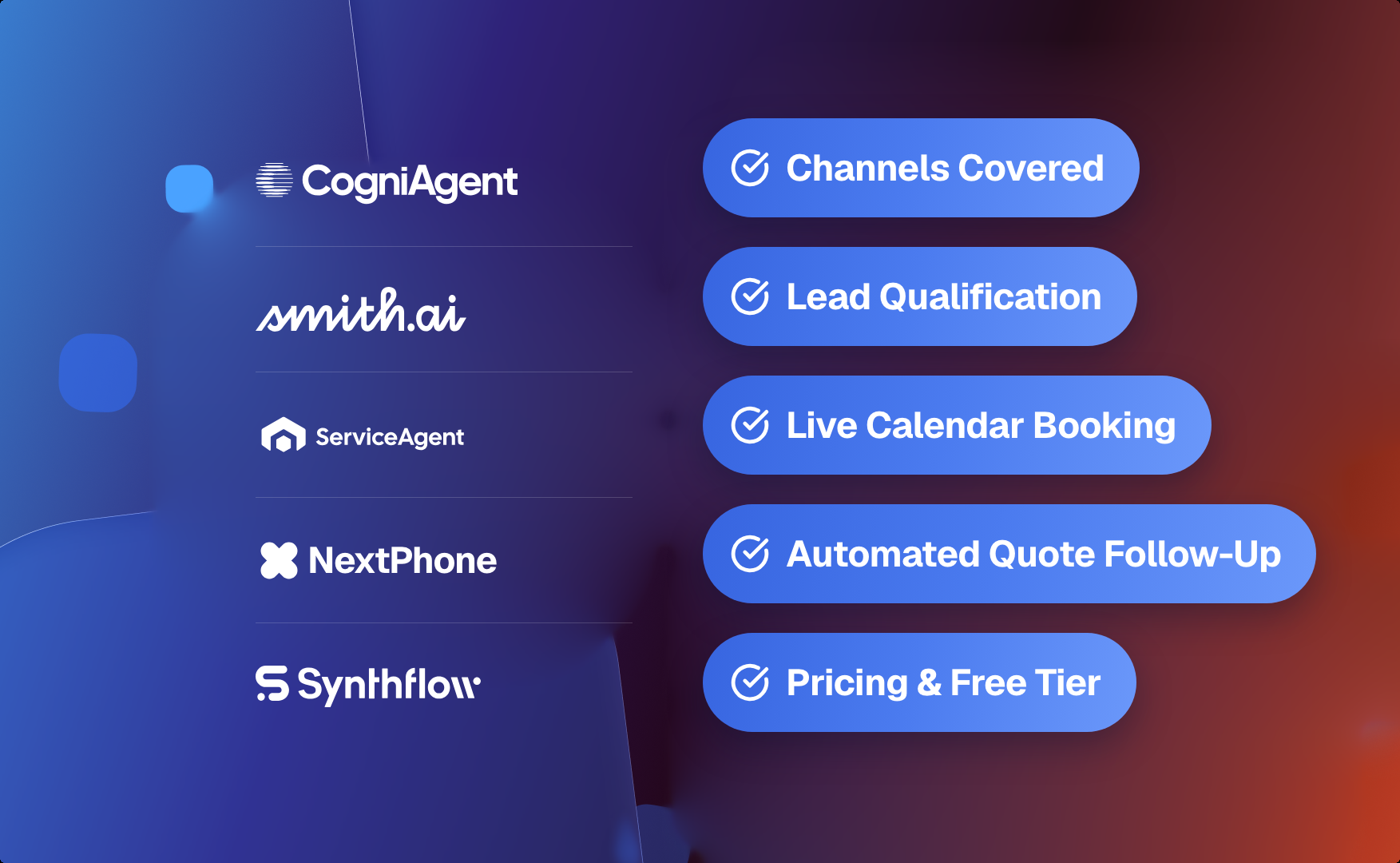
2,700+ integrations - the agent reads live data and updates records inside the tools you already run, not afterwards.




















What CogniAgent Does That Standard HVAC Answering Services Don't
Standard answering services and chatbots take a message. An AI agent for HVAC has to actually run the lead - triage urgency, look up the customer in dispatch, price the visit, and book a technician on a real calendar. The comparison below maps the gaps.

Standard HVAC Answering

- Takes a message, forwards a ticket - your dispatcher still has to call back
- Office-hours coverage, slow on weekends and holidays
- Single channel - usually voice OR web chat
- Generic script, no system access
- Per-call or per-message billing - costs scale linearly with volume
- Vendor-controlled flow; changes require a ticket and a wait
- No follow-up logic - quotes go cold, tune-ups don't get sold

CogniAgent HVAC Agent

- Qualifies, prices, and books the technician on your live calendar in the same call
- Sub-minute pickup 24/7, every channel, every season
- Voice, SMS, WhatsApp, email, web chat from one canvas with shared context
- Reads and writes ServiceTitan, Housecall Pro, FieldEdge, Jobber, or your CRM mid-conversation
- Pay-as-you-go credits, no contract, no per-seat fee, free to start
- You build, modify, and own the agent - no vendor approval cycle
- Day-1, day-3, day-7 quote follow-up plus seasonal membership outreach run automatically
The Measurable Shift
From Day One
24/7
Inbound coverage across voice, SMS, WhatsApp, web, and email - including evenings, weekends, and during stacked job-site days.
Sub-minute
First-response on every channel; the first business to respond wins the job 78% of the time (LeadConnect, cited Hatch 2025).
9x
Higher conversion versus a 30-minute response window, per Harvard Business Review research on lead response timing.
27%
Industry-average missed-call rate the agent recovers as bookings - revenue most HVAC operators currently lose to voicemail (AgentZap, 2026).
Pricing
Pay only for what you use. Full visibility on every credit spent.
Pay-as-you-go
No subscription. No monthly fee.
Buy credits from $10
- 5,000 credits loaded on signup
- Full canvas + all AI features
- 2700+ integrations, templates
- Free messaging channels
- Up to 5 user seats
- Production deployment
- Human chat support*
- Credits never expire

* activates on first credit purchase
Enterprise
Custom plan. Annual subscription,
negotiated rate.
- Annual credit package
- Custom user seats
- SSO
- Bring your own LLM API keys
- Extended usage logs
- Assisted onboarding + training
- Agents built by CogniAgent team
- Premium support + SLA

Pay 3-4X Less
Than a Full-Time Hire
A CogniAgent virtual employee running the same lead-handling function for a 15-20 person HVAC company costs around $1,000/month all-in.
| Full-Time CSR | CogniAgent | |
|---|---|---|
| Monthly cost | $3,500-4,200 | ~$1,000 |
| Slow season | Same fixed salary | Spend drops with volume |
| Peak season | Hire or burn out your team | Scales automatically |
Enterprise-Grade
Security & Compliance


Data Protection
End-to-end encryption in transit and at rest for call recordings, transcripts, photo and video uploads, and payment-on-file records. Configurable retention windows aligned to state, federal, GDPR, or UK GDPR rules.
Secure System Integration
Role-based access across dispatch software, CRM, scheduling tools, and financing partner connections. Encrypted channels for every read and write the agent performs mid-conversation, including PCI-scope-aware payment handoff.

Privacy Assurance
Customer data stays yours. Conversations, call recordings, and CRM records are never used to train public AI models. Bring-your-own API keys keep LLM calls inside your provider relationship.

Audit & Monitoring
Full activity logs for every call, text, booking, quote follow-up, and dispatch write. Time-stamped records support compliance reviews, dispute resolution, and TCPA / state-call-recording-consent audits.

![Best AI Tools for Auto Repair Shops [2026 Guide]](https://cogniagent-preview-def77a0f.nyc3.digitaloceanspaces.com/media/2026/07/Best-AI-Tools-for-Auto-Repair-Shops-2026-Guide.png)
Frequently Asked Questions about
AI Recruiting Agents
Yes. Agents built in the same Application share context, transfer conversations between one another, and coordinate steps that cross departments. Because a workflow can start a conversation and a conversation can start a workflow, the handoff happens inside one system instead of between separate tools.
Yes. Tone-of-voice guidelines, brand rules and response style are uploaded to the Knowledge Base, and every agent answers within them, so the same voice comes back on chat, email and phone regardless of which agent handles the request. Voice agents are assigned a speaking voice to match the brand.
Voice agents handle natural speech, including regional accents, industry terminology and background noise, and reply fast enough to hold a real conversation rather than a command exchange. Recognition quality depends on the audio your channel delivers, so test against your own call recordings during the build rather than taking a number on trust.
Yes. Conversational interfaces – both text and voice – live natively inside workflows on our cognitive AI platform. Your existing workflow configurations work across every channel automatically. Add voice support with a single click; no rebuilding required. This unified approach eliminates the need to stitch separate chatbot, voice AI, and automation tools together.
Yes. CogniAgent connects to 2,700+ business tools, including CRMs, eCommerce platforms, ERPs and support systems. What matters is when it connects: your agent reads and writes to those systems during the conversation, so the customer gets a resolved answer in the same exchange rather than a ticket and a callback.
Data is encrypted in transit and at rest, access is controlled by role, and every agent interaction, workflow run and system connection is logged for audit. Agents act only through the integration permissions you grant them. CogniAgent does not currently hold SOC 2, ISO 27001 or HIPAA certification; Enterprise plans include a security review and compliance documentation.
Over 2,700 tools, including CRMs (Salesforce, HubSpot, Pipedrive), eCommerce platforms (Shopify, WooCommerce, Magento), ERPs (Odoo, NetSuite), support systems (Zendesk, Intercom), communication channels (Web Widget, Gmail, Outlook, Slack, SMS, WhatsApp Business, Microsoft Teams), calendars, spreadsheets and payment processors.
No. Agents are assembled on a visual canvas from typed nodes rather than written in code. Start from a workflow in the Templates Center, or describe your process and let the AI Concierge generate a first canvas from it. You supply the knowledge of how the process runs; the platform supplies the structure to run it.
Signup is self-serve, with no card and no sales call. Every account starts with 5,000 credits and full access to the canvas, all AI features and 2,700+ integrations. There is no subscription and no monthly fee, and credits never expire. Buy more from $10 when you go live; human chat support activates on your first purchase.
Most teams are live in 7 to 14 days: signup and first canvas on day one, building from a template through day three, connecting systems and testing real scenarios to day seven, then deploying across channels. Starting from a Templates Center workflow for a common process can produce something working in the first session.
Assisted onboarding is included with Enterprise: a CogniAgent engineer builds your first agents with you, so your team learns the platform while the work gets done and can manage it independently afterwards. On pay-as-you-go you self-serve with the Templates Center and the AI Concierge, plus human chat support once you have bought credits.
The agent hands the conversation to a named person mid-conversation with the full context attached, then picks the workflow back up once that person has answered. Nothing restarts and the customer stays in one thread. You set the conditions that trigger a handoff — a value threshold, a sentiment signal, or a specific type of request.
A traditional builder runs a fixed flowchart from start to finish and ends. CogniAgent workflows react to business events as they happen (an inbound message, a status change, a scheduled check), and can hold a multi-turn conversation while the rest of the workflow keeps running. A workflow can start a conversation, and a conversation can start a workflow.
Most tools do one of three things: chat, background automation, or workflow logic. CogniAgent runs all three on one canvas, so an agent can hold a conversation, act in your systems during it, and hand off to a person without leaving the workflow. Conversation and execution are one build here, not two products stitched together.
Event-driven workflows for the operational work your team repeats: lead capture and routing, returns and order status, payment verification, inventory alerts, approval chains, and appointment or showing scheduling. If it follows business logic and happens often, it can be automated, with a handoff to a person at the points where judgment is needed.
Home services and field trades (HVAC, plumbing, roofing, cleaning, restaurants) and eCommerce where a missed call is a lost job, and high-turnover businesses running constant hiring and screening. Both have high-volume inbound work with a measurable cost attached to a slow reply. CogniAgent is not limited to these; they are simply where results arrive fastest.
Customer support and case resolution, sales qualification and booking, recruiting intake and screening, marketing campaign response, invoice and payment processing, order and inventory operations, and internal approvals. Each can run as a conversation, as a background process triggered by an event, or as both inside the same workflow.
You choose your support model. Many operations managers prefer self-service – monitoring dashboards, making adjustments, and adding processes independently. Others prefer ongoing expert involvement available through the Enterprise tier for workflow optimization, new integration setup, and strategic automation planning. Either approach works.
Human chat support activates on your first credit purchase and covers build questions, integration troubleshooting and configuration. Enterprise adds assisted onboarding, dedicated success management, premium support and an SLA. Before your first purchase, the Templates Center and the AI Concierge cover the self-serve path.

No results