Stop Losing Techs to Whoever Replied First
Every stage of hiring (from first reply to bay filled) runs without pulling you out of the shop.

Instant Reply
The moment an application comes in, your agent sends a reply. No delay, no batch processing. Applicants know they’re heard before they consider another shop.

ASE & License Check
Your agent verifies ASE certs, specialty endorsements, driver’s license, and right-towork status — then collects background-check consent with timestamped disclosure. Unqualified applicants are filtered before a single callback happens.

Shift Fit Screen
Shift preferences, weekend and evening coverage, commute range, tool ownership - all collected in the same conversation. No scheduling surprises after a hire.

Interview Scheduling
Your agent offers available slots, confirms the booking with both the candidate and your service manager, and handles no-shows with an automatic rebook, without anyone leaving the shop floor.

Candidate Reactivation
When a new bay opens, your agent resurfaces pre-screened techs, checks whether their certs are still valid, and delivers a shortlist. No starting from scratch every time.
Every Bottleneck in Your Hiring Process — Solved
The Bottleneck
What the Agent Does


Service managers double as recruiters
The same person overseeing the shop floor reviews applications. Qualified applicants who apply Monday morning have accepted another offer by the time anyone responds.

Sub-minute response on every channel, any hour
The agent reaches every applicant before they open the next job listing, regardless of what the service manager is working on.
Certification checks consume coordinator time
Every applicant needs ASE status, endorsement type, and license confirmed before they're worth a callback.
Certification capture and validation inside the conversation
The agent collects ASE number, specialty, and expiry, then flags gaps before any human reviews the file.
Screening criteria drift under pressure
Different managers apply different bars, so unqualified applicants waste interview slots.
One configured standard, applied every time
Criteria are set once and held consistently regardless of who's managing the floor.
Pre-screened candidates disappear
A technician cleared for one opening but not hired vanishes when the next bay opens, and screening restarts from scratch.
Continuous pool re-engagement
The agent re-checks certification validity and current availability when a new opening is posted, surfacing qualified candidates instantly.
Applications scatter across job boards and walk-ins
Indeed, LinkedIn, direct referrals, and walk-ins each have their own response logic. Audit trail is unreliable.
One screening flow, one record per applicant
Every source routes into the same agent, producing a single structured candidate file.
From Your Current Hiring Process to a Live Agent
You don't need a developer or an HR technologist. Most auto repair operators have a working agent live within a week.
Your Auto Repair Recruiting Agent in Action
Single canvas, certification validation, calendar booking, ATS write — no/low code.
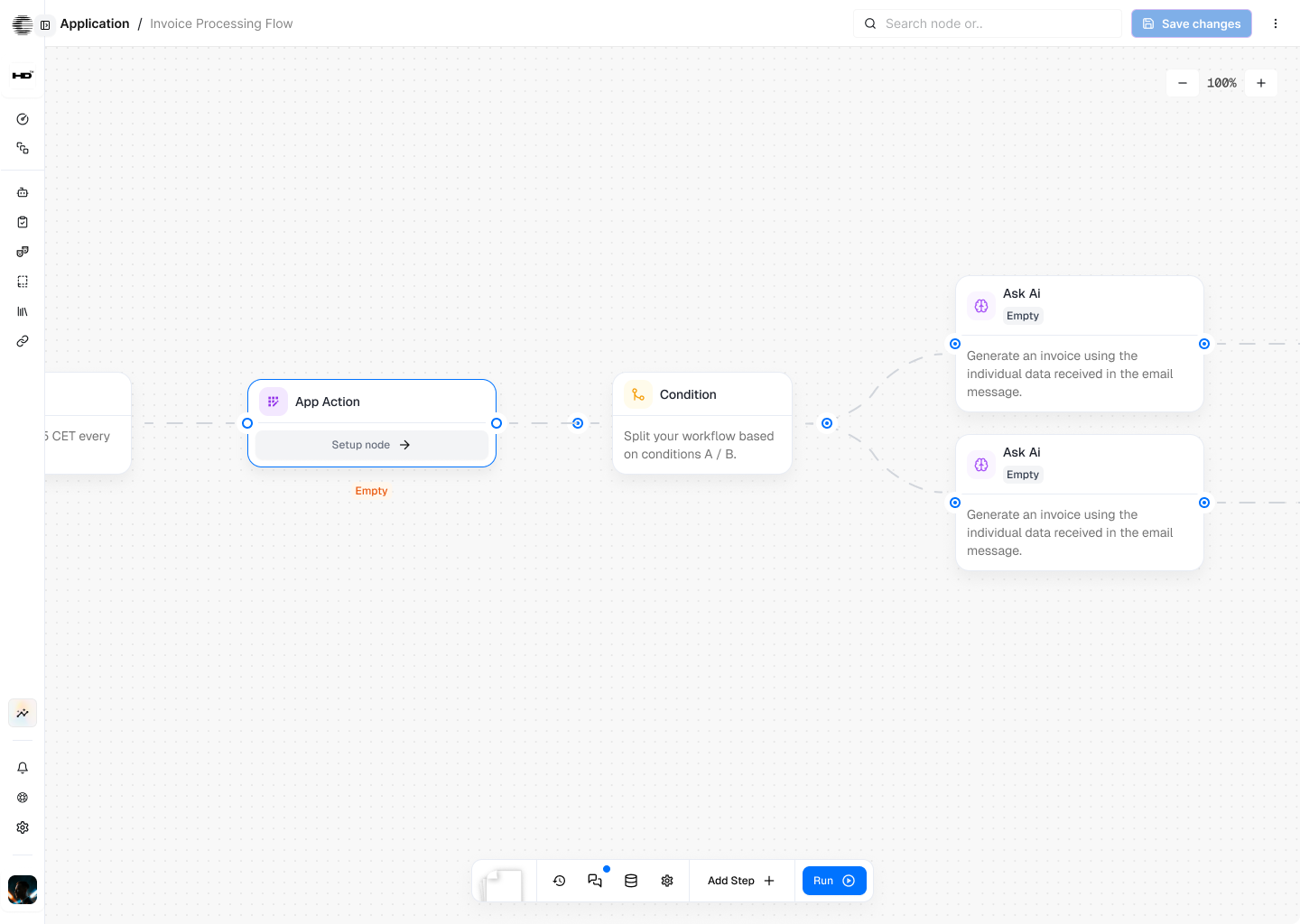
One Agent. Every Channel Your Applicants Use.
Automotive job seekers don't all communicate the same way. The agent meets each one where they are.
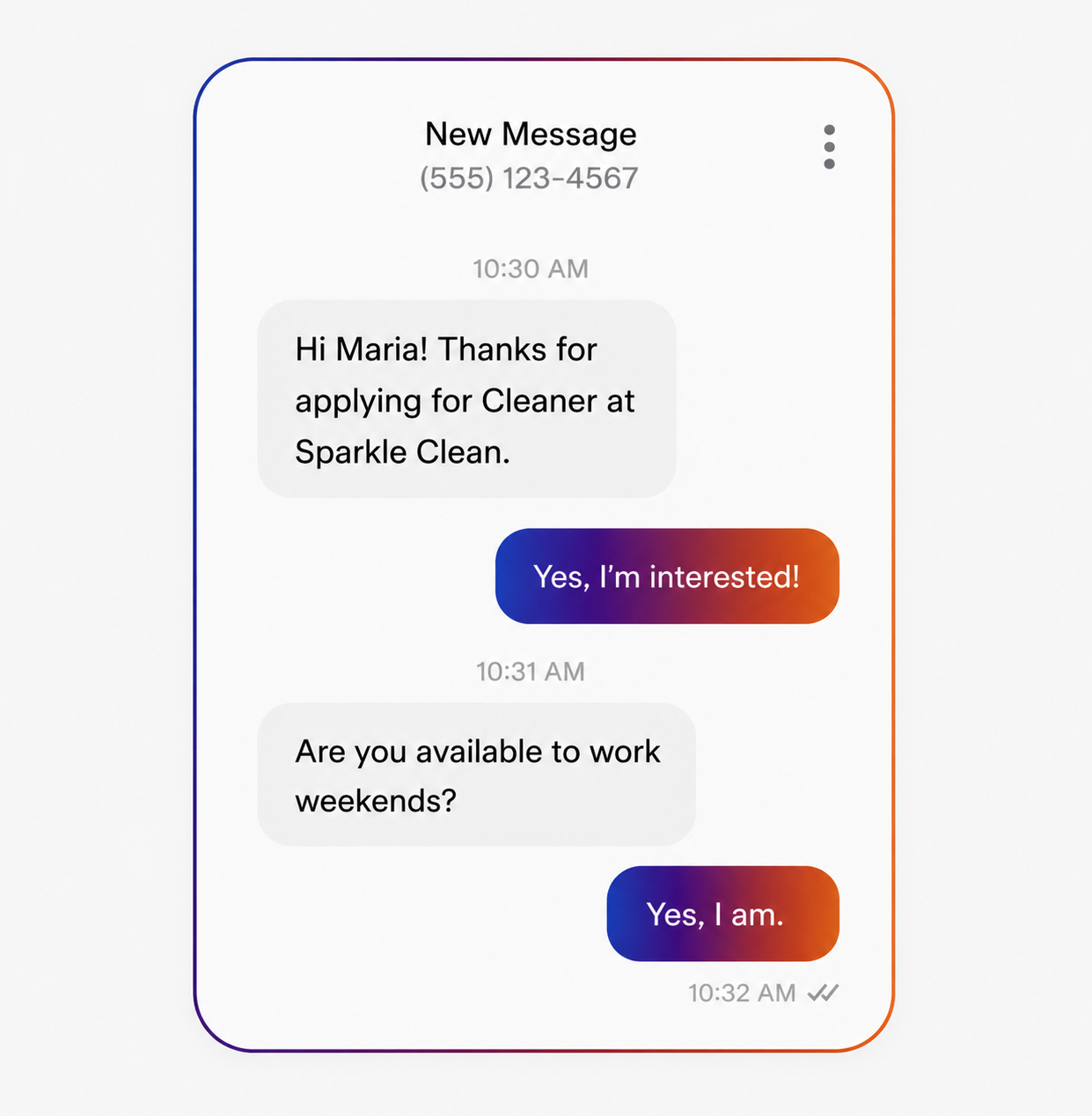
SMS
The highest-response channel for hourly applicants. Full screening and interview booking over text alone. Text response rates run roughly 8x higher than email in high-volume hourly hiring (Carv, 2025).
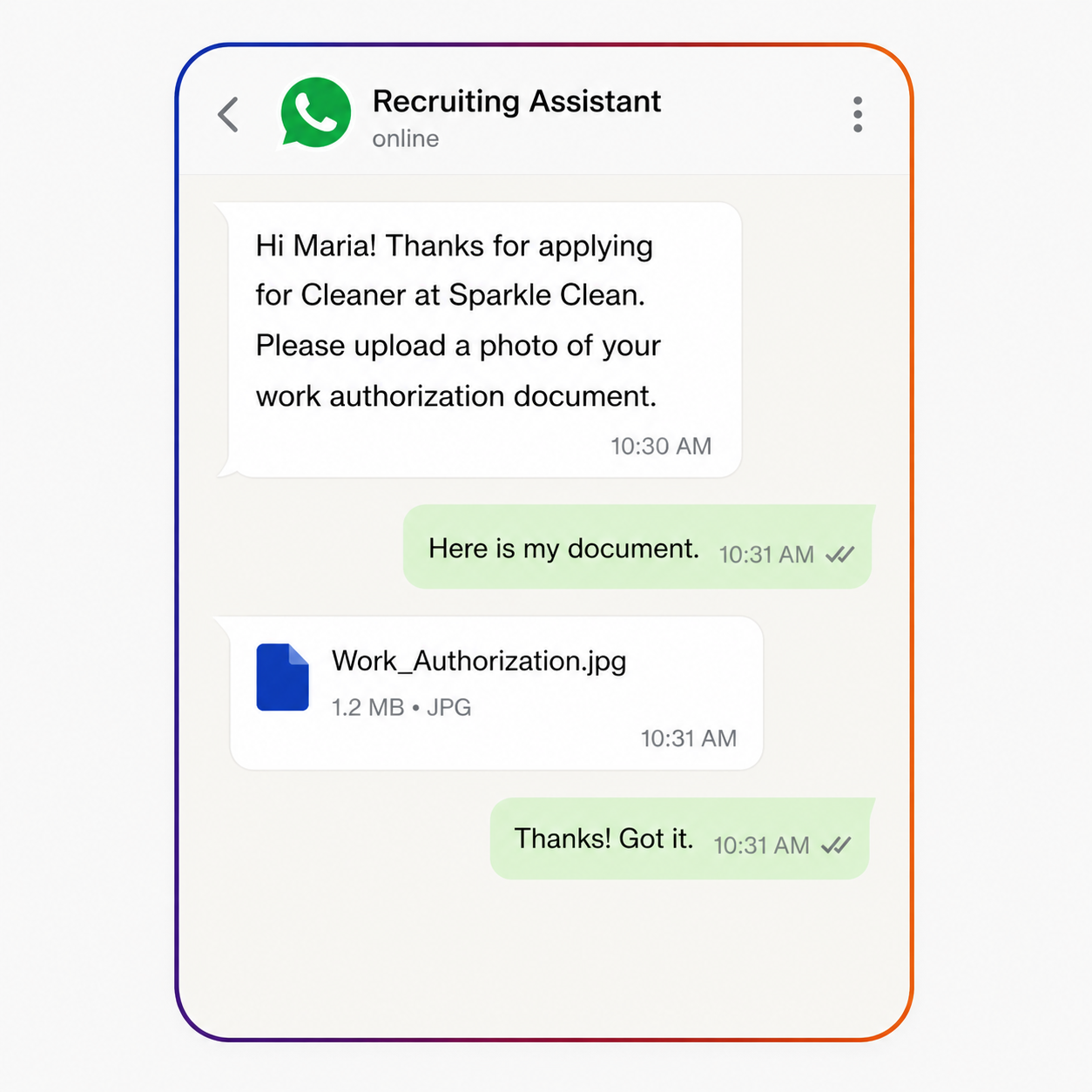
The default channel for many urban and immigrant communities where shop technician hiring concentrates. Document upload (certifications, ID) handled inside the same conversation thread.
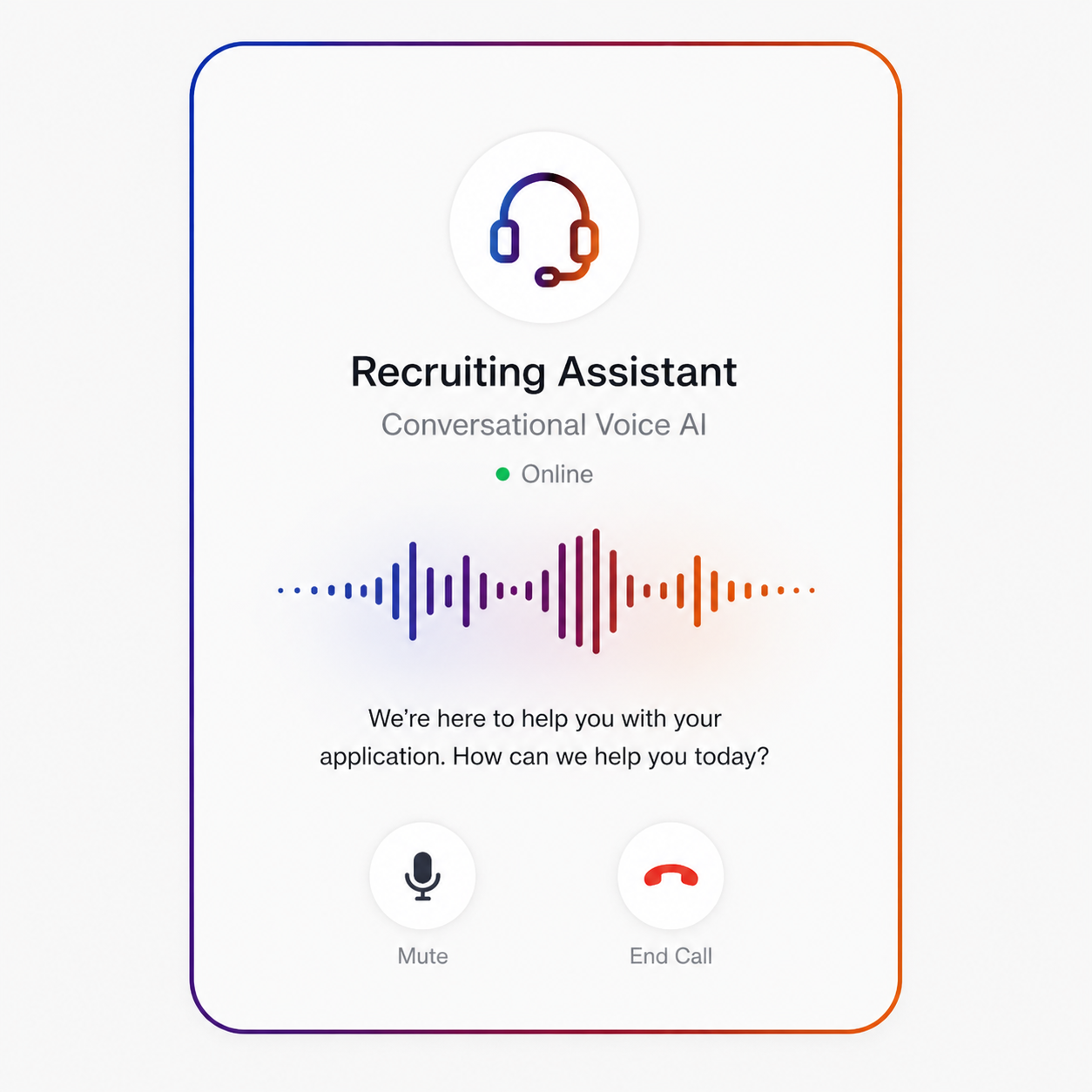
Conversational Voice AI
Inbound line for applicants who prefer to call, plus outbound voice follow-up for high-priority candidates who haven't responded to text.
Web & In-App Chat
Engages applicants who land on your careers page directly in the chat window. Pre-screening starts before they leave the page.
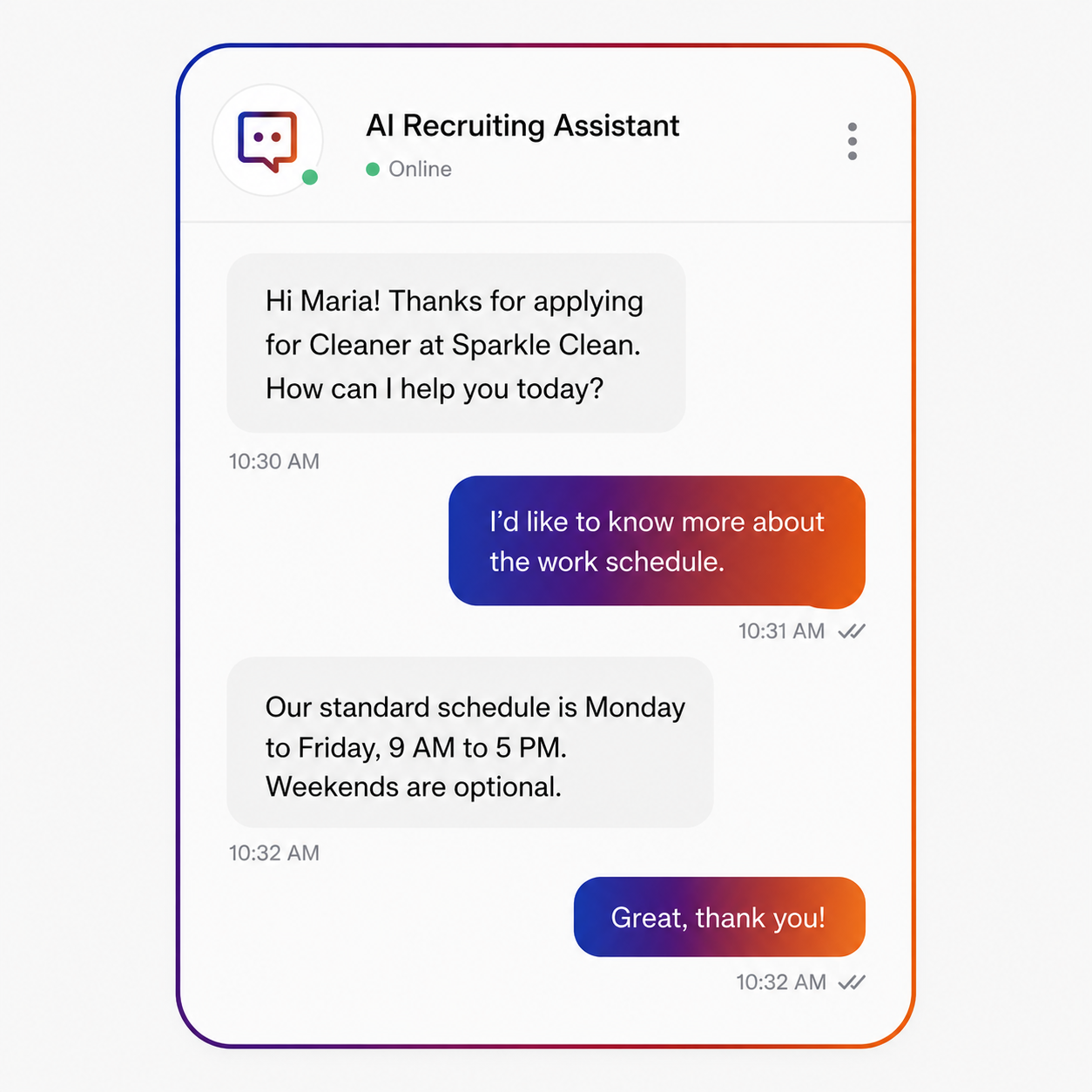
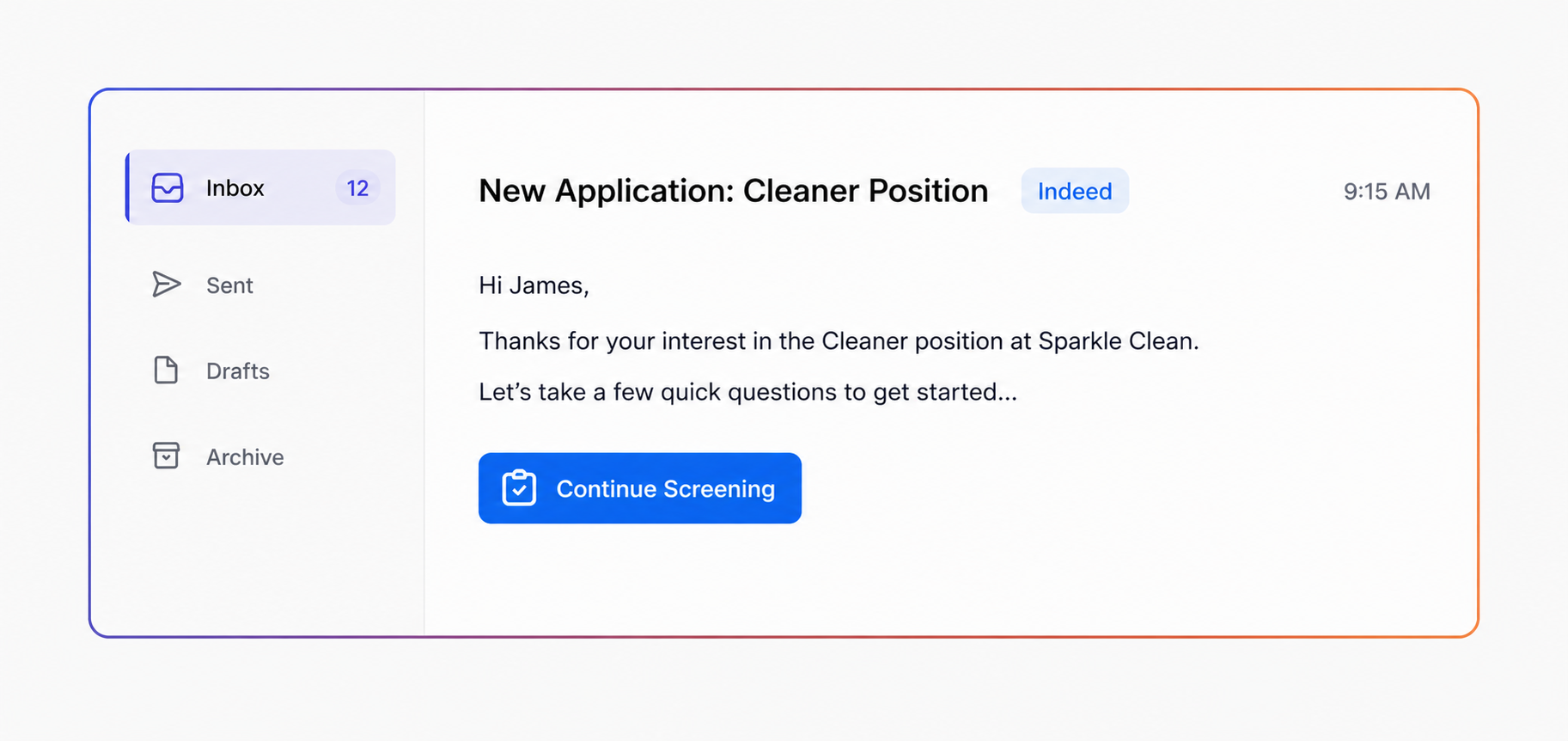
Covers job-board pipelines where the application arrives by email forwarding. Screening, outreach, and interview confirmations automated end-to-end.
Five Capabilities That Make This Work for Auto Repair Recruiting
Behind every applicant conversation, the platform is doing structured work — reasoning about certification rules, writing to your ATS, switching channels mid-conversation, and keeping the candidate record intact throughout.
Why it matters for shops:
Generic recruiting chatbots collect answers and forward them. Auto repair hiring needs live certification validation, role-aware screening for ASE specialties, and re-engagement when a tech leaves but the bay reopens later.
CogniAgent internal study, Q1 2026
Integrations
One Agent That Reads, Updates, and Acts Across Your Entire Hiring Stack
2,700+ native integrations — connected in real time, not batched after the fact.






 WhatsAppbusiness
 Gmail / Outlook
 Slack / Teams
What CogniAgent Does That Standard Recruiting Chatbots Can't
Generic recruiting chatbots are built for office hiring. An AI agent for auto repair shops has to handle off-hours applications, certification verification, and pipeline re-engagement for a continuously churning candidate pool.

Standard Recruiting Chatbots

- Business-hours response; weekends and evenings go unanswered
- Collects answers and queues them; system updates happen in batch after the conversation ends
- Web chat only — misses the SMS and WhatsApp channels technicians actually use
- Keyword-match logic; incomplete or unusual answers get logged without follow-up
- Vendor-controlled flow; customisation requires a support ticket
- Per-seat plus per-resolution billing

CogniAgent Recruiting Agent

- Sub-minute response around the clock on every channel, including evenings and weekends when technicians job-search
- Reads from and writes to ATS, calendar, and certification databases live during the conversation
- SMS, WhatsApp, voice, web, and email from one canvas with shared applicant context
- Structured reasoning re-prompts on incomplete or evasive answers before recording any outcome
- You build, modify, and own the agent — no vendor approval cycle, no waiting
- Pay-as-you-go credits, no contract, free to start
The Measurable Shift From Week One
24/7
Application coverage across all channels, including weekday evenings and weekends when technicians actively job-search.
75%
Reduction in manager time spent on first-pass screening and application communication.
4x
Faster from application to interview-ready candidate, with structured screening replacing inbox triage.
Zero
Screening drift across locations, shifts, or managers — one configured bar applied every time.
Pricing
Pay only for what you use. Full visibility on every credit spent.
Pay-as-you-go
No subscription. No monthly fee.
Buy credits from $10
- 5,000 credits loaded on signup
- Full canvas + all AI features
- 2700+ integrations, templates
- Free messaging channels
- Up to 5 user seats
- Production deployment
- Human chat support*
- Credits never expire

* activates on first credit purchase
Enterprise
Custom plan. Annual subscription,
negotiated rate.
- Annual credit package
- Custom user seats
- SSO
- Bring your own LLM API keys
- Extended usage logs
- Assisted onboarding + training
- Agents built by CogniAgent team
- Premium support + SLA

Enterprise-Grade
Security & Compliance
Built for auto repair shops handling sensitive candidate data — certification numbers, background-check consent, and employment eligibility documents — across every jurisdiction.


Data Protection
End-to-end encryption in transit and at rest for certification data, consent records, and applicant documentation. Configurable retention windows aligned to state, federal, and GDPR requirements.
Secure System Integration
Role-based access across ATS, certification lookup, and background-check provider connections. Encrypted channels for every read/write the agent performs mid-conversation.

Privacy Assurance
Applicant data stays yours. Conversations and screening records are never used to train public AI models. Bring-your-own API keys keep LLM calls inside your provider relationship.

Audit & Monitoring
Full activity logs for every screening conversation, certification check, consent capture, and ATS write. Time-stamped records support compliance reviews and dispute resolution.

![Best AI Tools for Auto Repair Shops [2026 Guide]](https://cogniagent-preview-def77a0f.nyc3.digitaloceanspaces.com/media/2026/07/Best-AI-Tools-for-Auto-Repair-Shops-2026-Guide.png)

Frequently Asked Questions about the
Auto Repair Recruiting AI Agent
Job board and ATS chatbots collect answers and forward them. Your agent reasons across those answers, validates certification data against registries inside the conversation, and re-engages candidates who go quiet. It also runs across SMS, WhatsApp, voice, and email from the same canvas — where most ATS chatbots stop at web chat.
The agent handles first contact, certification capture and validation, shift-fit screening, consent collection, interview booking, follow-up, and re-engagement. Your team handles interview decisions, judgment calls on specialist roles, and final offers. You configure a human handoff at any node — any time the applicant asks something out of scope, the agent escalates with full context attached.
You define the escalation triggers. Out-of-scope questions, sensitive topics, or edge cases route to the named human contact by SMS, email, voice transfer, or whichever channel you configure — with full conversation history attached. The agent does not improvise outside its defined scope.
Yes. The platform connects to ServiceTitan, Tekmetric, Shop-Ware, and others via the integration grid above, plus 2,700+ additional native connectors and full API access. Once a hire is confirmed, the onboarding flow can write the first shift and brief the new technician — through the same channel used for screening.
You do. Transcripts, certification records, consent logs, and screening outcomes live in your account. They aren’t shared with third parties, aren’t used to train public AI models, and can be exported or deleted on your timeline.
Three factors affect timing. First, how custom your screening criteria are — a standard ASE certification and availability flow runs from a template in days, while shops hiring for EV or diesel specialisations may need additional configuration. Second, integration depth — live ATS sync and calendar booking each add an integration step. Third, channel scope — text-only deployments are faster than full SMS, WhatsApp, voice, and email coverage. Most shop operators land between five and fifteen working days.
Each agent action draws a defined credit cost from your balance — a conversation turn, a certification API call, a calendar write, an ATS update. A typical text-only screening conversation runs roughly 10 to 20 turns before disqualification or interview booking. Voice and live API lookups cost more per action than text-only steps. The pricing page lists per-action costs in detail.
Yes. The same platform handles inbound service inquiry qualification, customer status updates, appointment reminders, and other shop workflows — including pure rule-based deterministic automation for fixed-path processes. Most auto repair operators start with recruiting because the volume and time pressure are highest, then layer on additional agents on the same canvas as confidence builds.

No results