Article Updated Nov 04, 2026
 12 min read
Benefits of AI in HR for Service Businesses: Use Cases, Limits, and Measurement
Updated Nov 04, 202612 min read Updated Nov 04, 202612 min read
AI can reduce repetitive HR communication, organize candidate information, and help employees navigate approved instructions. For a service business, the practical benefit is less time spent asking the same questions, chasing missing details, and moving information between people and systems.
Those benefits depend on current job descriptions, clear process rules, appropriate integrations, and a named employee responsible for exceptions. AI can collect information, coordinate steps, and prepare drafts. Hiring decisions, rejection decisions, pay, and employment terms should remain with authorized people.
A useful starting point is one recurring task: gathering availability for an open role, coordinating interviews, or answering questions from an approved onboarding handbook. Measure whether that task becomes easier without introducing unacceptable errors or additional review work.
Cleaning, facilities maintenance, repair, and other service companies can have different hiring requirements. A shared opportunity is the administrative work surrounding those requirements—not delegating employment judgment to a model.
The following table describes possible workflow designs, not functions that every AI product provides out of the box.
|
Task |
What AI can help with |
What a person checks |
How to measure the result |
|---|---|---|---|
|
Candidate questions |
Answer from an approved role description and identify questions outside its scope |
Accuracy of pay, hours, location, and employment information |
Time to a substantive response; correction rate |
|
Availability and experience intake |
Extract candidate-provided details into agreed fields and ask about missing information |
Ambiguous answers, relevant experience, and exceptions |
Applications with sufficient information; handling time |
|
Interview coordination |
Collect preferences and use permitted scheduling operations |
Correct calendar, interviewer, time zone, and booking result |
Successfully confirmed interviews; scheduling errors |
|
Employee onboarding |
Deliver an approved checklist and send configured reminders |
Whether required steps were actually completed and accepted |
Overdue steps; employee questions requiring intervention |
|
Employee policy questions |
Retrieve relevant instructions from approved documents |
Conflicting policies, sensitive requests, and individual circumstances |
Supported answers; escalations and corrections |
|
Administrative completeness checks |
Flag missing fields or inconsistent records for review |
Meaning of the discrepancy and the appropriate correction |
Confirmed issues found; false alerts; review effort |
The company still needs a source of truth for each task. A conversation history should not quietly replace the official candidate record, onboarding checklist, or payroll system.
AI-assisted recruitment coordination means helping people exchange and organize information around hiring. It does not require AI to decide who deserves a job.
CogniAgent’s AI recruiting agent offering covers candidate conversations, structured intake, and interview coordination. Treat the specific workflow as something to configure and verify: a listed integration does not establish that the required operation is available, authorized, or working in your account.
A controlled intake process can follow these steps:
A proposed interview time is not a confirmed appointment. Confirmation requires the correct operation to succeed in the scheduling system, with the intended interviewer, candidate, date, and time zone. If the booking result is uncertain, report that uncertainty instead of sending a success message.
Use approved, job-related questions. Do not infer reliability, honesty, or suitability from a candidate’s accent, writing style, or conversational confidence.
Applying the same questions does not establish that a process is fair. The questions, interpretation, accessibility, and handling of exceptions all need review. An automated rejection should not be the default response to missing information or an unusual answer.
In the United States, the EEOC’s resources on artificial intelligence and the ADA address disability-related issues involving software and algorithms used to assess applicants and employees. Businesses operating elsewhere need to check their own jurisdiction’s requirements. A human review step is a process safeguard, not a guarantee of legal compliance.
Provide an alternative contact route for candidates who cannot use the automated process or need assistance.
Onboarding support works best when the company already knows which steps apply to each role and location.
An AI-assisted process could provide an approved checklist, explain where to find instructions, and remind an employee about an unfinished step. That requires a reliable record of completion—not simply a record that a message was sent.
Keep these states separate:
None of these automatically proves that the employee understood a policy or can safely perform a task.
For employee questions, prepare a maintained set of approved documents. Each document should have an owner, an effective date where relevant, and a clear scope. A policy for one location should not be applied to another simply because its wording appears relevant.
If the source material contains no answer, the assistant should say so and route the question to the appropriate person. If two documents conflict, it should not invent a compromise.
Questions about an individual’s pay, leave, disciplinary matter, health, or employment terms require additional care. A general policy assistant should not expose another employee’s information or make commitments beyond its authority. Use an appropriate private process for individual cases.
Training assistance and administrative checking serve different purposes. Neither should be presented as automatic proof of competence or compliance.
AI can help locate approved learning materials, explain an instruction in simpler language, or prepare practice questions for review.
For example, a maintenance company could use an assistant to help employees find the correct equipment manual. The assistant should work from approved material, identify uncertainty, and direct safety-critical questions to a qualified supervisor.
A generated explanation should not replace the official procedure. Likewise, completing an AI quiz does not establish professional certification or competence to perform a hazardous task. Keep practical assessments and required qualifications within the company’s established training process.
Start with narrowly defined checks: an empty mandatory field, conflicting start dates, or a record marked complete without the required evidence.
Some of these checks need no AI. Explicit validation rules are often enough to identify missing fields. A language model may help interpret an unstructured note, but the resulting flag still needs verification.
Payroll is a limited example. With appropriate access and integrations, a process could prepare a list of missing timesheet entries or discrepancies for payroll staff. That is different from calculating lawful pay, applying deductions, or approving payment.
Final payroll review and authorization remain in the company’s payroll process. Do not treat a generated summary as financial or legal assurance.
Consider an illustrative company recruiting cleaners for morning and evening shifts across several service areas. This is a proposed process, not a customer case or a measured implementation result.
The company prepares a current role description and an approved intake questionnaire. Its assistant collects:
The assistant does not request identity documents, bank details, or medical information through an ordinary chat. Where sensitive information is necessary later, the company uses its approved collection process.
Suppose a candidate says they can work evenings but also says they must finish before the advertised shift ends. The assistant asks a neutral follow-up question and records the answer. It does not label the candidate unreliable or automatically reject them.
The coordinator receives a summary alongside unresolved questions and the relevant candidate statements. They check whether availability matches the actual vacancy, whether experience needs clarification, and whether an alternative shift is worth discussing.
After the coordinator authorizes the interview step, the process collects suitable times. It reports an interview as confirmed only after the scheduling operation succeeds.
If saving the candidate record fails, the process should not claim that the application has been recorded successfully. Route the failure for review. If a timeout leaves the result unknown, check the destination before retrying and potentially creating a duplicate.
If the candidate stops replying, apply the company’s approved follow-up policy. Keep “awaiting response” separate from “withdrawn” or “rejected.”
Onboarding begins after an authorized hiring decision and the company’s required acceptance steps—not because the assistant finished asking screening questions.
The AI recruiting agent for cleaning companies page provides sector-specific product context. Before using it for this scenario, verify the exact intake fields, scheduling operations, record destination, and human handoff required by your process.
A fixed reminder does not need an agent to decide what to do.
If an employee has an incomplete checklist item and the reminder date has arrived, configured rules can check the status and send the approved message. The same applies to changing a status after a verified event.
AI becomes more useful when language needs interpretation. A candidate may describe availability in a paragraph rather than selecting form fields. An employee may ask a policy question using wording that does not match the handbook heading.
Even then, an AI step inside a fixed workflow may be sufficient. Extracting information from a message does not require giving the model control over hiring decisions or external actions.
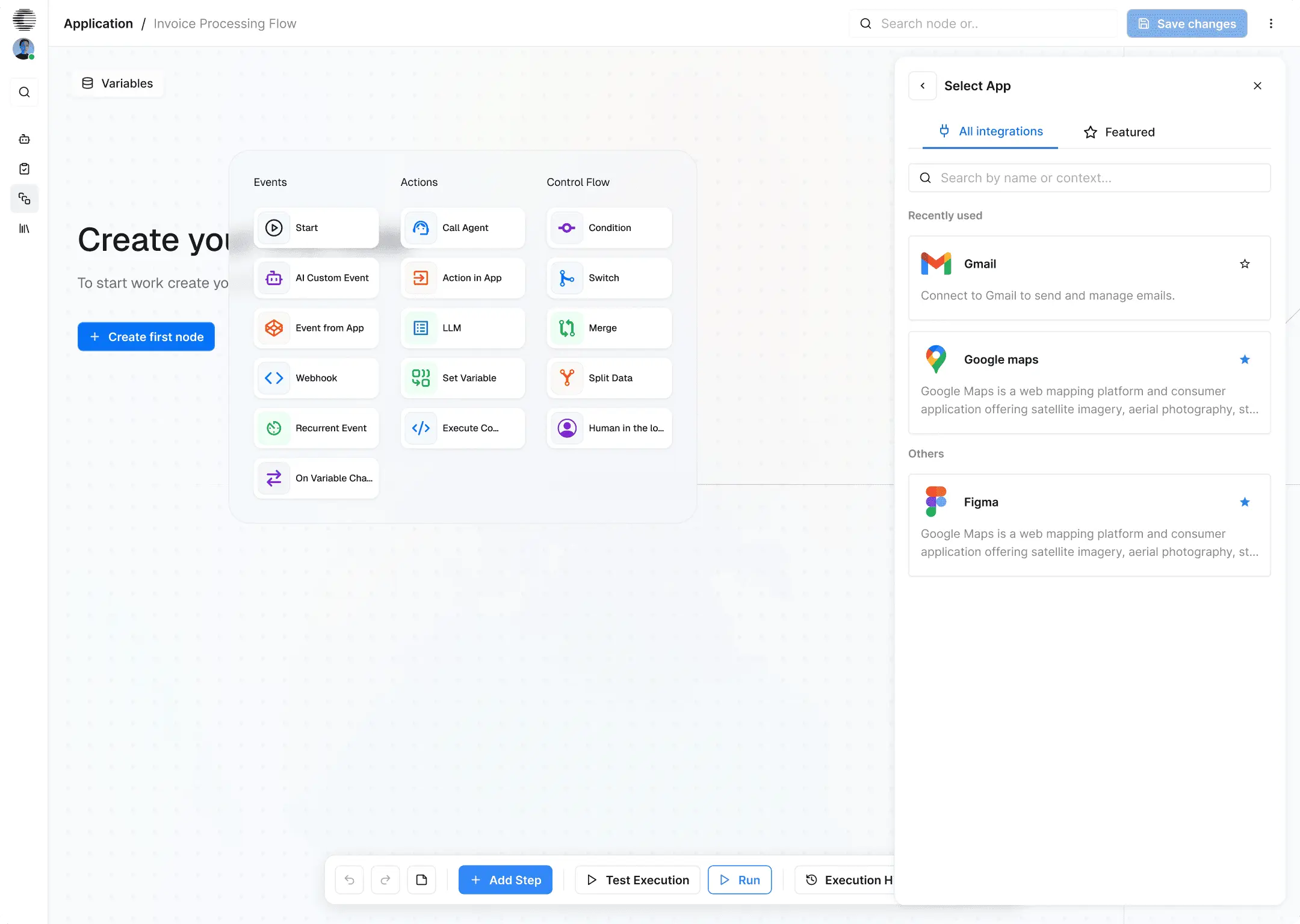
The workflow builder interface; the example shown is Invoice Processing Flow, not an HR-specific workflow.
The distinction between AI workflow automation and AI agents is useful when choosing the design. Use explicit rules for known obligations and consider bounded AI assistance where interpretation or follow-up questions add value.
For meaningful actions, define the permitted operation, account, destination, approval requirement, and failure path. An agent is not inherently more reliable than a conventional workflow, and a conventional workflow containing AI can still produce incorrect outputs.
Measure completed work and review effort, not just the number of conversations handled.
Establish a baseline using the current process, then compare a limited pilot under reasonably comparable conditions. Record differences in role difficulty, application source, volume, staffing, and operating hours.
|
Metric |
Practical definition |
Important boundary |
|---|---|---|
|
Time to first substantive response |
Time from receiving an application to a response that addresses the role or gathers necessary information |
An automatic receipt acknowledgment alone does not count |
|
Staff handling time per application |
Active employee time spent processing applications, including corrections and exceptions |
Include work created by the new process |
|
Applications with sufficient information |
Share of reviewed applications containing the agreed intake fields at the defined checkpoint |
Complete fields do not prove candidate suitability |
|
Successfully confirmed interviews |
Share of booking attempts that result in a verified, correct appointment |
Track attendance separately |
|
Unfinished onboarding steps |
Required steps still incomplete at the relevant deadline |
Distinguish overdue work from work not yet due |
|
Correction or escalation rate |
Share of reviewed interactions needing an answer correction or human escalation |
Separate expected handoffs from avoidable failures |
Define denominators and review windows before comparing rates. Report the number of applications or interactions reviewed so a small pilot is not mistaken for broad evidence.
Use medians or distributions where they reveal delays hidden by an average. Keep unanswered applications visible rather than calculating response time only for those that received a reply.
Time to first contact is not time to hire. Faster responses do not establish better hiring decisions, improved retention, or a better employee experience. Those outcomes require their own measures and observation periods.
Also compare total operating cost: software, model and channel charges where applicable, setup, document maintenance, monitoring, and employee review. A faster interaction may still be a poor trade if it creates substantial correction work.
Choose a task with a clear input, a limited action, and an observable completion condition. Candidate availability intake or questions from an approved onboarding handbook can provide a narrower starting point than an entire hiring process.
Build the pilot in six stages:
The guide to testing an AI agent before launch explains how to inspect the conversation, execution, and external result. A convincing response is not evidence that a candidate record was saved or an interview was booked.
CogniAgent’s recruiting offering is one option to evaluate for this bounded process. Start by checking whether its available actions and configuration meet your requirements. Expand responsibility only after the pilot demonstrates acceptable outcomes and the process owner approves the next step.