Article Updated Oct 30, 2026
 10 min read
AI Receptionist Pricing: How to Estimate Your Monthly Cost
Updated Oct 30, 202610 min read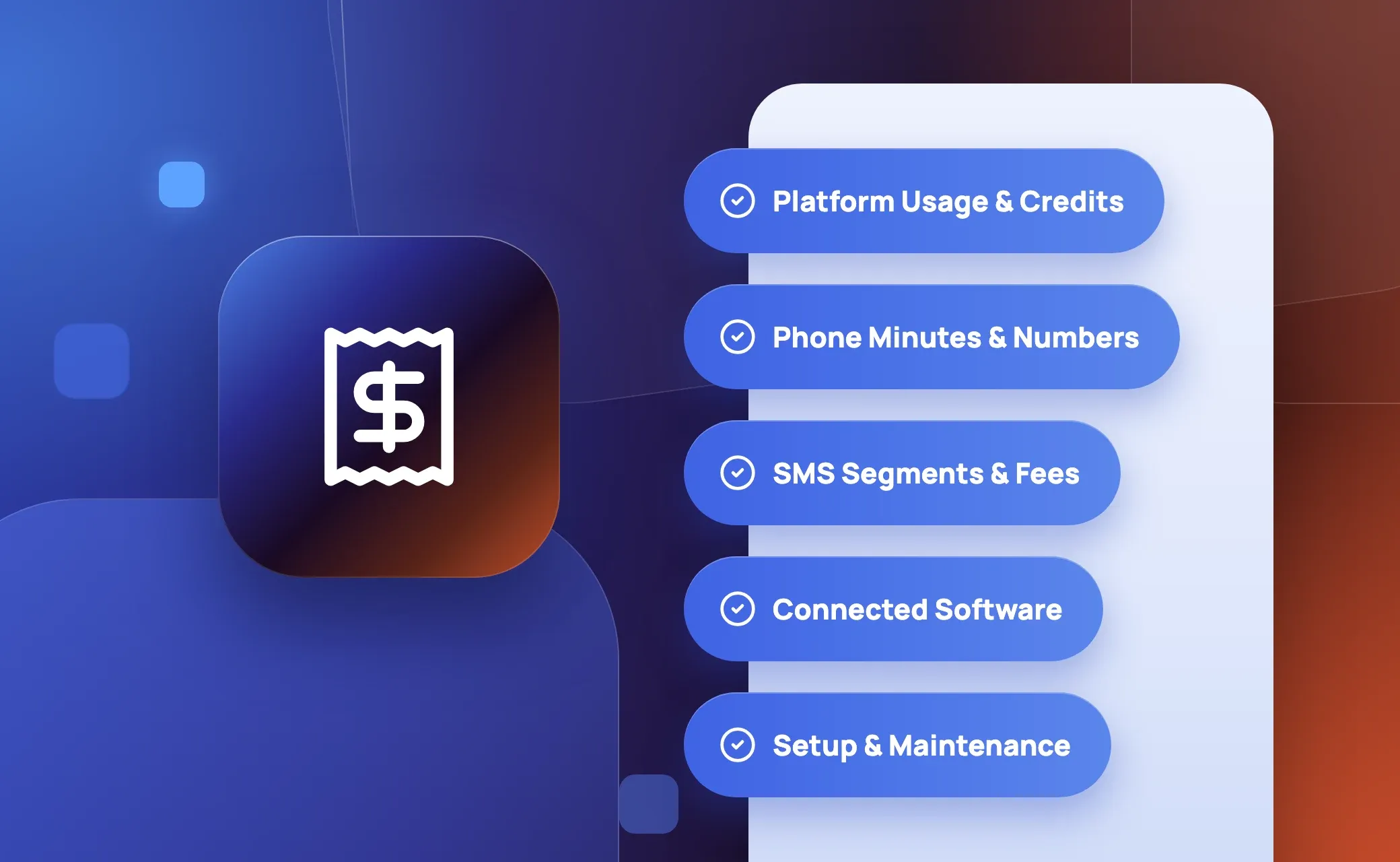 Updated Oct 30, 202610 min read
An AI receptionist’s monthly cost depends on your workload, the tasks it performs, and which charges are included in your agreement. A subscription price or credit top-up alone may not cover the full budget: check platform usage, external communication channels, connected services, and setup or ongoing support.
The same task can be priced differently across providers. Use this checklist to identify which costs are included in a quote and which require a separate estimate.
|
Cost item |
Billing unit |
Included or separate? |
Where to verify |
|---|---|---|---|
|
Platform access |
Subscription, credits, or contract period |
Depends on the plan |
Platform pricing page and agreement |
|
Conversation usage |
Turns, conversations, included allowance, or another unit |
May draw on credits or an allowance |
Usage documentation and account history |
|
AI model usage |
Input and output tokens or other model units |
May already be reflected in platform usage |
Model and platform pricing; usage statement |
|
Workflow and knowledge actions |
Executions, searches, indexed data, or other units |
Some actions may be free; others may consume credits |
Platform rate table and actual configuration |
|
Phone calls |
Minutes, possibly differentiated by direction and destination |
May be included or billed by a separate provider |
Voice provider’s rate card and invoice |
|
Phone number |
Number and billing period |
May be a separate recurring charge |
Number provider’s terms |
|
SMS |
Message segments plus applicable carrier or registration fees |
May be included or billed separately |
Messaging provider’s pricing and invoice |
|
Connected software |
Subscription, seat, or usage |
Depends on existing subscriptions and integrations |
Each software provider’s agreement |
|
Initial setup |
One-time project, hourly work, or included onboarding |
Confirm with the implementer |
Written proposal or statement of work |
|
Maintenance |
Monthly retainer, support plan, or staff time |
Depends on who maintains the workflow |
Support agreement or internal budget |
None of these rows should automatically be treated as an extra charge. A package might include some of them; a separately billed service might already be covered by an existing subscription. Mark the overlap before adding totals.
For example, Twilio’s US voice pricing distinguishes call usage from phone-number pricing. Its US SMS pricing describes per-segment billing and applicable carrier fees. Check the country, number type, direction, registration requirements, and services actually used; US rates are not a quote for international traffic.
Ask each provider to price the same scenario. Start with the locations and channels your business needs, then describe what the receptionist must do during an interaction.
Three workloads might require different amounts of processing and different connected services:
These descriptions do not imply a fixed duration, cost, or supported integration. Before requesting a quote, gather:
One conversation turn is not the same unit as one telephone minute. A short call may contain several turns; a minute-based voice charge and a turn-based platform charge can both apply if they come from different billing systems.
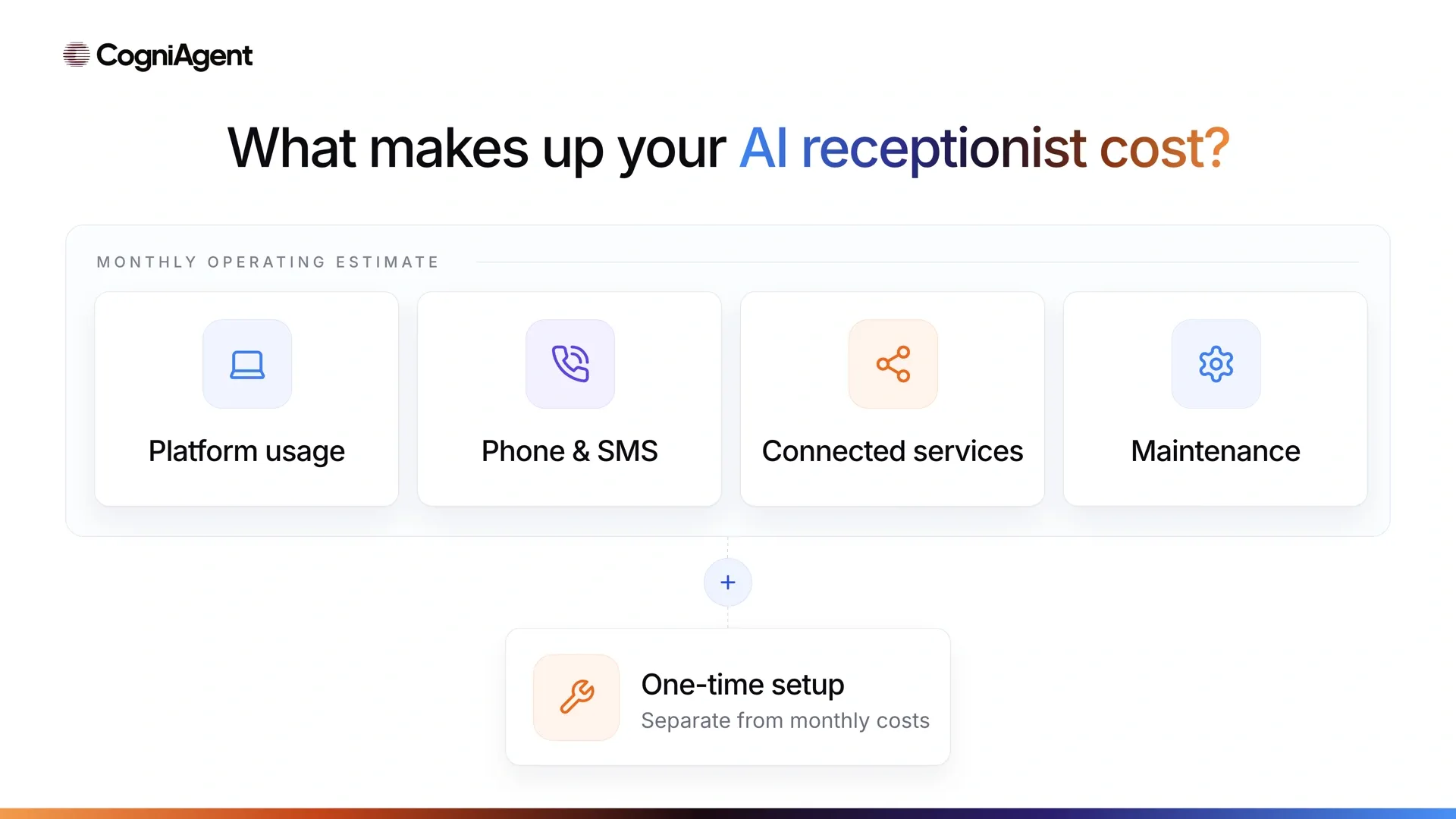
Use the following formula after identifying which charges overlap:
Monthly operating estimate = platform usage + separately billed channels + separately billed connected services + maintenance.
First-month estimate = monthly operating estimate + one-time setup.
These are planning estimates, not invoices. Add applicable taxes separately, use a consistent currency, and record any exchange-rate assumptions. Leave an unknown amount marked “to confirm”; do not silently treat it as zero. If you include existing staff time in maintenance, state how you valued it and avoid adding an external support fee for the same work.
As checked on October 28, 2026, CogniAgent pricing lists 5,000 signup credits. Its pay-as-you-go packages include 5,000 credits for $10 and 100,000 credits for $100, so the cost per purchased credit depends on the package. Enterprise annual terms are separate and should be checked in the applicable contract.
For pay-as-you-go, the pricing page says LLM token usage is charged at the underlying model provider rate plus 12.5%, converted into credits and deducted from the balance. Some workflow nodes are free, while other actions or associated services can consume credits. Check the specific operation rather than assuming every node is paid or free.
CogniAgent describes phone and SMS as using the customer’s own Twilio account. No platform channel fee does not mean phone calls, numbers, or messages are free: check the separate provider account and applicable charges.
There are two alternative ways to estimate platform usage:
1. Use the total consumed-credit history. Multiply the credits consumed during the period by the applicable cost per credit. If the total already includes model usage, turns, and actions, do not add those items again. If credits came from packages with different rates or from a promotion, ask how to value the actual balance and disclose your assumption.
2. Estimate non-overlapping components. Estimate the billable platform actions and model usage separately using their applicable rates. Apply the 12.5% markup only to the relevant underlying LLM provider cost, then convert that amount to credits using the applicable package rate. Do not apply the markup to all platform costs, Twilio bills, or credit consumption that already reflects it.
For voice processing or any other item whose billing treatment is unclear in your configuration, check the actual usage statement or ask the provider. Keep it as an unconfirmed line until you know whether it is already included. Compare estimates with the bill rather than assuming the same component appears on only one screen.
|
Assumption |
Illustrative amount |
|---|---|
|
Selected package |
$100 for 100,000 credits |
|
Monthly consumption |
25,000 credits, including the model usage and platform actions used in this example |
|
Separately billed communication channels |
$40/month |
|
Separate connected services |
$15/month |
|
Separate maintenance |
$50/month |
|
One-time setup |
$150 |
The package rate is $100 ÷ 100,000 = $0.001 per credit. At that assumed rate, 25,000 consumed credits represent $25 of platform usage. Because this is the total assumed consumption, no additional LLM charge is added to the calculation.
|
Calculation |
Result |
|---|---|
|
Platform consumption |
25,000 × $0.001 = $25 |
|
Monthly operating estimate |
$25 + $40 + $15 + $50 = $130 |
|
First-month estimate including setup |
$130 + $150 = $280 |
There is a separate cash-payment question. If the customer starts with no paid credit balance and buys the whole $100 package in the first month, the assumed payments are $100 + $40 + $15 + $50 + $150 = $355. After 25,000 credits are consumed, 75,000 credits remain, valued here at $75 using the same package rate.
The $280 estimate values credits consumed in that month; $355 describes the assumed cash paid during that month. Do not add the $100 top-up to the $25 consumption when calculating a single total. Real prices, use, tax treatment, purchased-credit valuation, and charges will depend on the account and contract.
Copy the table and replace each dash with your own quantity, rate, source, and check date. Use either the platform-total row or the component rows; do not add both. Record top-ups separately as cash payments, not as another operating-expense component.
|
Cost item |
Quantity and unit |
Rate and currency |
Included elsewhere? |
Monthly subtotal |
Source and check date |
|---|---|---|---|---|---|
|
Platform total — option A |
— consumed credits |
— per credit |
— |
— |
— |
|
Platform actions — option B |
— actions or turns |
— per action or turn |
— |
— |
— |
|
Model usage — option B |
— tokens or model units |
— per unit; markup if applicable |
— |
— |
— |
|
Other platform or voice-processing usage — option B |
— units, if separately billable |
— |
— |
— |
— |
|
Phone usage |
— inbound/outbound minutes |
— per minute |
— |
— |
— |
|
Phone number |
— numbers |
— per number/month |
— |
— |
— |
|
SMS and applicable fees |
— segments and applicable fees |
— per segment or fee |
— |
— |
— |
|
Connected software |
— subscriptions or seats |
— per month |
— |
— |
— |
|
Maintenance |
— hours or service plan |
— per hour or month |
— |
— |
— |
|
Taxes and currency conversion, if applicable |
— |
— |
— |
— |
— |
|
Monthly operating total |
— |
— |
Exclude duplicated or unknown rows |
— |
— |
|
One-time setup — separate |
— hours or project |
— per hour or project |
— |
— one-time |
— |
For cleaning-company owners comparing the workload and supplier options behind the numbers, see AI receptionists for cleaning companies.
A pilot gives you actual usage for a defined workload rather than a guess based only on advertised starting prices. Agree on the pilot period, channels, tasks, test volume, and who will review the results. The checklist to test an AI agent before launch can help structure that review.
At the end of the same period, record:
Divide the agreed pilot cost by handled conversations for one measure. For a different measure, divide the same scoped cost by verified completed tasks. Define both denominators first: a conversation can be handled without a booking, and a proposed booking is not necessarily a confirmed calendar event. If the denominator is zero, report the result as unavailable rather than calculating a rate.
These metrics answer different questions and should not be presented as savings or revenue. When comparing an AI setup with a human answering service or an employee, compare the same coverage hours, channels, responsibilities, exceptions, and review work.
Define one workload, request a quote for its actual scope, and run a limited pilot before committing to a larger deployment. For product context, review the CogniAgent AI receptionist for your business alongside the current pricing and channel terms.