Article Sep 11, 2026
 7 min read
8 Best Conversational AI Solutions for Dealerships in 2026
Sep 11, 20267 min read Sep 11, 20267 min read
A dealership's phone system is a revenue system, and most of the time nobody treats it that way. Service calls stack up at 7:45am when the lane opens and the advisors are already standing in front of customers. A sales lead comes in at 9pm through a third-party marketplace and sits until morning. Somebody calls to check whether their part came in, gets voicemail, and calls the store down the road instead. None of this is a marketing problem. It's a coverage problem, and it's the reason conversational AI has moved from novelty to standard equipment in dealership operations.
The catch is that "conversational AI for dealerships" now describes at least four different product categories. Some tools answer the phone. Some work leads that are already in your CRM. Some live on your website. Some are general-purpose platforms you configure yourself. Comparing them on a single feature list is how dealers end up buying three overlapping subscriptions.
Below are eight options worth evaluating in 2026, with a note on what each one is actually built to do.
One thing to check before you shortlist anything: how the tool connects to your DMS and CRM. A voice agent that can't read live service availability out of Xtime or write an appointment back into VinSolutions is a very expensive answering machine. Ask for the specific integration, not the logo wall.
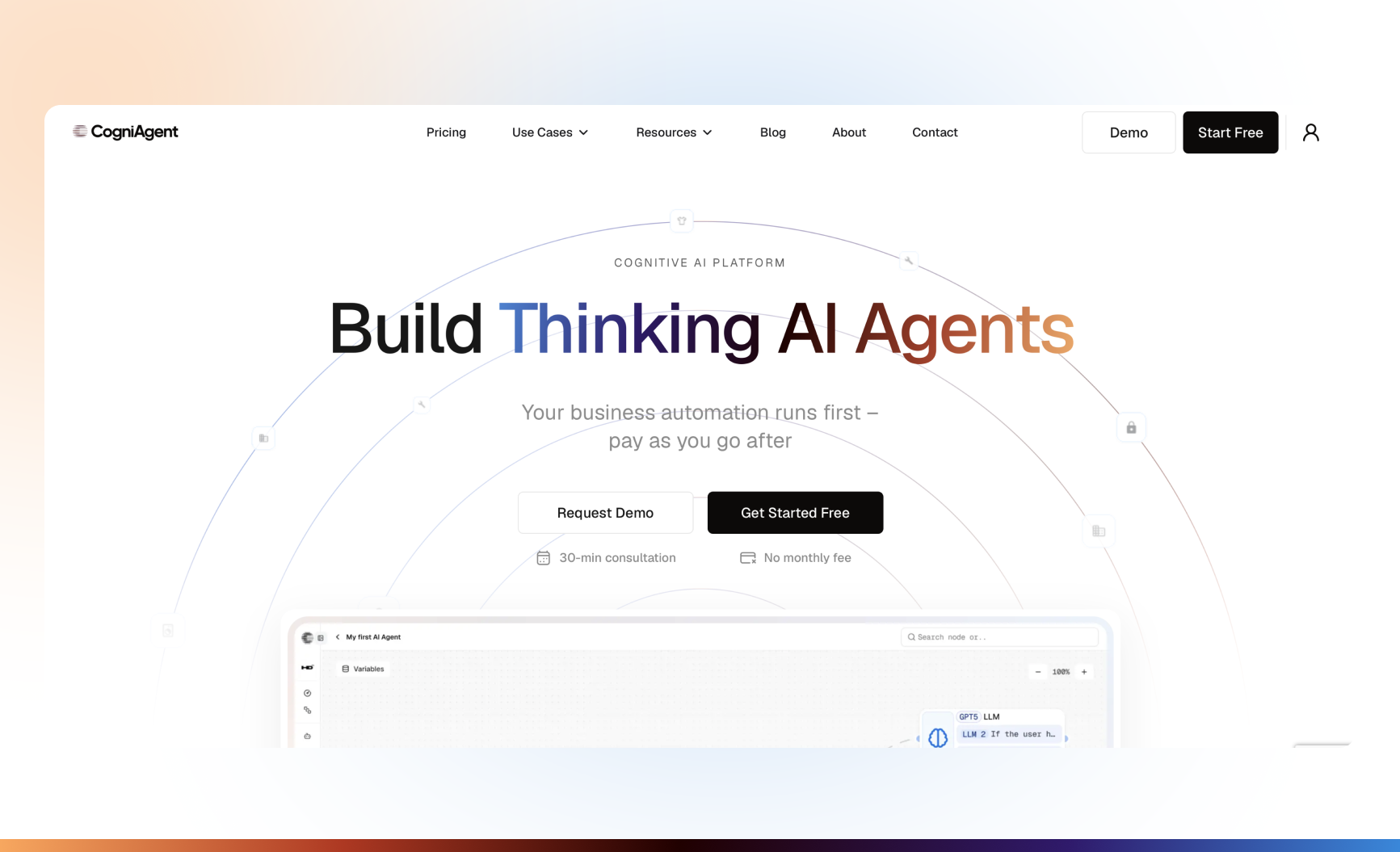
CogniAgent is not an automotive-specific product, and that's the honest starting point — but it's the most flexible option on this list, and for dealer groups with processes that don't fit a packaged tool, that flexibility is the whole argument. It's a workflow automation platform with conversational AI built in natively rather than bolted on, which means a single agent can hold a real multi-turn conversation with a customer and run the follow-on automation on the same canvas: check availability, write the record, notify the advisor, schedule the reminder.
The conversational layer runs on what CogniAgent calls its Skillset Engine, which collects information through dialogue instead of interrogating a caller field by field — the company reports a 92% first-attempt success rate against 64.5% for standard tool-augmented alternatives. Practically, that's the difference between an agent that gives up when someone says "it's the silver one, the lease is up in March I think" and one that works out what it still needs and asks for it.
It runs across web chat, SMS, WhatsApp, email, Slack, and Microsoft Teams, with voice available as well, and connects to 2,700+ platforms including HubSpot, Salesforce, Google Calendar, webhooks, and databases — which is how you'd wire it into a DMS that doesn't have a prebuilt connector. Pricing is credit-based (1 credit = $0.001), with a free tier of 500 credits and paid plans starting at $5, so a store can pilot a single use case — after-hours service intake, say — without committing to a platform contract. You can see how the pieces fit together on the agent builder page and the pricing page.
The trade-off is real and worth naming: you configure this one. There's no prebuilt "recall campaign" template waiting for you the way there is with an automotive-native vendor. If your group has an ops person who enjoys building things, that's an advantage. If you want it working on Monday with no setup, look further down the list.

Impel is the heavyweight of automotive-specific AI, built from the merger of Outsell and SpinCar into what the company positions as an automotive AI operating system — sales, service, chat, voice, marketing, and merchandising under one roof. It's designed for lifecycle coverage: the same customer record gets touched from first website visit through service retention years later.
That breadth is the reason to pick it and the reason to be careful. For a large dealer group or an OEM program, having one vendor own the whole lifecycle removes a lot of integration headaches. For a single rooftop, you may be buying and paying for a great deal of platform to solve one specific problem.

Numa is the one to look at first if your pain is in fixed ops. It's voice-first and service-focused, deployed across more than 1,200 rooftops, and built around a Smart Inbox that consolidates voice, text, and email into a single queue your advisors can actually work.
The important detail is that Numa pulls live DMS data during the call, so when a customer asks whether their vehicle is ready or their part arrived, the agent answers from real data rather than deflecting. It books appointments during the conversation and hands off to staff with full context attached. If your service lane drops calls at open and at lunch, this is the category leader for that specific problem.

Fullpath (formerly AutoLeadStar) approaches the problem from the data side. Its foundation is a customer data platform that unifies DMS, CRM, website, and inventory data, and the conversational layer sits on top of that unified profile rather than beside it.
The payoff is targeting. An agent that knows a customer's lease maturity date, service history, and what they've been browsing on your site writes a meaningfully different follow-up than one working from a name and a phone number. If your group's data is scattered across systems and you suspect you're leaving equity-mining and lease-renewal revenue on the table, Fullpath is the most data-sophisticated option here.

Toma is the newest name on this list and raised a $17M Series A from Andreessen Horowitz on the strength of its dealership voice agents. The reference number the company points to is Martin Management Group booking 9,000 service appointments in 90 days, which it attributes to more than $2M in revenue.
Treat vendor-reported figures as vendor-reported figures and ask for a reference store of your size. That said, Toma is worth a demo if you want a voice-native product built recently, on current models, without a decade of legacy IVR architecture underneath it.

Matador splits the work across five specialized agents — Engage, Reply, Follow-Up, Call AI, and Chat AI — each owning a specific stage of the customer journey, trained on what the company describes as 1.2 billion real dealership messages. Its Sales Autopilot and Service Autopilot features handle follow-ups, lease renewals, recall outreach, and appointment booking.
The multi-agent structure is a genuine architectural choice rather than marketing: separating "first response" from "long-term follow-up" means each agent can be tuned for a different job, and a stalled lead doesn't get the same message cadence as a fresh one. Strong fit for stores whose biggest leak is in follow-up discipline rather than call answering.

Conversica is the veteran of automotive lead nurture, used by 1,000+ dealer teams, and it does one thing with unusual persistence: it works leads that already exist in your CRM. Email and SMS, over weeks or months, until a contact responds or is genuinely dead. It covers sales, service, and F&I follow-up, and integrates with DealerSocket, CDK, and VinSolutions.
What it does not do is engage a live visitor on your website or answer your phone. That's a real limitation and also the point — this is a reactivation tool for a CRM full of aging leads nobody has time to call. If that describes your database, it pays for itself in a category the other tools on this list mostly ignore.

Gubagoo is the most widely deployed dealer chat platform in North America, and its model is deliberately hybrid rather than fully automated. Its ChatSmart product uses a behavioral scoring engine to track visitor intent and trigger conversations at the right moment, with trained human specialists handling live chats while AI assists behind the scenes; after hours, the AI layer takes over. It supports more than 120 languages.
For dealers who've been burned by a bot mishandling a ready-to-buy website visitor, having humans on the live conversations is a legitimate reason to choose this over a fully autonomous product — at a correspondingly different cost structure.
Start by naming the leak. "We want AI" is not a requirement. "We miss 40% of inbound service calls between 7 and 9am" is, and it points straight at Numa or Toma. "We have 12,000 dead leads in the CRM" points at Conversica. "Our website converts browsers badly" points at Gubagoo. "Our customer data is a mess and our follow-up is generic" points at Fullpath. Buying by category instead of by leak is how dealers end up with overlapping tools that each solve a third of the problem.
Second, insist on the escalation path. Every vendor on this list will tell you their agent hands off to a human. Ask what triggers it, what the customer hears, and what the advisor sees when the conversation lands. A handoff that dumps a customer into a queue with no context is worse than no automation, because the customer has now explained the problem twice.
Third, be realistic about setup. The automotive-native tools arrive configured for dealership workflows and get you live faster. A platform approach takes more work upfront and gives you processes nobody else has. Neither is the right answer in general; they're the right answer for different stores.
That configurable path is the one CogniAgent is built for: conversational AI to hold the actual back-and-forth, autonomous agents to run the tireless background work like recall and lease-maturity outreach, and deterministic workflow automation to make sure every outcome lands in the right system — with a clear, fast handoff to a person the moment a conversation needs one.