Running human resources without a dedicated team is genuinely hard. A restaurant manager hiring five part-time staff in a single week, a cleaning company onboarding a wave of summer contractors, a retail owner buried in new-hire paperwork between shifts — these are people managing real HR work on top of everything else they’re responsible for. They don’t need theory. They need AI tools that actually reduce the day-to-day load.
That’s exactly where AI has started to make a measurable difference. Over the past two years, small and mid-size service businesses have begun using AI not as a futuristic experiment, but as something running in the background every day — screening applicants, collecting documents, scheduling interviews, answering onboarding questions at 11 PM. The benefits of using AI in HR are no longer confined to whitepapers. They’re showing up in payroll hours saved and time-to-hire cut in half.
This article covers what AI actually does across the core HR functions, recruitment, onboarding, training, payroll, and process automation, and why service businesses without a full HR department stand to gain the most from the shift.
AI Is Reshaping HR, and the Timing Has Never Been Better
AI is reshaping human resource management in ways that matter most to teams stretched thin. The decision to bring AI into HR operations rarely comes from a board-level strategy discussion. It usually comes from a breaking point: a hiring manager who spent three hours reviewing 80 identical resumes, or a business owner who had to walk a new employee through the same document portal twice in their first week.
According to a 2024 McKinsey report, 65% of organizations now use AI in at least one business function, up from 33% just two years prior. HR professionals are increasingly recognizing the opportunities to use AI not just for cost reduction, but for consistency and quality across every hire.
The hidden cost of manual HR tasks
Without dedicated HR staff, the work doesn’t disappear; it just falls to whoever is already overextended. Automating repetitive HR tasks such as interview scheduling, document chasing, and onboarding reminders could give HR teams back hours each week. When those tasks are done inconsistently, they create compliance gaps that cost businesses far more to fix than to prevent.
HR teams need a different approach — one where AI handles the predictable work so people can focus on what requires a human touch: culture-fit conversations, conflict resolution, career development, and employee development planning that no algorithm should own.
What the role of AI looks like in practice
Unlike rule-based automation tools that follow fixed scripts, modern AI systems, especially autonomous AI agents, understand context, respond to variations, and complete multi-step tasks without constant oversight. That means they handle exceptions, not just the standard flow. AI enables HR teams to manage candidate drop-offs, missing documents, or rescheduling conflicts without a human having to intervene at every step.
The use of AI in HR also minimizes human error in data-intensive processes such as payroll and benefits enrollment — areas where a single mistake can have downstream compliance consequences.
Core Benefits of AI in HR Across Key Functions
The benefits of AI in HR are clearest when you look at specific HR functions rather than the concept in the abstract. Recruitment, onboarding, training, payroll, and end-to-end process automation each benefit in distinct ways — and together, they paint a picture of an HR operation that runs more consistently and with far less manual effort.
Benefits of using AI in HR recruitment processes
Hiring in service industries is fast-paced and high-volume. A restaurant posting for seasonal staff, a retail store preparing for a peak period, a trades business scaling a crew — these operators can receive dozens of applications in a day, and most HR teams don’t have the bandwidth to review every submission with care.
AI for HR changes that equation entirely. When businesses leverage AI in recruitment, it can scan resumes for role-relevant signals, rank candidates by custom criteria, send first-round messages to shortlisted applicants, and answer candidate questions through a chat interface — all before a recruiter opens a browser tab. According to LinkedIn’s 2024 Future of Recruiting report, companies using AI screening tools reduced time-to-first-contact by up to 50%.
CogniAgent’s AI agents for HR handle exactly this workflow: candidate intake, screening questions, disqualification messages, and interview scheduling — all within a single automated flow that HR teams configure once and reuse across every open role. HR professionals can leverage AI here to eliminate the most time-consuming part of recruitment without losing control of the final hiring decision.
Faster, more consistent onboarding
Onboarding is where many small businesses quietly lose ground. A new hire starts with enthusiasm, then spends their first week waiting for emails, hunting for documents, or receiving conflicting instructions from two different managers. By week three, some are already looking elsewhere.
AI-assisted onboarding addresses this consistency problem directly. A conversational AI platform can walk every new employee through the same structured process — document submission, policy acknowledgment, role-specific training content — at whatever pace works for them, flagging anything incomplete to the manager automatically. This is particularly valuable for businesses hiring across multiple locations or during peak seasons when managers can’t personally run every onboarding conversation.
Allowing HR professionals to focus on relationship-building rather than document-chasing is one of the most practical benefits of using AI in HR, and onboarding is where that shift becomes immediately visible.
Benefits of using AI in HR training programs
Traditional training in service businesses often means a printed manual, a two-hour shadowing session, and an assumption that the new employee will piece together the rest. This isn’t always a process failure — it’s usually a resource constraint. Most small operators simply can’t run structured training programs at scale.
The benefits of using AI in HR training programs come down to personalization and availability. An AI agent can deliver role-specific modules, check comprehension with brief quizzes, adjust pacing based on employee responses, and remain available for questions outside business hours. For HR leaders managing shift workers, remote contractors, or multi-site teams, this kind of flexibility is difficult to replicate through any other method.
A 2023 IBM study found that employees who receive AI-assisted training complete learning modules 40% faster and retain information at higher rates than those who use traditional training formats. For an HR department trying to get a new hire fully productive within a week, that’s a meaningful gain.
Generative AI is increasingly used in this space to dynamically create training content — adapting materials to specific roles, locations, or business contexts rather than deploying a one-size-fits-all program. AI technologies like these give HR leaders a level of training customization that previously required significant investment.
Benefits of AI in payroll and HR
Payroll is an area where small errors carry outsized consequences. A misclassified shift, a missed overtime calculation, a benefits enrollment window that closed without a notification — these aren’t just administrative headaches; they’re compliance risks.
The benefits of AI in payroll and HR center on accuracy and speed. AI algorithms can cross-check timesheets against scheduling data, flag anomalies before they become problems, calculate variable pay components like tips or commissions, and generate audit-ready reports that used to take an afternoon to compile. For HR operations managing hourly employees across multiple sites, achieving this level of consistency manually is hard.
AI can help ensure that every employee receives the right pay, on time, with the right deductions applied, a baseline that helps HR teams build trust with their workforce.
Benefits of AI automation in HR processes
Beyond individual HR functions, the benefits of AI automation in HR processes come from connecting them. When recruitment, onboarding, training, and payroll operate as separate manual tasks, each handoff creates friction and opportunity for error. When AI handles the transitions — moving a hired candidate automatically into the onboarding flow, triggering document requests at the right moment, notifying payroll when a new hire clears all onboarding steps — the whole process becomes faster and less dependent on someone remembering the next action.
CogniAgent’s business workflow automation is built around exactly this kind of connected logic. Enabling HR teams to define a workflow once and have it run reliably for every employee is one of the most practical uses of AI today. HR teams can leverage AI here to integrate AI into HR operations without rebuilding existing HR systems from scratch.
What Makes Agentic AI Different from Standard Automation
The benefits of agentic AI in HR management come from its ability to manage whole processes rather than isolated tasks. A traditional automation tool sends a reminder when a deadline arrives. An agentic AI notices the reminder wasn’t acted on, checks how close the deadline is, determines whether escalation is appropriate, and loops in a human manager only when the situation genuinely requires human interaction. That’s a different class of reliability — and a different level of confidence for the HR team running it.
An AI agent builder like CogniAgent’s lets HR teams design these agents without writing code. They define the goal, the inputs, and the decision rules; the platform handles the execution. This is what modernizing HR with AI actually means in practice — not replacing HR professionals, but giving them AI capabilities that handle the routine so they can focus on talent management, coaching, and the decisions that require real judgment.
Investing in AI at this level also gives HR leaders access to data they previously had to pull manually: completion rates, bottlenecks, time-in-process by stage, and patterns across hires that help them improve recruitment and retention over time. For HR departments ready to move beyond task-level tools, the benefits of agentic AI in HR management are most visible here — in the compounding efficiency of processes that run themselves.
Real use cases for AI in service businesses
In practice, benefits of using AI in HR recruitment processes look like this: an AI agent that manages the full candidate journey from application to accepted offer without manual touchpoints; an agent that monitors license and certification expiry for field employees and sends renewal prompts before compliance windows close; or a powered-by-AI chat interface that answers employee questions about scheduling, HR support requests, and policy clarifications around the clock.
HR teams can leverage AI agents for all of these workflows today — through platforms designed specifically for service business operations. Embracing AI tools at this level doesn’t require a large HR department or a technical team. It requires the right platform and a clear starting point.
Challenges of AI in HR (and How to Address Them)
No implementation comes without friction, and HR is an area where getting things wrong has real consequences. HR leaders must go in with clear expectations on the challenges of AI in HR before committing to a rollout.
- Data quality: AI systems work from the data they’re given. If job descriptions are inconsistent or existing HR records contain gaps, AI outputs will reflect that. Human review — especially for hiring decisions — remains an essential part of the process
- Integration with existing HR systems: Many service businesses run a mix of scheduling apps, payroll tools, and communication platforms. To integrate AI into HR effectively, those connections need setup time. Platforms like CogniAgent’s conversational AI platform are built with this flexibility in mind
- Employee trust: People have reasonable concerns about AI involvement in decisions that affect their careers. Using AI for human-facing processes requires transparency about what’s automated and what involves a human review — that communication is what allows HR teams to maintain trust during an AI transformation in HR
Getting these right is what separates an AI adoption that sticks from one that quietly gets abandoned after three months. HR teams need a rollout plan, not just a software subscription.
Modernize Your HR Operations with CogniAgent
Manual intake, inconsistent follow-up, and missed onboarding steps have a direct cost — and for many service businesses, that cost compounds quietly every week. CogniAgent is built to close that gap. It’s an AI-powered conversational platform designed to handle the full HR automation cycle: screening candidates, managing onboarding flows, collecting documents, answering employee questions, and keeping every new hire moving forward, 24 hours a day.
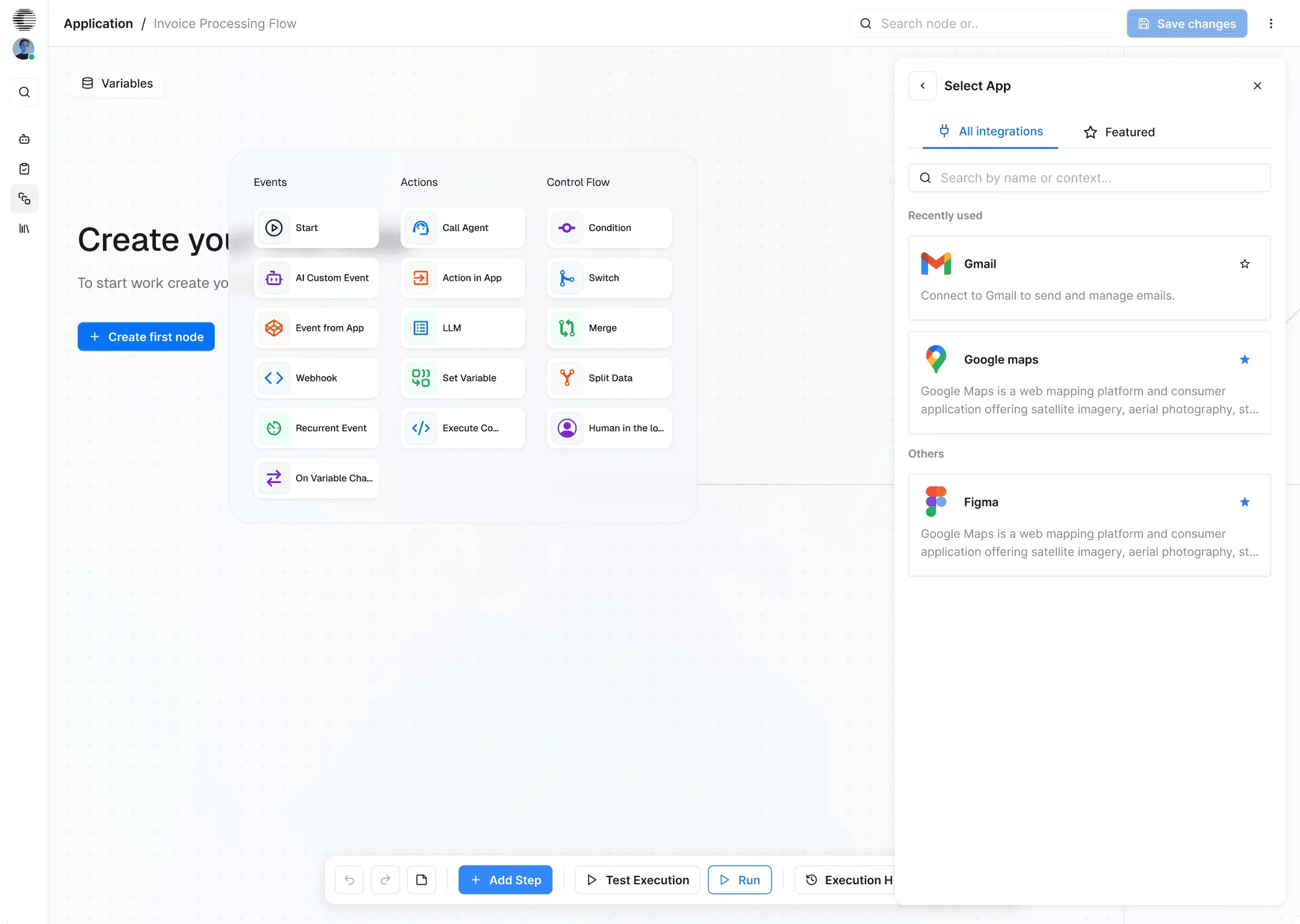
Unlike single-function HR tools, CogniAgent manages voice, chat, email, and SMS through a single connected system — synced with your existing HR setup, scheduling software, and payroll tools. Whether you’re handling a hiring surge across multiple locations or automating the repetitive front-desk HR work your team shouldn’t be doing manually, the platform gives your HR operations the coverage they need without adding headcount.
Request a demo and see how CogniAgent fits your HR operation.
![Top AI Receptionists for Cleaning Services [2026]](https://cogniagent.ai/wp-content/uploads/2026/07/Top-AI-Receptionists-for-Cleaning-Services-2026-300x185.webp)
![Best AI Tools for Auto Repair Shops [2026 Guide]](https://cogniagent.ai/wp-content/uploads/2026/07/Best-AI-Tools-for-Auto-Repair-Shops-2026-Guide-300x185.png)