Article Updated Aug 31, 2026
 5 min read
5 Best AI Recruiting Agents for Veterinary Clinics
4.6/5 - (17 votes)
 Updated Aug 31, 20265 min read
 Updated Aug 31, 20265 min read
Veterinary practices replace about 23% of their team every year, according to AAHA retention research reported by AVMA News. For a ten-person clinic, that means roughly two vacancies a year, filled from a credentialed pool so small that any applicant worth interviewing is weighing several practices at once. Hiring turns on how fast a clinic responds rather than how well the role is written, and where there is no HR function, that response competes with appointments, surgeries, and a full phone queue.
AI recruiting agents for veterinary clinics target that gap. Instead of waiting for a manager to free up their time, an agent answers an application within minutes, asks the questions that determine fit — credential type, issuing state, expiration, shift, and on-call availability — and books the interview.
The shift toward faster response is already showing up in the numbers. SHRM's 2025 Talent Trends research found that 43% of organizations now use AI in HR tasks, up from 26% the year before, with much of that growth in first contact and first-pass screening.
If any of this sounds familiar, you already know why this is hard to solve with more hours or a better job post. It's a matching and speed problem, and it's one even a seasoned veterinary recruiter can't out-work alone. Understanding your options starts with seeing what the market actually offers. Below, you can explore 5 AI recruiting agents for veterinary clinics, along with their features, pricing, and the type of practice each one fits best.
Veterinary hiring is not a volume problem the way retail, hospitality, or warehouse hiring is. A technician opening might draw a dozen applicants, but in most markets only one or two of them will hold a current, matching credential; the rest simply aren't qualified for the role. That scarcity changes what a slow process actually costs a clinic: instead of losing a few names out of a hundred, a clinic risks losing the only two candidates worth interviewing to whoever calls them back first. Three benefits explain why an AI recruiting agent closes that gap better than a manager working the phones between appointments.
Speed to first response is the variable clinics control most directly and act on least consistently. Applicants expect to hear back within a week, and most don't — a vet tech who applied to four practices on a Sunday afternoon usually interviews with whichever one calls first. But when the vet and techs are mid-surgery, and the office manager is alone at the front desk juggling check-ins and phone calls, recruiting becomes background noise until the day slows down enough to notice it. An agent closes that window automatically, without depending on someone remembering between appointments. A two-doctor practice receiving three applications over a weekend can have all three answered the same evening, with two interviews on the Monday calendar.
In most practices, first-pass screening is unpaid overtime for whoever has the least protected calendar. LinkedIn's Future of Recruiting 2025 report found recruiting teams using generative AI save roughly 20% of their work week, the equivalent of a full workday. An office manager filling a kennel assistant role and a front-desk role at once loses most of those hours to phone tag rather than evaluation. Agent conversations come back as screening records that take minutes to review.
At two vacancies a year, a clinic is never far from its next opening, and every cycle is a chance for the process to drift depending on who ran it. An agent removes this variation and asks the same questions for each candidate and each screening in the same order: credential type, state and expiration, years in practice, shift and on-call availability, anesthesia or dental experience. Answers land as structured fields rather than notes, so candidates from different months remain directly comparable. A technician hired in March and one hired in September show up in the same format, side by side, instead of one clean record and one page of scribbled phone notes.
With a growing list of veterinary staffing AI tools to choose from, picking one comes down to a handful of practical questions: does it actually understand licensure, does it screen for the shifts you need covered, and will it fit a clinic filling four roles a year instead of four hundred? Here's what to check before you shortlist anything:
The five tools below span two different approaches. Some are built to run the whole screening conversation, asking about credentials, checking availability, and booking the interview in one exchange, while others are general applicant tracking systems with AI layered on top for scoring or scheduling, leaving credential and shift screening to a form.
Which fit is right depends less on the tool's reputation and more on how much of the process you want an agent handling versus how much you want to keep managing yourself.
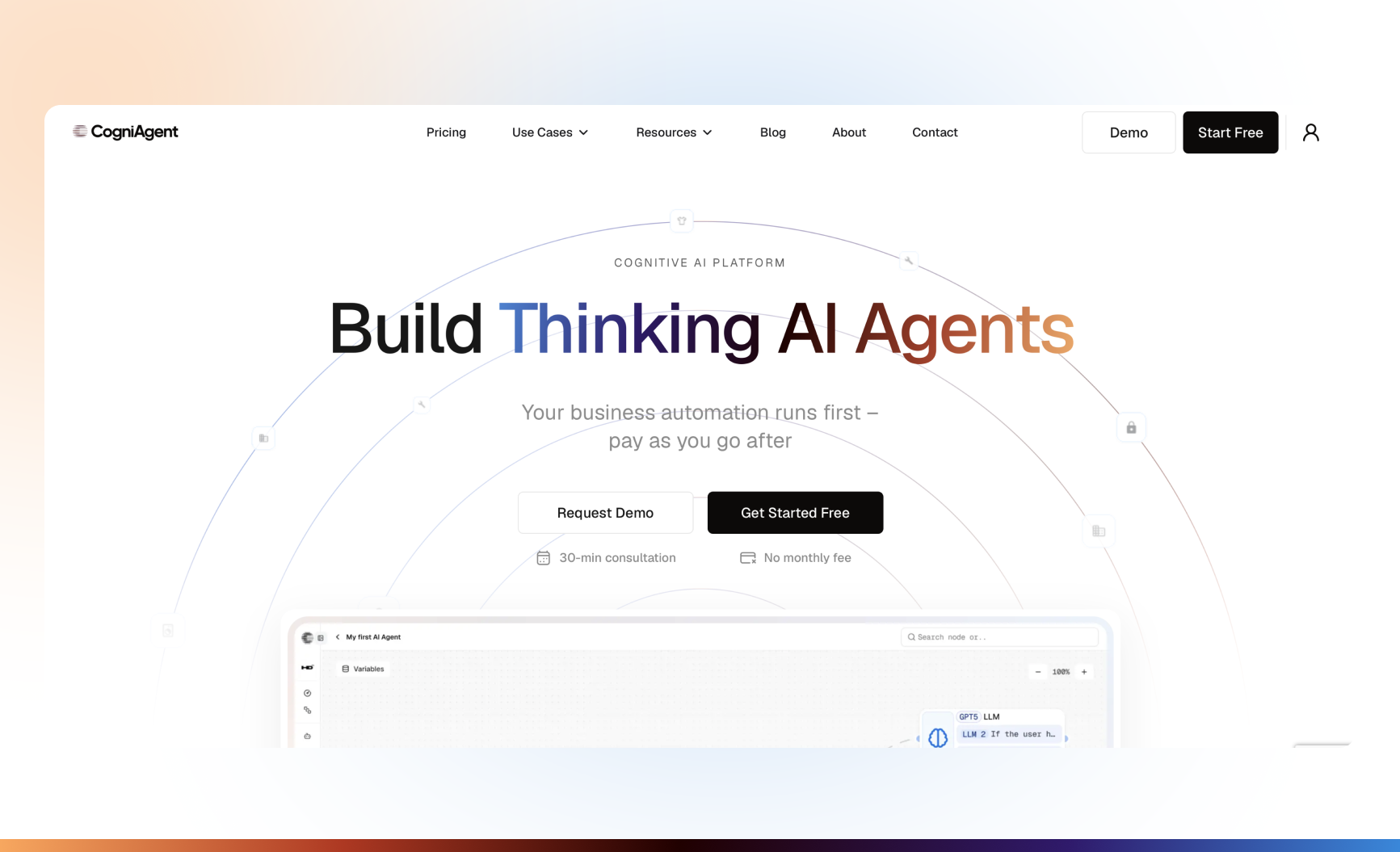
Often, you'll find tools that handle only one part of hiring and leave the rest to a separate system. CogniAgent runs the whole thing as one agent: it holds the screening conversation, validates what the applicant enters, books the interview, and triggers onboarding document collection, all without handing off between tools. It is a cognitive AI platform combining conversational AI agents, autonomous agents, and deterministic workflow automation on one no/low-code system — which also means an application arriving at 10 p.m. gets answered the same night instead of sitting until morning. Practices build with the AI Concierge and own the agent afterward. CogniAgent is a product of Glorium Technologies.
Key features:
Best for: Single-site and small multi-site practices hiring technicians, assistants, and front-desk staff without a dedicated HR function.
Pricing: Pay as You Go starts free with 5,000 credits on signup and no card required, including production deployment. Top-ups start at $10, and credits never expire. Enterprise is annual prepay at a negotiated rate.
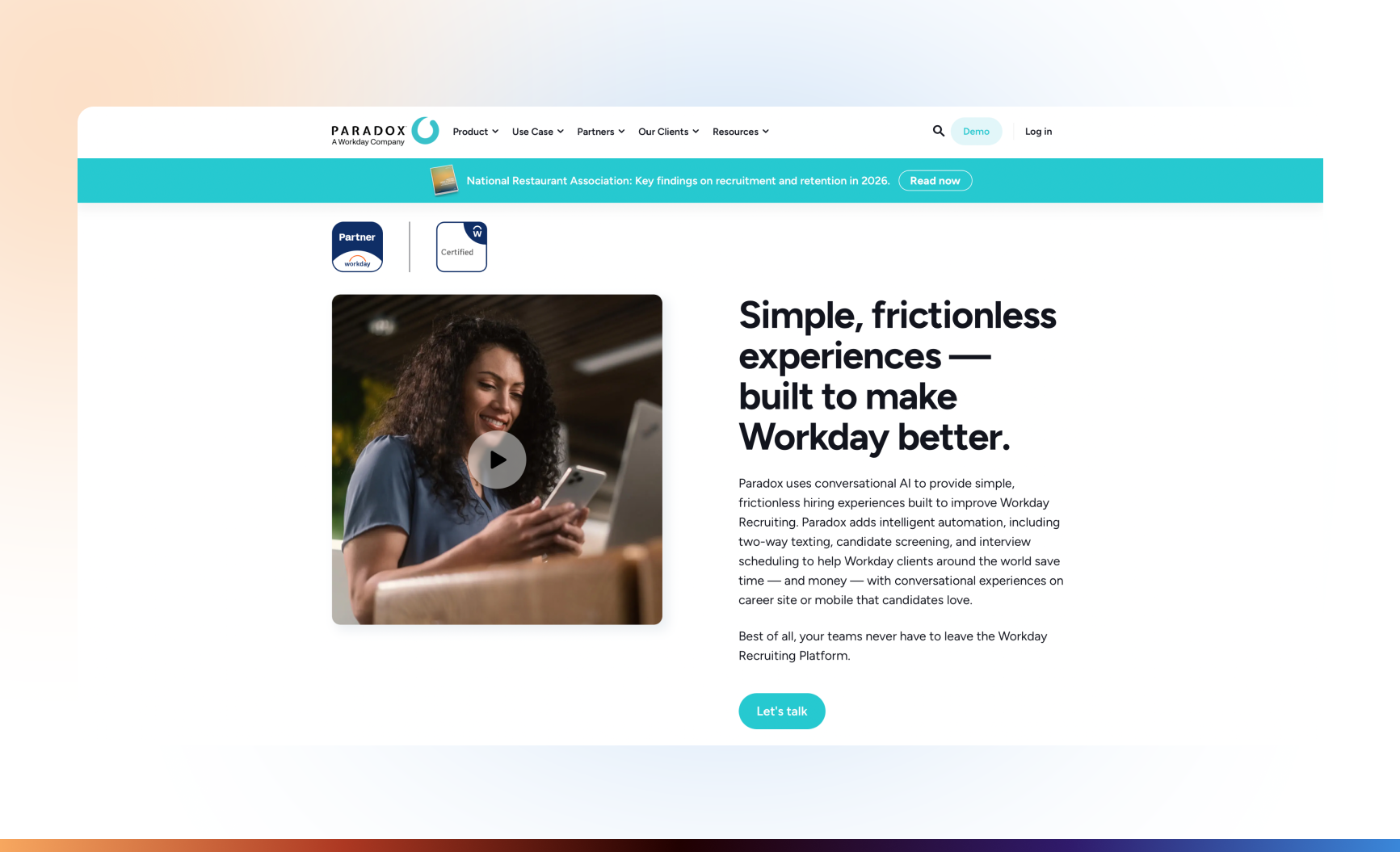
Paradox is a conversational recruiting platform built around Olivia, an assistant that moves the top of the funnel from web forms into text message. A candidate taps an ad, answers screening questions by SMS, and books an interview against a hiring manager's calendar without a recruiter involved. Founded in Scottsdale, Arizona, in 2016, it is the established option for frontline hiring in retail and hospitality. Workday completed its acquisition on October 1, 2025, and Olivia is being folded into Workday's talent acquisition suite, so confirm current packaging before committing.
Key features:
Best for: Large multi-location employers and franchise networks with continuous hiring volume and an enterprise ATS already in place.
Pricing: Not published publicly. Contact for a quote; positioned for enterprise and multi-location deployments.
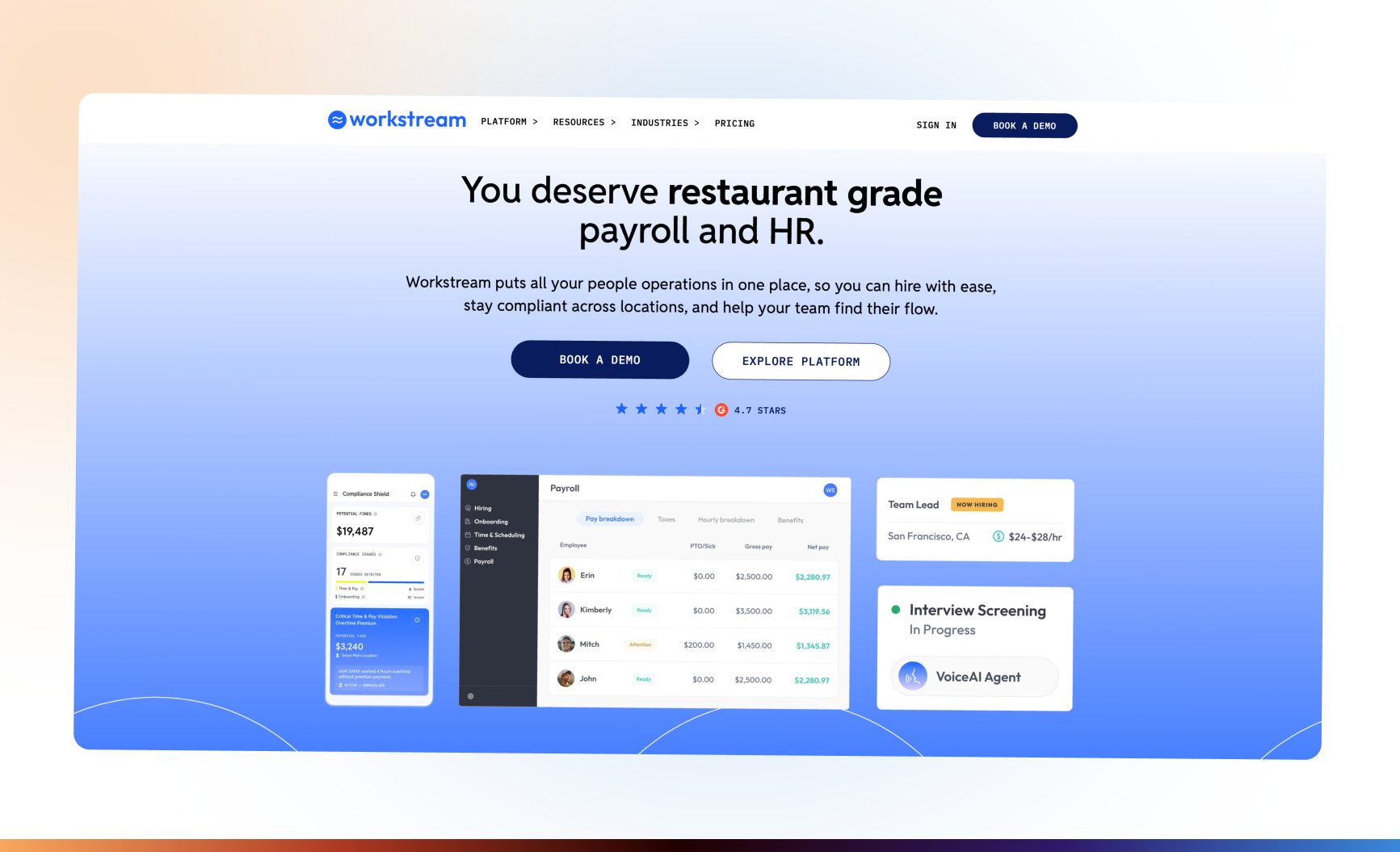
Workstream is an HR, hiring, and payroll platform built for hourly and frontline teams, with most of its base in multi-location restaurants, retail, and healthcare support roles. Its hiring module covers everything from sourcing to onboarding through text-based workflows and mobile-first forms. Because hiring records connect to scheduling and payroll on the same employee record, it suits operators who want one system rather than several. Setup runs through a guided sales process.
Key features:
Best for: Multi-location operators consolidating hiring, onboarding, scheduling, and payroll on one platform.
Pricing: Quote-based, priced per employee per month and varying by modules, employee count, location count, and contract length. No self-serve trial.
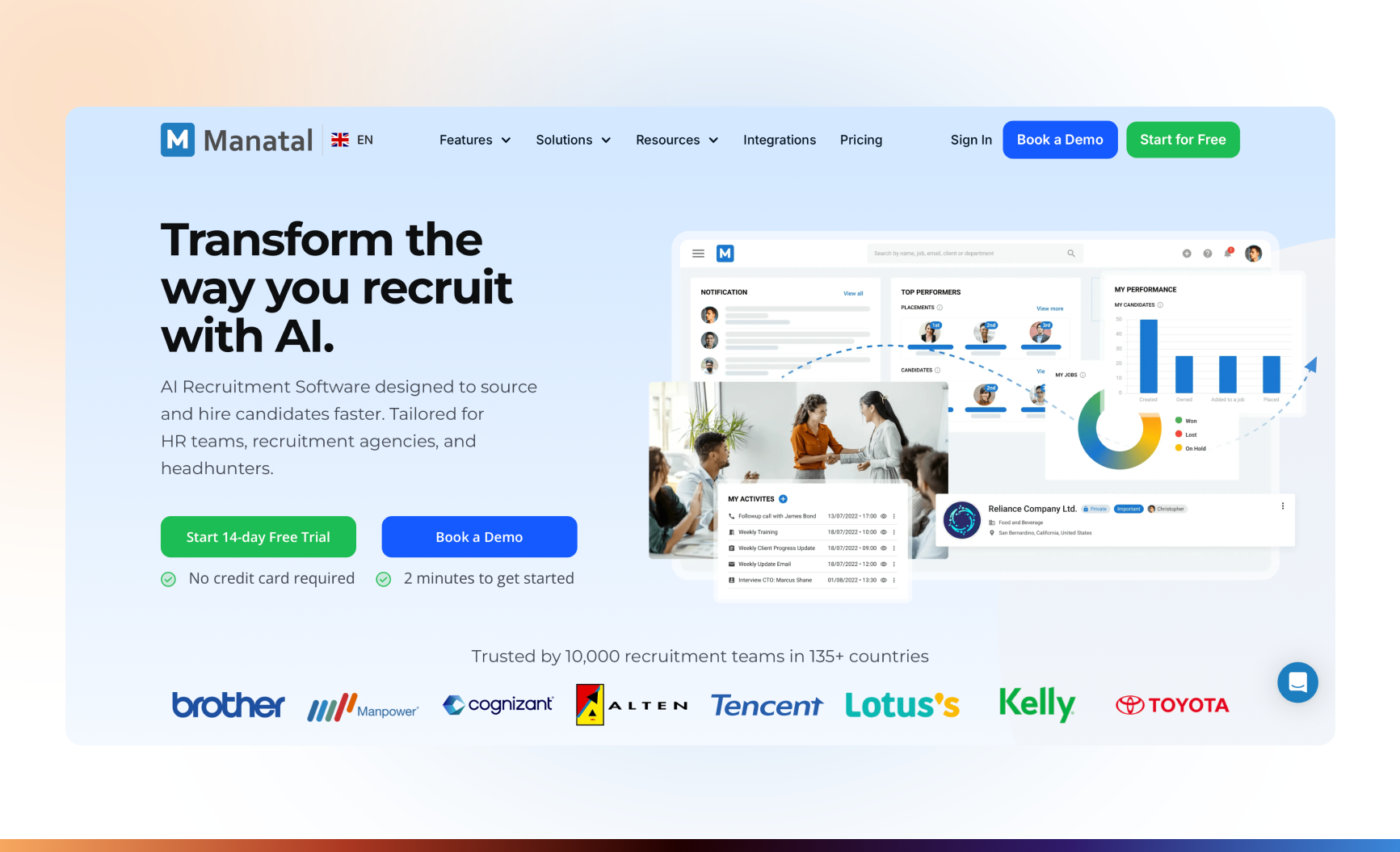
Manatal is a cloud-based applicant tracking system and recruitment CRM with AI layered across sourcing and screening. Priced per user, it is within reach of a practice that wants a structured pipeline rather than a spreadsheet. Its AI scores and ranks candidates already in the database and parses resumes into structured profiles, and an AI Interviewer add-on runs automated video screening around the clock.
Key features:
Best for: Small hiring teams that want a low-cost per-user ATS with AI screening on a conventional pipeline.
Pricing: Professional starts at $15/user/month billed annually (15 jobs, 10,000 candidates), Enterprise at $35, and Enterprise Plus at $55, with custom pricing above that. A 14-day free trial requires no card.
Breezy HR is an end-to-end recruiting platform for small and mid-sized employers, covering job distribution, pipeline management, scheduling, and offers. Its distinguishing feature for small practices is a permanent free tier supporting one active position, enough to run a technician opening with a real pipeline instead of an inbox. Paid plans include unlimited users at flat pricing, which suits a clinic where the owner, manager, and lead technician all weigh in.
Key features:
Best for: Small practices making a few hires a year that want a structured pipeline with a free entry point.
Pricing: Bootstrap is free for one active position. Startup plan runs $189/month or $157 billed annually, Growth $329 or $273, and Business $529 or $439, with Pro at custom pricing.
|
Tool |
Main Features |
Free Entry Point |
Starting Price |
|
CogniAgent |
Multi-channel screening, structured licensure and availability intake, mid-conversation booking, onboarding automation, 2,700+ integrations |
Free tier, 5,000 credits, no card |
Free; top-ups from $10 |
|
Paradox (Olivia) |
SMS-native screening, automated scheduling, multilingual conversations, enterprise ATS integration |
None published |
Contact for a quote |
|
Workstream |
Text-to-apply, VoiceAI phone screening, mobile onboarding, connected payroll |
No self-serve trial |
Quote-based, per employee per month |
|
Manatal |
AI candidate scoring, resume parsing, knockout screening, AI Interviewer add-on |
14-day trial, no card |
$15/user/month annually |
|
Breezy HR |
Free single-position tier, screening questionnaires, scorecards, self-scheduling, video interviews |
Free for 1 active position |
Free; paid from $157/month |
AI recruitment for animal hospitals comes down to one question: which tool matches how your practice actually hires. The remaining question is more specific: which one matches how your practice actually hires. Answer these to identify what your clinic needs from an AI recruiting agent:
Answer these to assess your readiness to implement AI hiring software for veterinary in your practice:
Working through these separates a tool that runs quietly in the background from one that becomes another tab nobody opens. A platform built for 200 locations will not fit a two-doctor practice, and a basic form-based screener will not hold up when an applicant answers a credential question unexpectedly.
Credentialed technicians go to whichever practice answers first. That is a response-time problem rather than a budget or culture problem, and fixing it does not require hiring a recruiter. Start where your hiring loses the most ground, put one tool against it, and run it through a full opening before adding another.
Choosing CogniAgent means the screening conversation, the credential and availability intake, the interview booking, and the onboarding paperwork run as one workflow instead of four tools, across text, web chat, WhatsApp, email, and voice. You can see how AI agents for recruiting handle first-pass screening before committing to anything.
Start free with CogniAgent — 5,000 credits, no card required — and have a screening agent live on your open roles.
Veterinary staffing AI tools collect credential details as structured data — type, issuing state, and expiration — and flag answers that are incomplete or inconsistent. Formal verification against a state board registry remains a separate step your practice performs before hire.
Response speed generally matters more to applicants than who sends the first message, particularly for shift-based roles where candidates apply to several employers at once. What matters is accurate answers, a real booking, and a clear handoff to a person.
It depends on the platform. Paradox is designed to sit on top of an ATS, while CogniAgent, Manatal, and Breezy HR can act as the system of record. If you manage applicants in email and spreadsheets, choose a platform that does not assume an ATS underneath it.