Taking Claims 24/7: How an Insurance Agency Cut Claim Intake Time by 71% with a Conversational AI Agent
 Oct 30, 2026
 5 min read
 Oct 30, 20265 min read
This client is an independent property and casualty agency in the US Midwest with 85 employees, four offices, and roughly 14,000 policies in force across personal auto, homeowners, and small commercial lines. It places business with six carriers. Claims are filed with the carrier, but customers call the agency first, so the agency's customer service representatives (CSRs) take the first notice of loss (FNOL), collect the details, and submit them to the right carrier portal.
The same CSR team also answers routine policy questions about ID cards, payment dates, deductibles, and coverage documents, which make up most of the inbound volume. After 5 p.m. and on weekends, calls went to voicemail, and in hail and wind season inbound volume tripled for days at a time.
The agency needed to take loss reports at any hour, hand carriers complete files faster, and keep licensed staff on the conversations that need judgment, without letting an automated system give coverage opinions.
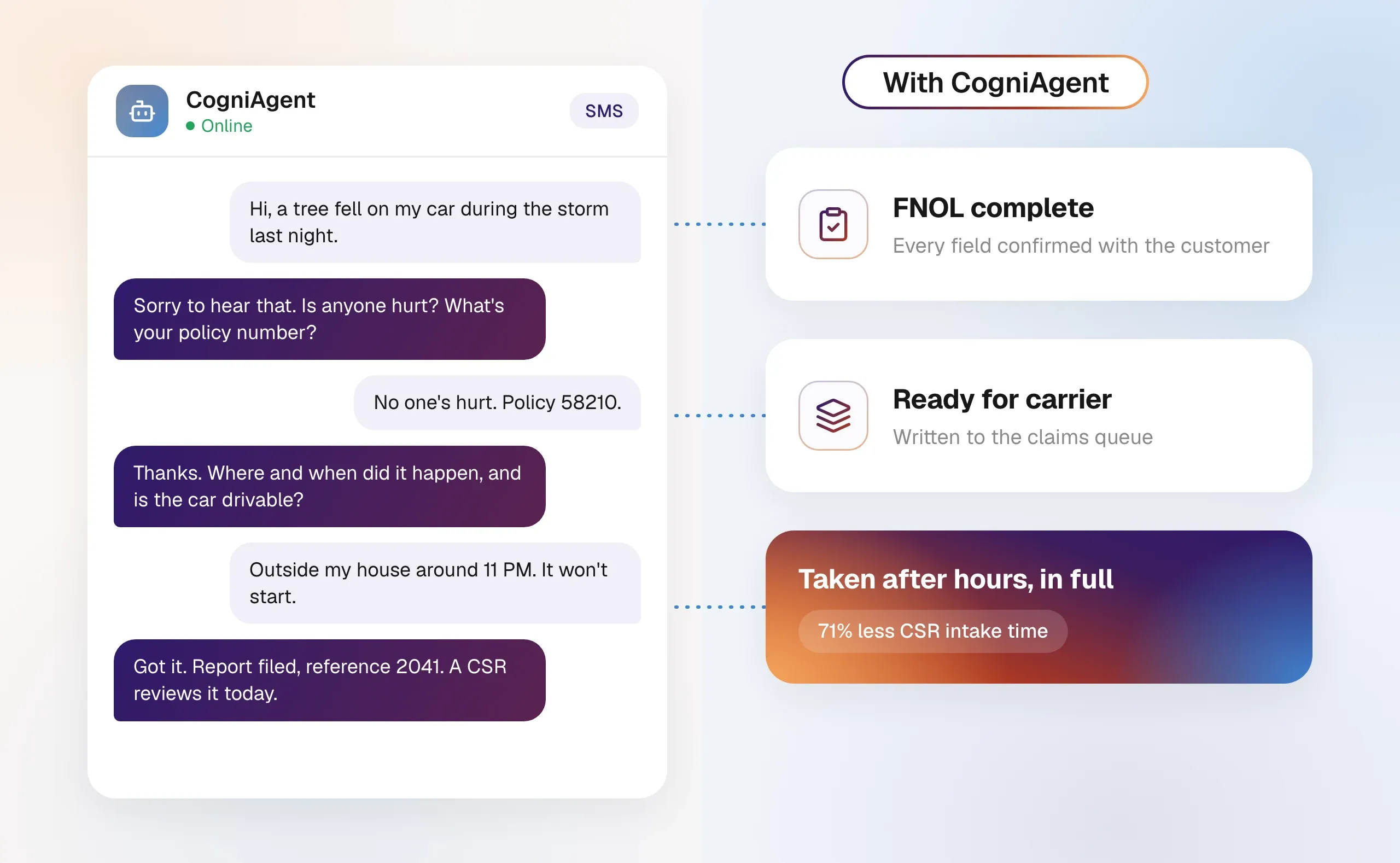
About 38% of FNOL contacts arrived after hours or on weekends. Customers left voicemails, and CSRs spent the next morning calling back to rebuild the details.
A complete FNOL took a CSR 18-25 minutes on the phone, followed by re-keying the same details into the carrier portal and the agency management system.
Missing items such as the police report number, the other driver's insurer, or the exact time of loss sent files back from carriers and delayed adjuster assignment.
Roughly 3,400 policy questions a month, most of them about ID cards, payment due dates, and deductibles, took CSR time away from renewals and coverage reviews.
A single hail event could triple claim contacts for a week, which meant overtime, long hold times, and customers who gave up and called the carrier directly.
We built the agency's intake and service workflow in CogniAgent Applications and deployed it on the website Web Widget, SMS through Twilio, and the shared Outlook claims inbox.
The rollout ran in three phases between February and April 2026: discovery with the claims and service leads, configuration and carrier-by-carrier testing, and go-live with a two-week period in which CSRs reviewed every automated conversation.
Licensed staff kept every coverage decision; the agent collects information and answers documented questions, and never confirms whether a loss is covered.
A Channel Dispatcher in responder mode listens on the Web Widget, Twilio SMS, and the claims inbox, so a customer can report a loss through whichever channel they reach first, at any hour.
A Communication Actor collects the agency's FNOL fields as a natural conversation: policy number, date, time and location of loss, loss type, description, injuries, police report number, and third-party details. It handles corrections mid-conversation and reads the summary back for the customer to confirm before submitting.
An LLM node extracts the collected details into structured output, and a Multi-Condition routes the report. Injuries, a possible total loss, or a liability dispute go straight to the on-call claims liaison with a full summary; standard reports move to carrier submission.
The completed report is written to the agency management system through an HTTP Request to its API and posted to the claims queue with the carrier, policy, and every required field filled, so CSRs review and submit instead of re-typing.
Search Knowledge answers routine questions from the agency's Knowledge Base: payment and grace-period rules, how to get an ID card, deductible explanations, and office procedures. Anything that requires a coverage interpretation is handed to a licensed CSR.
Send Message gives the customer a claim reference and next steps right away, then a follow-up once the carrier assigns an adjuster. Every conversation is logged to the customer record for audit.
| Before | After | |
|---|---|---|
| Claim intake time per FNOL | 18-25 min phone call plus re-keying | 6-7 min CSR review |
| After-hours loss reports | Voicemail, callback next morning | Taken in full, any hour |
| Carrier submission | Next business day | Same day, ~2 hrs on average |
| Files returned by carriers | 1 in 5 incomplete | 1 in 25 |
| Policy questions | All handled by CSRs | 64% answered by the agent |
| CSR time returned every month | 160+ hrs |
Structured conversational intake and automatic entry into the agency management system cut CSR time per FNOL from 18-25 minutes to about 6-7 minutes of review.
The 38% of FNOL contacts that arrived after hours are now captured in full while the details are fresh, instead of waiting in voicemail overnight.
Complete files reach the carrier in about two hours on average, so adjusters are assigned sooner and customers hear back faster.
Required fields are collected and confirmed in the conversation, so carriers sent back 1 in 25 files instead of 1 in 5.
ID card, payment date, and deductible questions are answered from approved documents, and coverage questions still reach a licensed person.
The team now spends that time on renewals, coverage reviews, and the complex claims that need a person. During a May 2026 hail event, the agency handled 3.1x its normal claim volume without overtime.


