Resolving 68% of Order-Status and Return Requests Without a Human: A Conversational AI Agent for an Online Retailer
 Oct 30, 2026
 5 min read
 Oct 30, 20265 min read
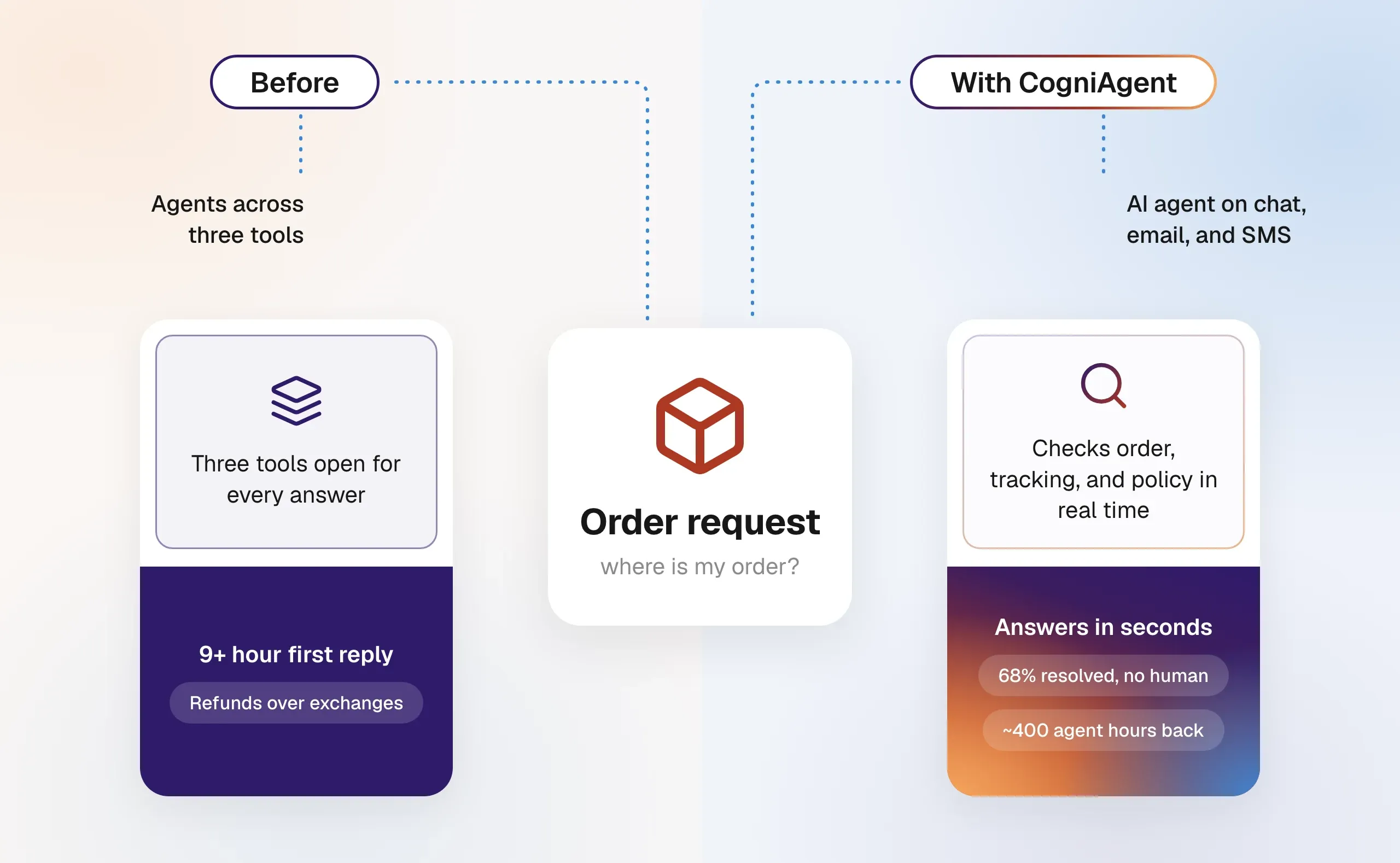
This client is a US direct-to-consumer outdoor apparel and gear retailer with about $38 million in annual revenue, selling through its own Shopify store and shipping around 37,000 orders a month from two fulfillment centers. Its support team of 14 agents, plus about 8 seasonal hires for the holiday peak, handled roughly 11,500 tickets a month across chat and email. Two kinds of requests made up 64% of that volume: "Where is my order?" (WISMO) questions and returns or exchanges. Each one meant opening Shopify, the carrier's tracking page, and the returns platform in separate tabs to answer a question the systems already had the answer to. First replies on email averaged more than nine hours, and refunds were issued in cases where an exchange would have kept the sale. The retailer needed routine order and return requests resolved instantly and correctly against its policy, with damaged, lost, or high-value cases reaching a person with the full context.
About 41% of all tickets asked where an order was, and each answer required looking up the order in Shopify and the carrier's tracking in a separate tool.
About 23% of tickets were returns or exchanges. Agents checked the return window and final-sale rules manually, then created the return in a separate returns platform.
Email first response averaged 9 hours 20 minutes, and many customers wrote a second time before anyone answered, adding to the volume.
Under time pressure, agents defaulted to refunds; only about 14% of return requests ended as exchanges, so the retailer lost revenue it could have kept.
Ticket volume more than doubled from November through early January, which meant hiring and training about 8 seasonal agents every year.
We built the retailer's order and returns workflow in CogniAgent Applications and deployed it on the Shopify store's Web Widget, the support Gmail inbox, and SMS through Twilio, connected to Shopify, the shipping carriers' tracking, and the returns platform. The rollout ran in three phases between February and March 2026: discovery with the support lead and a review of 1,000 historical tickets, configuration and policy testing, and go-live with agents reviewing a sample of automated conversations every day for the first month.
An LLM Actor confirms the customer's identity with the order number and email or ZIP code, then reads the order from Shopify through an Integration Action, so it only ever discusses the customer's own order.
The agent calls the carrier's tracking API through an HTTP Request and explains the status in plain language: where the package is, the expected delivery date, and what happens next if it is late.
Search Knowledge applies the retailer's return policy from the Knowledge Base, including the 30-day window, final-sale items, and worn-gear rules, and the agent creates an eligible return in the returns platform through an HTTP Request and sends the label.
For size and color returns, the agent checks stock in Shopify and offers an exchange before a refund, which keeps the sale when the customer only needs a different fit.
A Multi-Condition routes damaged items, packages stalled more than five days, orders over $250, and any frustrated or unclear conversation to a support agent, with an LLM-generated summary and the full transcript attached.
Each lookup, return, and handoff is logged to the customer's support history, and the conversation closes with a Send Message confirmation the customer can come back to.
| Before | After | |
|---|---|---|
| WISMO and return requests | 100% handled by agents | 68% resolved without a human |
| First response time | 9 hrs 20 min average on email | Under 1 minute |
| Time to issue a return label | Next business day | Instant for eligible orders |
| Return requests kept as exchanges | ~14% | ~27% |
| CSAT on these requests | 4.2 / 5 | 4.5 / 5 |
| Agent time returned every month | ~400 hrs |
About 5,000 of the 7,400 monthly order-status and return requests now close in the conversation, with the order, tracking, and policy checked in real time.
Customers get an accurate answer on the first contact instead of waiting more than nine hours, so second "any update?" emails dropped sharply.
Eligible returns are approved against the written policy and the label is sent in the same conversation, any hour of the day.
Offering an in-stock exchange before a refund raised the share of return requests kept as exchanges from about 14% to 27%.
CSAT on order and return conversations rose from 4.2 to 4.5 out of 5, while complex cases reach agents with a summary instead of a cold start.
The support team now focuses on damaged shipments, product advice, and VIP customers, and plans its 2026 holiday peak with 3 seasonal hires instead of 8.


