Cutting Reorder Cycles by 62% with an AI Replenishment Agent on Odoo
 Oct 07, 2026
 4 min read
 Oct 07, 20264 min read
This client is a US specialty home-and-gift retailer with nine physical stores, a direct-to-consumer web shop, and roughly $80 million in annual revenue. It carries about 18,000 SKUs across a central distribution center and store backrooms, selling through Shopify online and a separate point-of-sale system in-store.
The web shop, the stores, the warehouse, and finance each kept their own records, so the same SKU could show three different stock counts, and a single buyer set reorder timing and quantities from a spreadsheet. Tariff-driven demand swings had distorted two years of sales history, and rising store-labor rates made every hour of manual counting and reconciliation more expensive.
The retailer needed one accurate view of stock across every channel and replenishment that responded to live demand, reconnected without freezing sales across nine stores and a live web channel, and with buyers keeping the final sign-off on every purchase order.
The online store, the POS, and the warehouse showed different figures for the same SKU, which led to oversells and canceled orders.
A buyer set reorder timing and quantity from a spreadsheet, so bestsellers stocked out while slow movers piled up.
Tariff-driven demand swings distorted two years of sales history, and static min-max thresholds no longer matched how customers were actually buying.
Returns ran through email and manual credits, so refunded stock rarely made it back into sellable inventory on time.
POS, stock, and finance lived in separate tools, so sales trends and margin dips surfaced days after the window to act had closed.
Rising store-labor rates meant every hour a manager spent on manual counts and reconciliation cost more for the same result.
We moved the retailer onto a single Odoo database and added CogniAgent on top as the decision layer — Odoo became the clean system of record, and CogniAgent agents act on its live data. Reconnecting nine stores and a live web channel without freezing sales required careful sequencing, so the rollout ran in four phases between November 2025 and February 2026: discovery, configuration and migration, automation and CogniAgent, and go-live with two weeks of on-site support.
Odoo Sales, Inventory, Purchase, and Accounting replaced three disconnected tools. SKU, vendor, and open-order records from three sources were consolidated into one product master, so store, web, and finance work from the same data.
Event-driven webhook and API integration, with monitoring and error handling, keeps Odoo, Shopify, and the in-store POS in step, so stock counts match across channels.
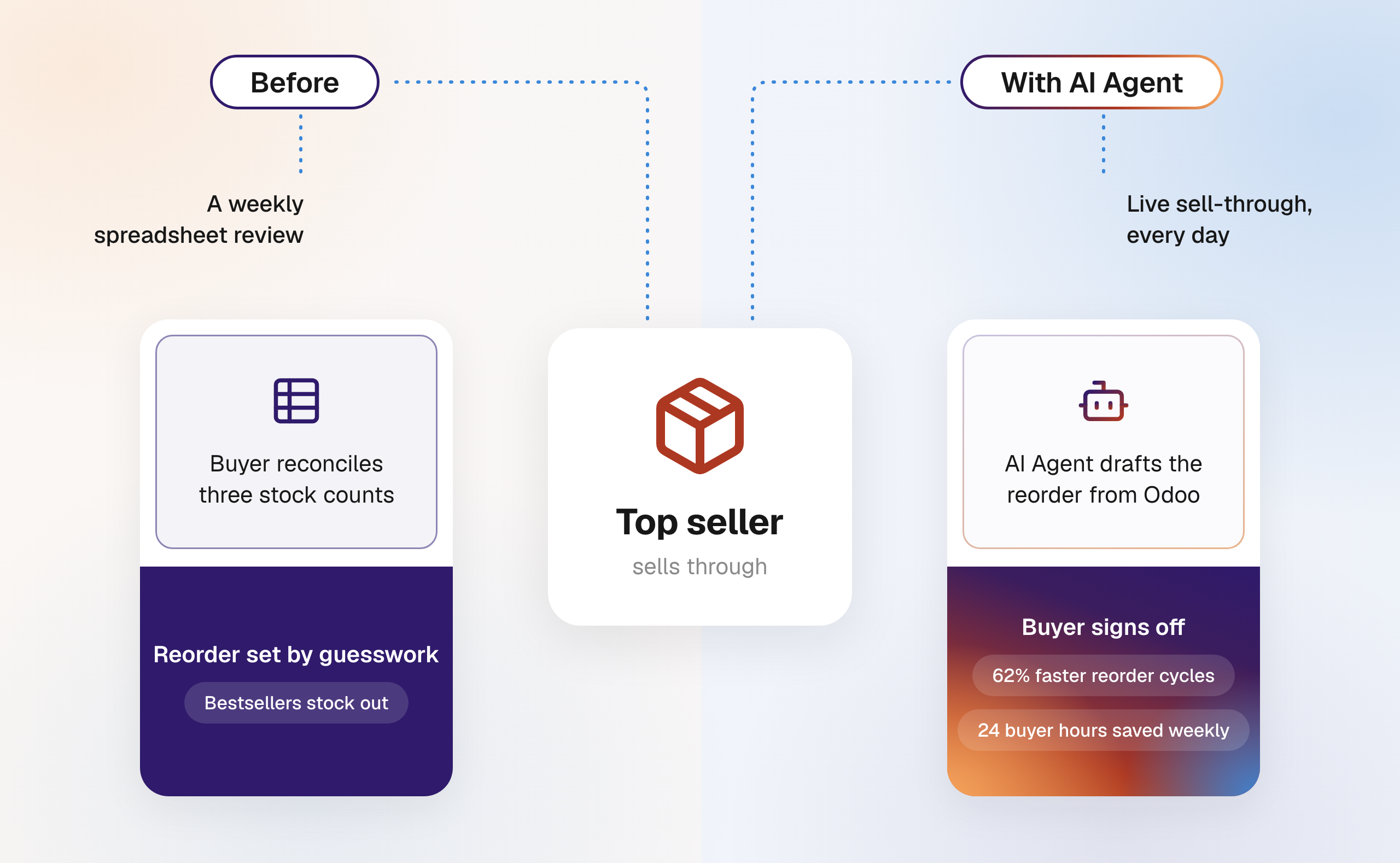
Connected to Odoo, a CogniAgent autonomous agent reads live sell-through and drafts replenishment orders on current demand. Buyers review and sign off on every order instead of building it from a spreadsheet.
Automated return workflow steps validate returned inventory before restocking, then coordinate reverse transfers and credit notes in Odoo, so refunded units are sellable again the same day.
A CogniAgent support agent works from the Odoo order record, giving service, sales, and fulfillment one shared view of every customer order.
Odoo chatter logs every action the agents and automations take for audit, and role-based access keeps store, merchandising, and finance teams working on live records with the right permissions.
| Before | After | |
|---|---|---|
| Reorder cycle | Weekly spreadsheet review | 62% faster |
| Overselling | Three stock counts per SKU | 96% decrease |
| Stockouts on top sellers | Bestsellers out, slow movers piling up | 41% fewer |
| Returns back to stock | Stranded in email and manual credits | Same day |
| Sales and margin trends | Visible days too late | Same day |
| Buyer time saved every week | 24 hrs |
CogniAgent reads live sell-through and drafts purchase orders on current demand, ending the weekly spreadsheet review that used to set replenishment timing.
With Odoo as the central inventory record, synchronized with Shopify and the POS, every channel sells against the same stock count.
Odoo replenishment logic, supported by CogniAgent demand signals, flags replenishment needs earlier, flattening the swing between empty shelves and dead stock.
Linked return and refund workflows recover sellable units that the manual email process used to strand.
With POS, stock, and finance on one platform, margin dips and demand shifts surface while the team can still reorder, promote, or reprice.
AI-drafted replenishment and automatic reconciliation removed the manual counts and report-matching that kept getting more expensive as store wages climbed.


