
The set-it-and-forget-it era of traditional automation has officially hit a wall. Your team might feel like it’s drowning in manual handoffs, and your automated sequences feel robotic to picky buyers. And more importantly (and frustratingly), despite your heavy tech spend, 86% of your sales reps are still guessing which tool they should be using for which task. In 2026, simply triggering an email based on a click is now the bare minimum.
Generative AI and autonomous agents have redefined the playbook, moving us from rigid if-this-then-that rules to intelligent systems that reason and adapt in real-time. Over 1.5 times as many of today’s workers are turning to AI agents to boost their creativity and performance, rather than settling for simple automation. And around 77% of marketers now use AI-powered automation capabilities to produce personalized content at scale. In other words, the gap between teams using next-gen tools and those still patching legacy platforms is widening.
Let’s explore AI tools for marketing automation that help you build a high-conversion stack that actually scales.
Why Your Stack Needs AI Marketing Automation Platforms in 2026
Do you know what’s the primary predictor of market share these days? The difference between “automated” and “intelligent.” Traditional platforms follow rigid rules to execute campaigns. Modern AI platforms for marketing automation interpret complex buyer behavior. They predict conversion likelihood and adjust messaging across every channel to increase the probability of converting. You can orchestrate hyper-personalized journeys that adapt in real time across every touchpoint using AI agents.
AI-powered lead scoring is now achieving up to 90% accuracy, allowing teams to focus exclusively on high-value opportunities. For teams managing complex funnels, AI handles predictive lead scoring and 24/7 campaign optimization — a workload that no human team can match consistently.
1.5x
more marketers now rely on AI agents daily
86%
of sales reps are still unsure which tool to use
2.245
GDPR fines were issued to businesses in a single year
How to Choose the Best AI Tools for Marketing Automation
Flashy features of an AI tool may catch your eye, but you should look beyond them to find the befitting solution. Not every AI marketing platform belongs in your stack. Before committing to a contract, zero in on these three pillars to save yourself a high-ticket mistake.
Integration capabilities
An AI tool is only as effective as the data it can access. It must offer seamless, bi-directional sync with your CRM to ensure marketing triggers are based on real-time customer behavior. Verify that it integrates natively with your CRM, CDP, and ad platforms; otherwise, you’re buying intelligence that operates in a silo.
Data privacy and compliance
GDPR and CCPA compliance is non-negotiable. Last year, regulators issued over 2,245 GDPR fines totaling approximately €5.65 billion (with marketing automation practices frequently in the crosshairs). Ensure the vendor provides transparent data processing agreements and robust encryption to protect sensitive lead intelligence.
Autonomous vs. assistive AI
Assistive AI acts as a co-pilot for content and scheduling, while autonomous AI can optimize entire workflows independently. Under GDPR Article 22, fully automated decisions based on profiling may require explicit consent and the transparent disclosure of the underlying logic. Know what level of human oversight your compliance posture and your team require.
Top 10 AI Marketing Automation Platforms Comparison
Speed and personalization now define success, making AI marketing automation a competitive must-have. These platforms use machine learning to streamline workflows, optimize ad expenses, and deliver hyper-targeted customer experiences. For both small startups and large corporations, selecting the best AI marketing tool means weighing advanced capabilities against ease of use. Let’s break down the top 10 industry leaders to help you find the perfect engine for your digital growth and get ahead in 2026.
#1 CogniAgent — cogniagent.ai
Founded: 2024 | USA (built by Glorium Technologies)
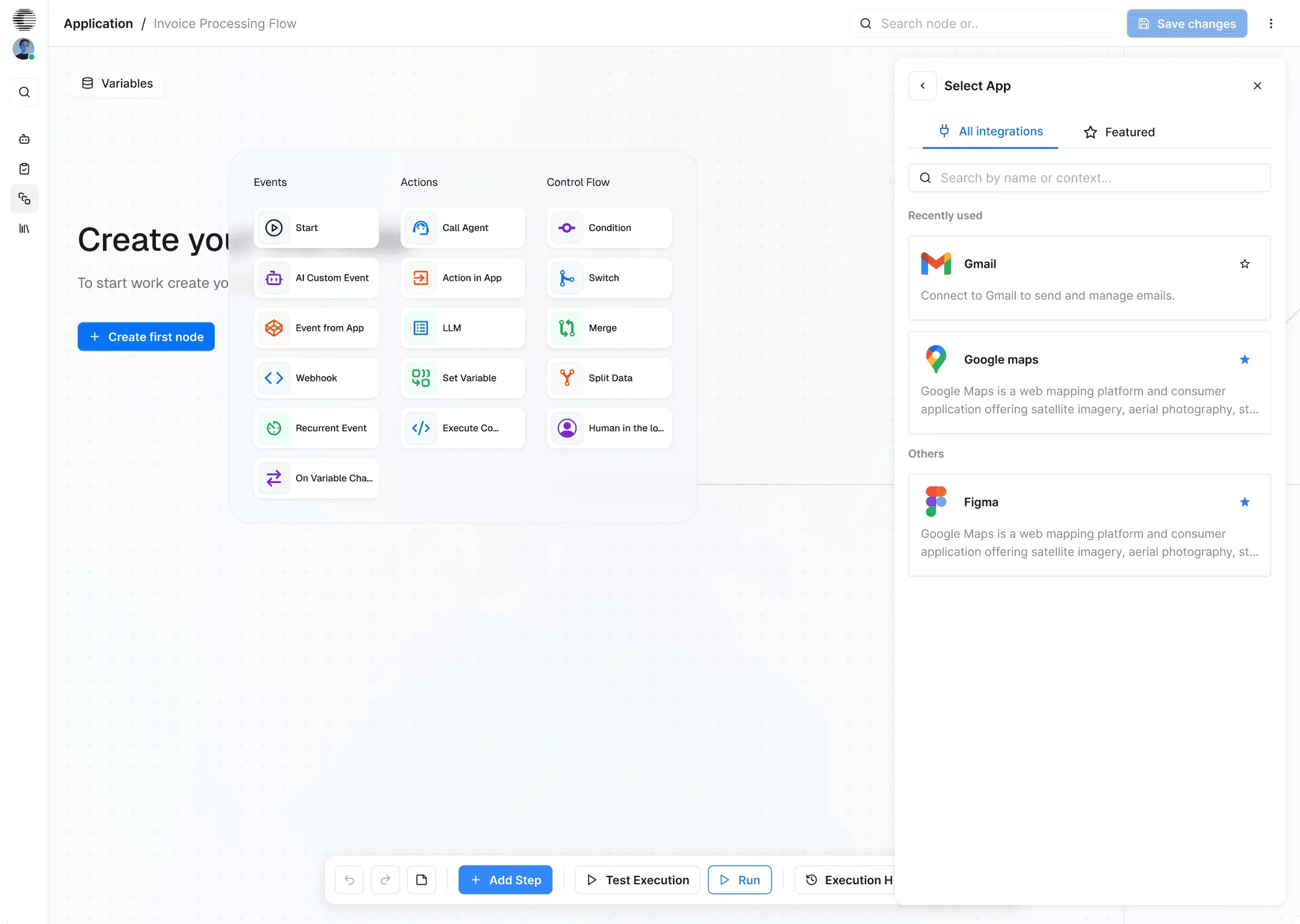
It is a cognitive AI marketing tool that goes beyond rule-based automation. Its agents reason, adapt, and execute multi-step marketing workflows autonomously across your entire marketing stack. Born from repeated client frustration with rigid, underperforming automation tools, it was built to replace fragmented execution with always-on intelligence. With 2,700+ native integrations and expert-guided onboarding, most teams reach production within 2–3 weeks.
Key features:
- Voice-enabled agents with real-time emotional intelligence and sentiment-adaptive responses
- Event-driven architecture that triggers and adjusts based on live business signals
- Coordination of marketing efforts across multiple channels (lead capture, CRM sync, email sequencing, and reporting, fully automated)
- Autonomous competitor monitoring and market trend detection
Use cases: Growth teams cutting reporting overhead; eCommerce businesses automating abandoned cart recovery; B2B SaaS building always-on lead qualification pipelines.
Best for: Marketing agencies, mid-market SaaS, and enterprise teams needing autonomous AI execution without sacrificing oversight.
Pricing: Free plan available. Paid plans start at $38/month (credit-based).
#2 Relevance AI — relevanceai.com
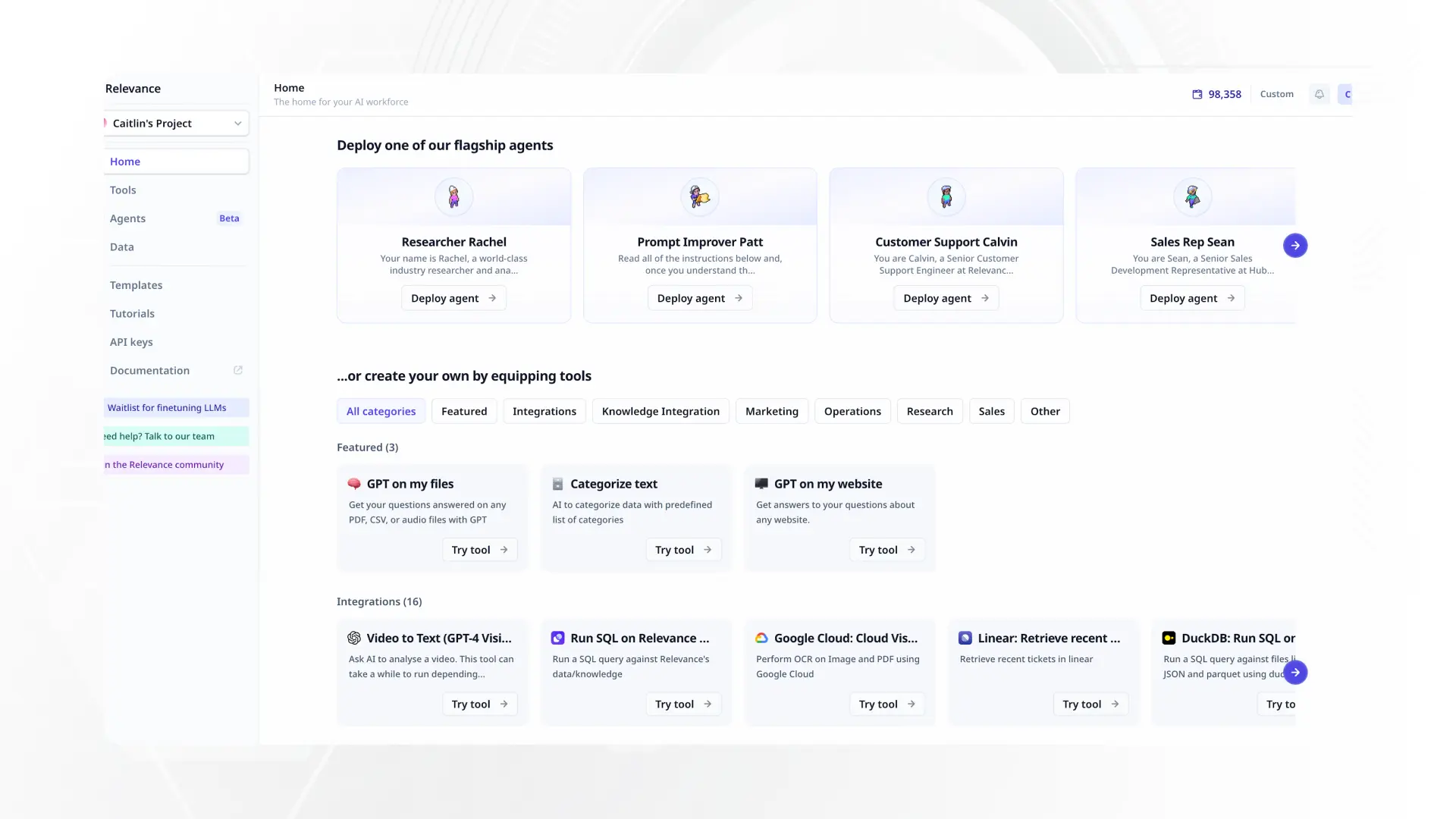
Relevance AI is an AI-driven marketing platform that functions as a workforce operating system — marketing teams build specialized agent “crews” that collaborate like human employees across inbound, outbound, and onboarding workflows. The multi-agent “Workforce” system lets non-technical users deploy entire GTM pipelines without writing code, and AI doesn’t require model expertise to configure.
Key features:
- Multi-agent system where agents hand off tasks across complex GTM processes
- Connections across Salesforce, HubSpot, Zapier, Gmail, and more
- Knowledge storage that agents reference and learn from during execution
- Full version history with instant rollback
Use cases: Automated account research; content and SEO workflows; customer support automation.
Best for: B2B sales and brand teams at growth-stage SaaS and enterprise companies.
Pricing: Free plan (200 actions/month). Pro from $19/month. Team at $199/month. Enterprise: custom.
#3 Lindy — lindy.ai
Founded: 2023 | USA
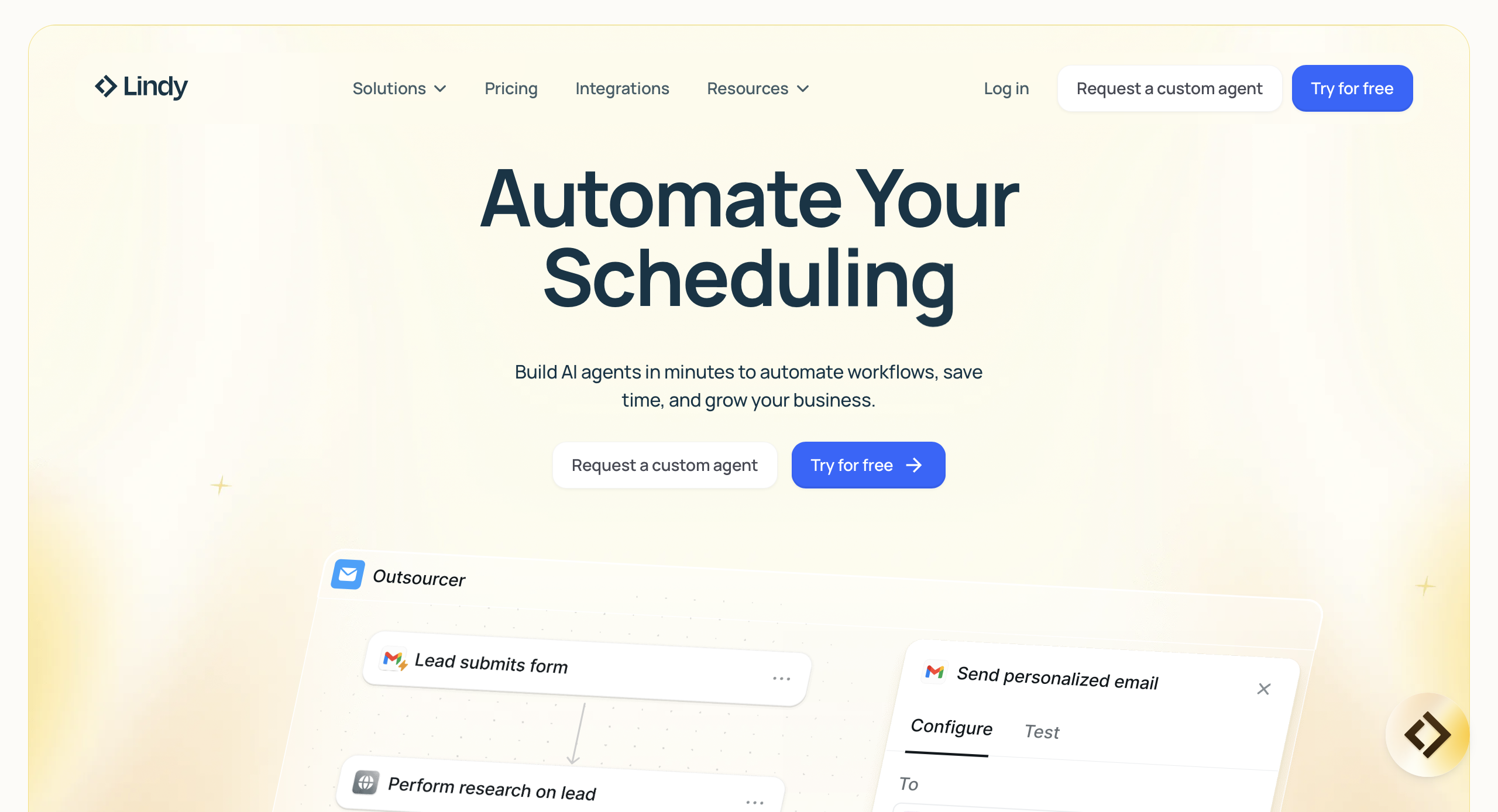
Lindy is an AI assistant built on a clear premise: workflows automate steps, agents own outcomes. Each “Lindy” reasons across email, CRM, calendar, phone, and Slack, acting without waiting for a human trigger. It’s AI-native from the ground up with built-in short- and long-term memory, making it one of the more intuitive platforms for non-technical teams.
Key features:
- Agent-to-agent communication for complex multi-step delegation
- Computer use (browser automation) that extends beyond API-dependent workflows
- 5,000+ integrations via Pipedream Connect
- SOC 2, HIPAA, and GDPR compliance with enterprise SSO
Use cases: Inbound lead qualification; AI-driven sales outreach and follow-up; customer support triage; inbox and calendar management.
Best for: Revenue ops teams at growing SMBs and mid-market companies.
Pricing: Free (400 credits/month). Pro at $49.99/month. Enterprise at $199.99/month.
#4 Gumloop — gumloop.com
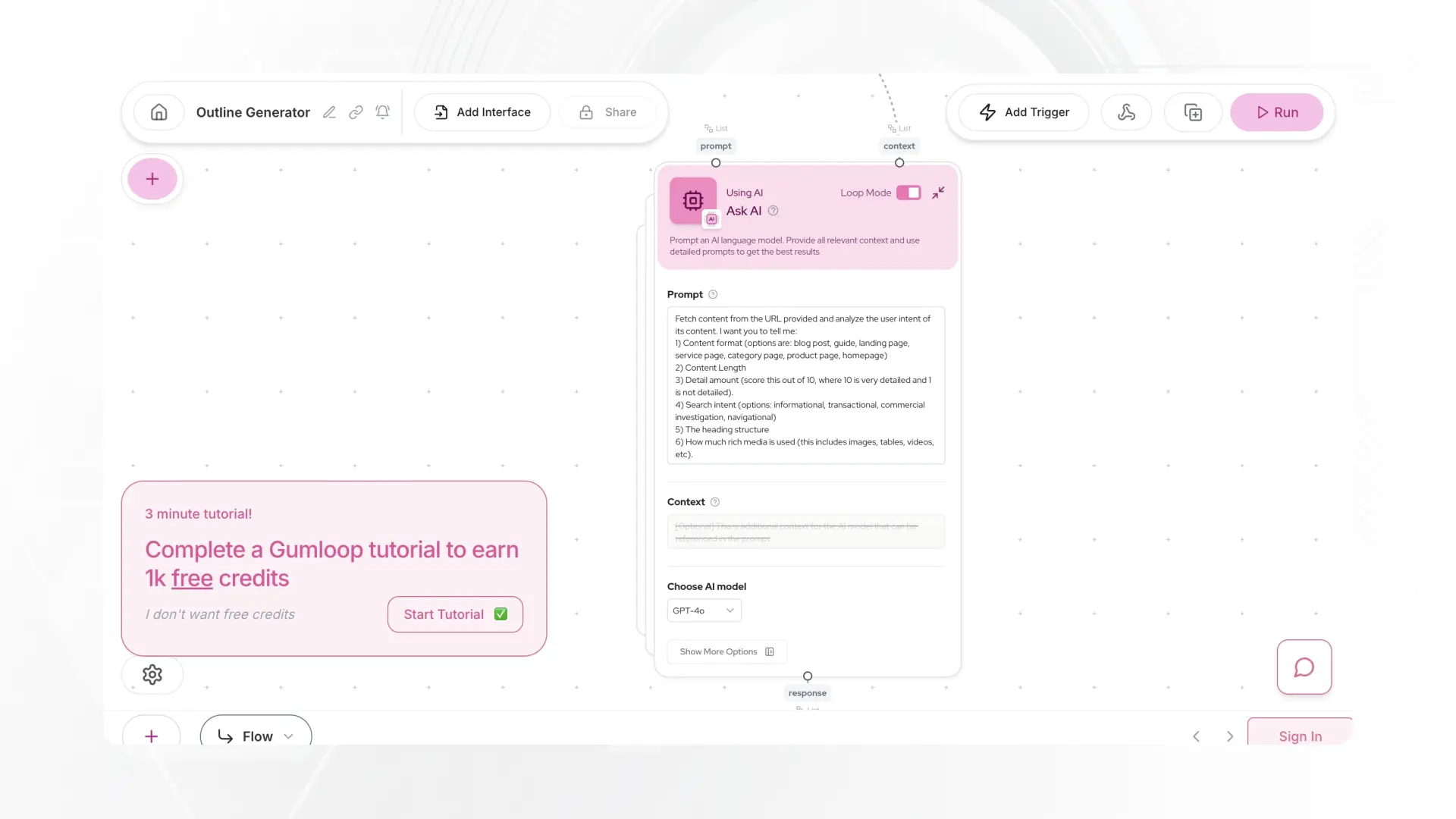
Founded: 2023 | Canada
Gumloop is the tool that helps technical marketers build serious workflow depth without engineers. Its canvas-based builder connects LLM calls, data sources, and business logic into parallel-executing pipelines.
Key features:
- Native LLM nodes with no extra API key setup
- Gummie AI assistant builds workflows from natural language descriptions
- Chrome extension for browser-based data extraction
- SOC 2, HIPAA, GDPR, SSO, SCIM, and audit logs
Use cases: Competitive intelligence pipelines; SEO research; lead enrichment and scoring; multi-source data extraction.
Best for: Marketing operations teams, growth agencies, and technical marketers who need advanced AI capabilities without writing code.
Pricing: Free (2,000 credits). Paid plans start at $37/month. Enterprise: custom.
#5 n8n — n8n.io
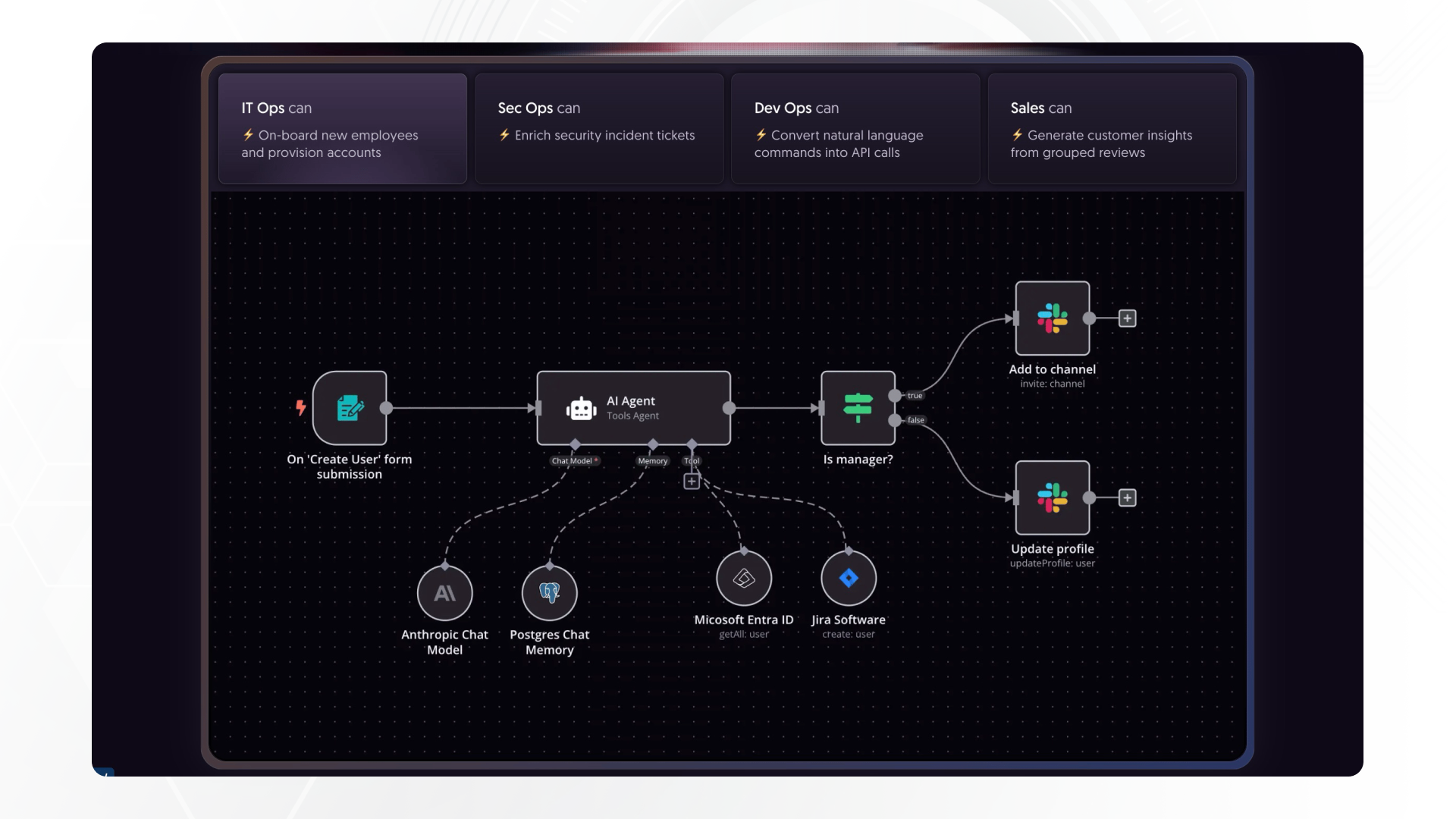
Founded: 2019 | Germany
n8n is open-source automation software that gives technical marketing divisions complete control over how AI pipelines are built, hosted, and governed. Its “fair-code” licensing allows self-hosting with full data sovereignty, which makes it a go-to for regulated industries or teams with strict security postures.
Key features:
- Native AI Agent node for multi-step autonomous workflows with OpenAI and LangChain
- 500+ integrations including all major CRM, analytics tools, and ad platforms
- Custom JavaScript execution within any node
- Self-hosting with encrypted secrets and role-based access control
- Community marketplace with thousands of pre-built templates
Use cases: Custom lead-to-CRM enrichment; automated content distribution; email marketing; data governance.
Best for: Technical marketing ops and RevOps engineers requiring self-hosted AI automation with full infrastructure control.
Pricing: Free (self-hosted, unlimited). Cloud Starter from ~€20/month. Enterprise: custom.
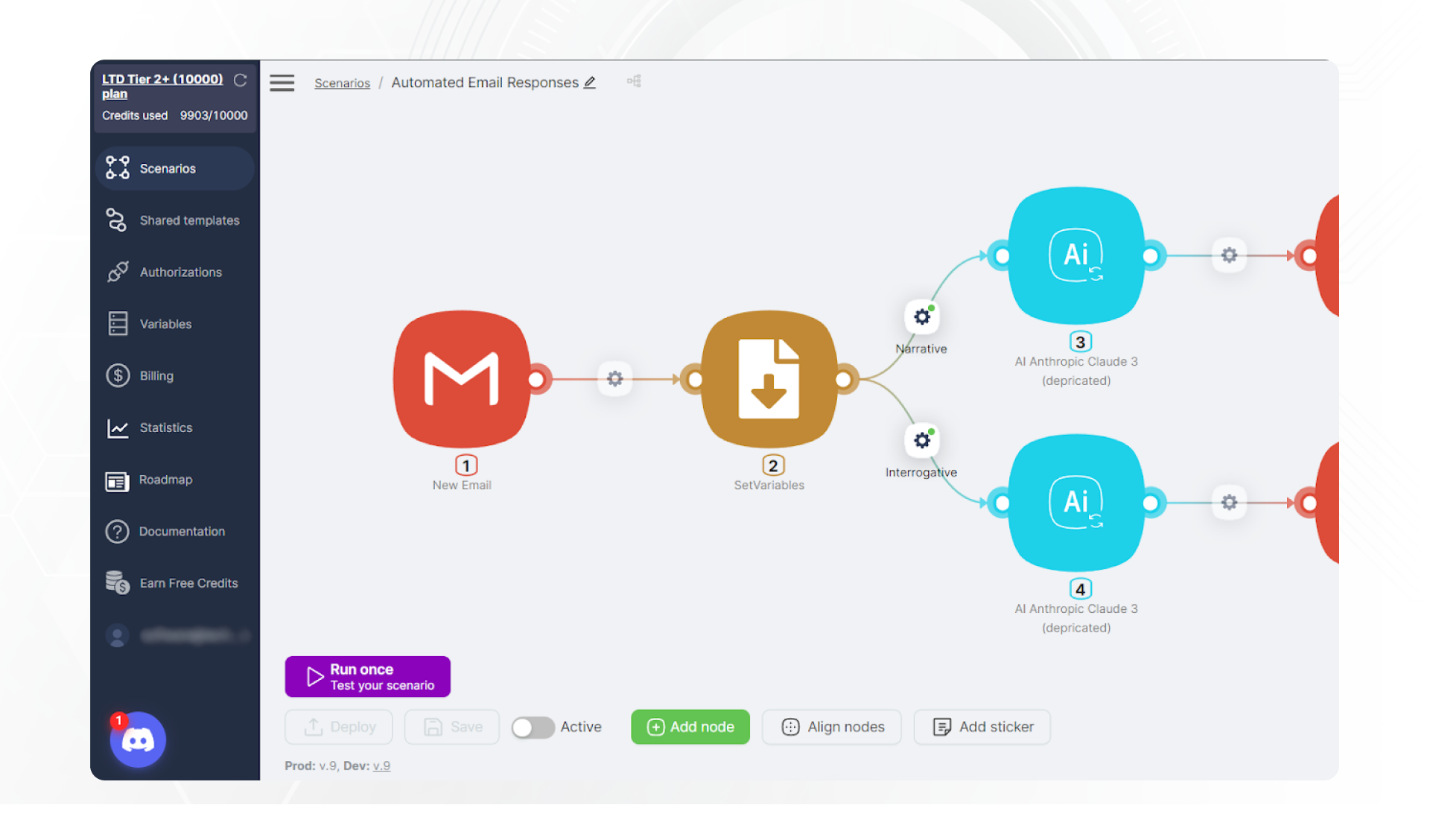
#6 Make — make.com
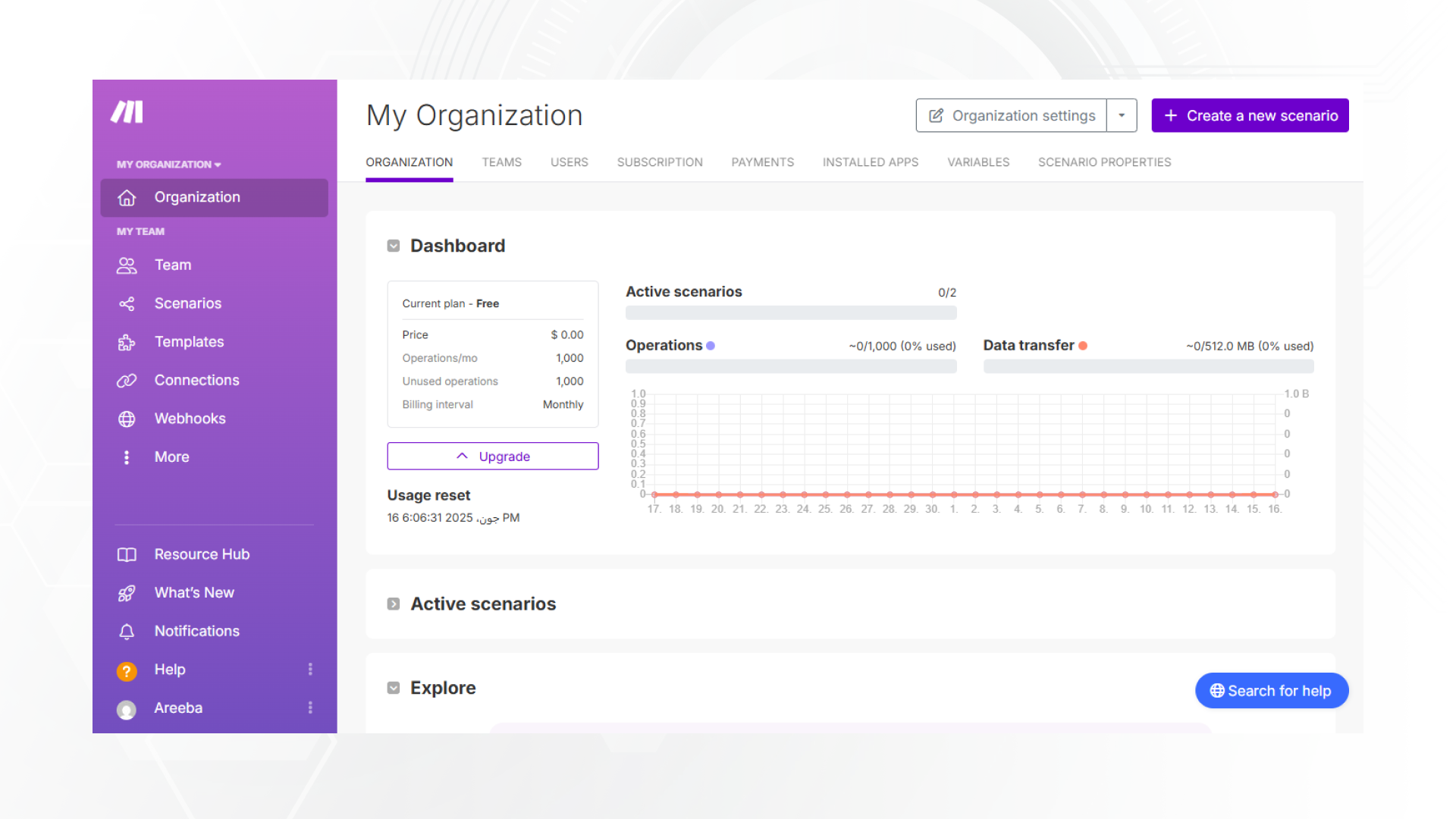
Founded: 2023 | Czech Republic
Make is a visual automation platform connecting 3,000+ apps through its “scenario” builder – a drag-and-drop canvas where data flowing across marketing channels is visible at every step. Originally Integromat, it was acquired by Celonis in 2020 and added native AI Agents in April 2025. Serving 350,000+ organizations globally, it suits teams managing complex multi-step marketing campaigns that demand precision over simplicity.
Key features:
- AI agents executing intelligent tasks within automation scenarios
- Real-time data flow visualization for debugging campaigns across multiple channels
- Error handling and conditional routing for mission-critical workflows
- Celonis-backed infrastructure with enterprise security and compliance
Use cases: Multi-source lead capture; customer lifecycle automation; email automation across CRM and ad platforms; AI-assisted content routing.
Best for: Marketing ops experts and agencies managing high-volume workflows.
Pricing: Free plan available. Core plans start at $9/month. Enterprise: custom.
#7 Activepieces — activepieces.com
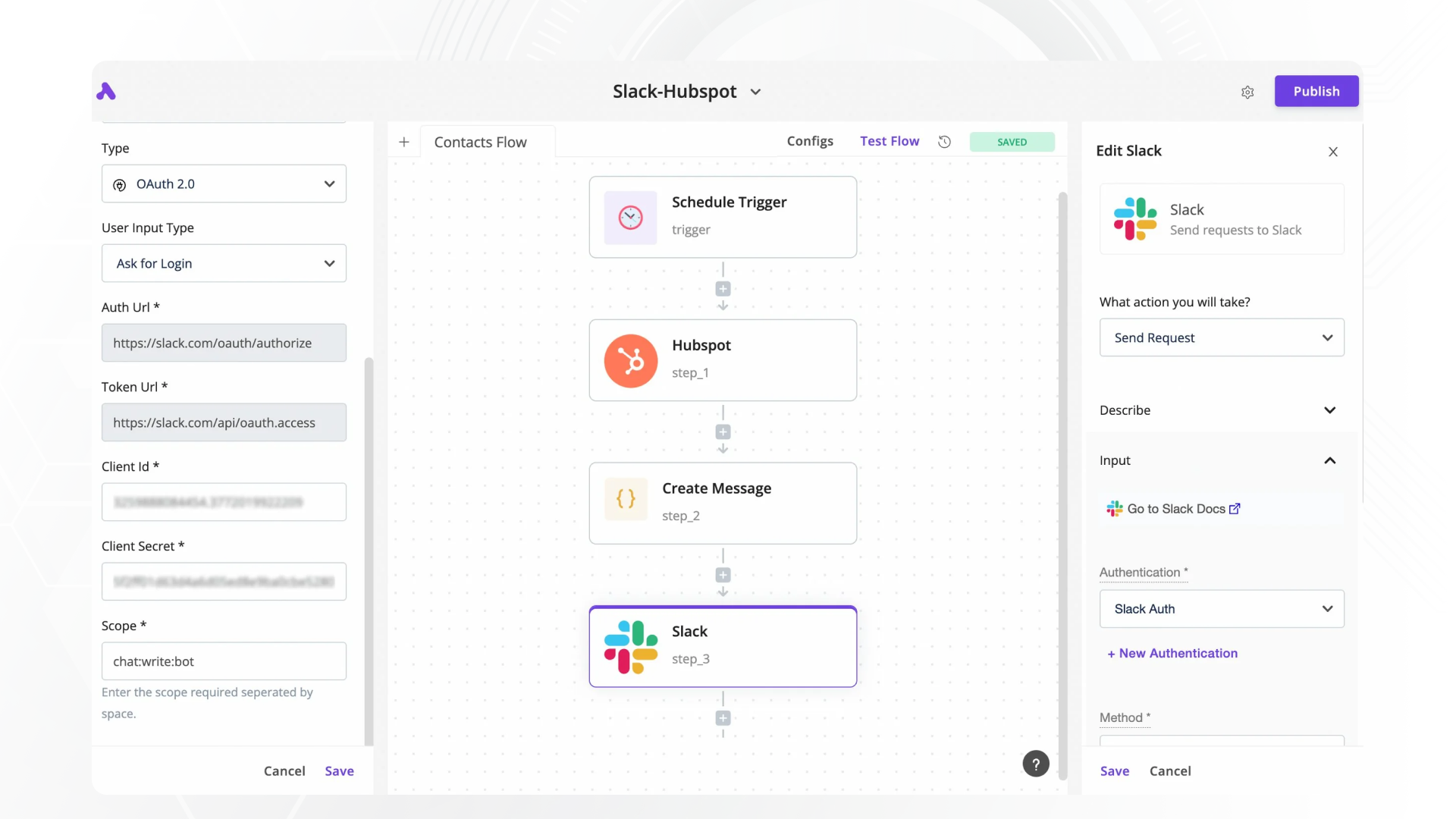
Founded: 2022 | USA
Activepieces is a MIT-licensed platform ideal for teams unwilling to pay Zapier-scale pricing or manage technical overhead. The native AI Agent framework, enhanced in mid-2025, lets users leverage AI for autonomous decision-making within standard workflow logic.
Key features:
- Modular Connector Protocol support for agent-to-application interaction
- Direct integration with AI models without separate API keys
- 450+ connectors with open-source community contributions expanding coverage
- Self-hosted Community Edition via Docker for data privacy
Use cases: Lead capture and CRM sync; AI writing and content repurposing workflows; email campaigns and social notifications; teams migrating from Zapier or Make.
Best for: Medium and small businesses, startups, and lean teams wanting unlimited task execution.
Pricing: Free (1,000 task executions/month). Business at $150/month. Enterprise: custom.
#8 Latenode — latenode.com
Founded: 2022 | USA
Latenode sits between no-code simplicity and full developer control. It is billed by execution time rather than per operation, bundling 400+ AI models into the platform, and offering full JavaScript with NPM access inside a visual builder. Its built-in machine learning memory and adaptive reasoning make it well-suited for dynamic, multi-step campaigns that basic automation tools can’t handle.
Key features:
- 400+ built-in AI models with no separate API key management
- Full JavaScript + NPM support inside a visual drag-and-drop builder
- Built-in agent memory and adaptive reasoning for context-aware workflows
- Execution-time billing: costs don’t spike with high-volume automation
Use cases: Personalized outreach across multiple channels; AI-powered content pipelines; dynamic data transformation; custom lead scoring with embedded LLM calls.
Best for: Marketing teams with some technical capability needing AI model flexibility without full developer tooling.
Pricing: From $17/month. Enterprise: custom.
#9 Zapier — zapier.com
Founded: 2011 | USA
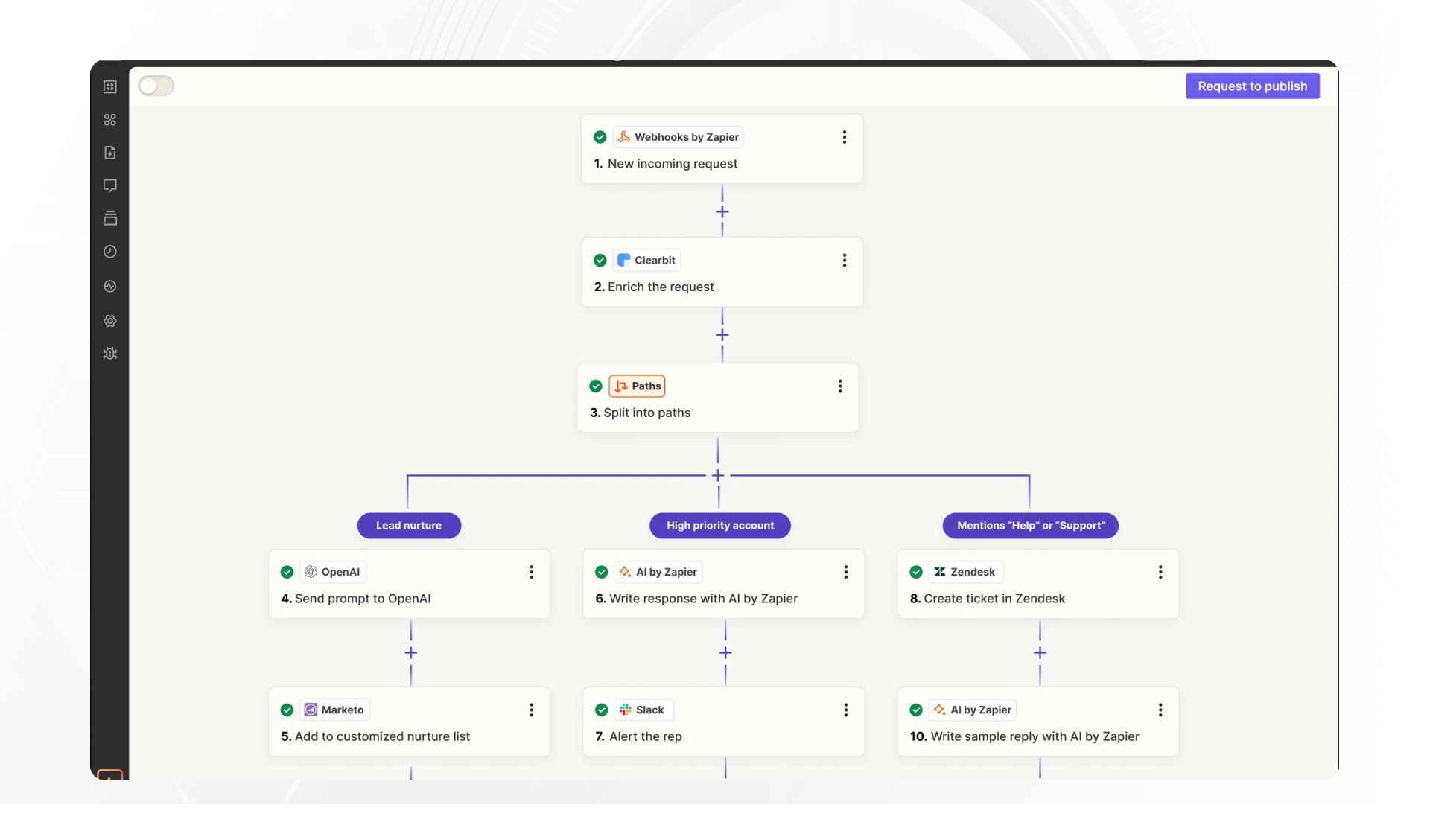
With 7,000+ app connections and an AI-powered Zap builder, it helps marketers move fast across email, CRM, ads, and beyond without touching code. Zapier delivers real value for teams that need broad connectivity over advanced AI autonomy. Its Canvas planning tool is particularly useful for mapping existing marketing workflows before rebuilding them with AI.
Key features:
- Native AI actions like text generation, data summarizing, etc.
- Workflow creation following plain-language descriptions
- Connections to 7,000+ apps across every major marketing channel
- Zapier Tables and Interfaces for lightweight data management
Use cases: Lead capture to CRM; email campaigns and follow-up sequences; cross-platform reporting.
Best for: SMBs and agencies that prioritize integration breadth and fast setup over deep AI orchestration.
Pricing: Free plan (100 tasks/month). Professional from $19.99/month. Team and Enterprise plans are available.
#10 CrewAI — crewai.com
Founded: 2023 | USA
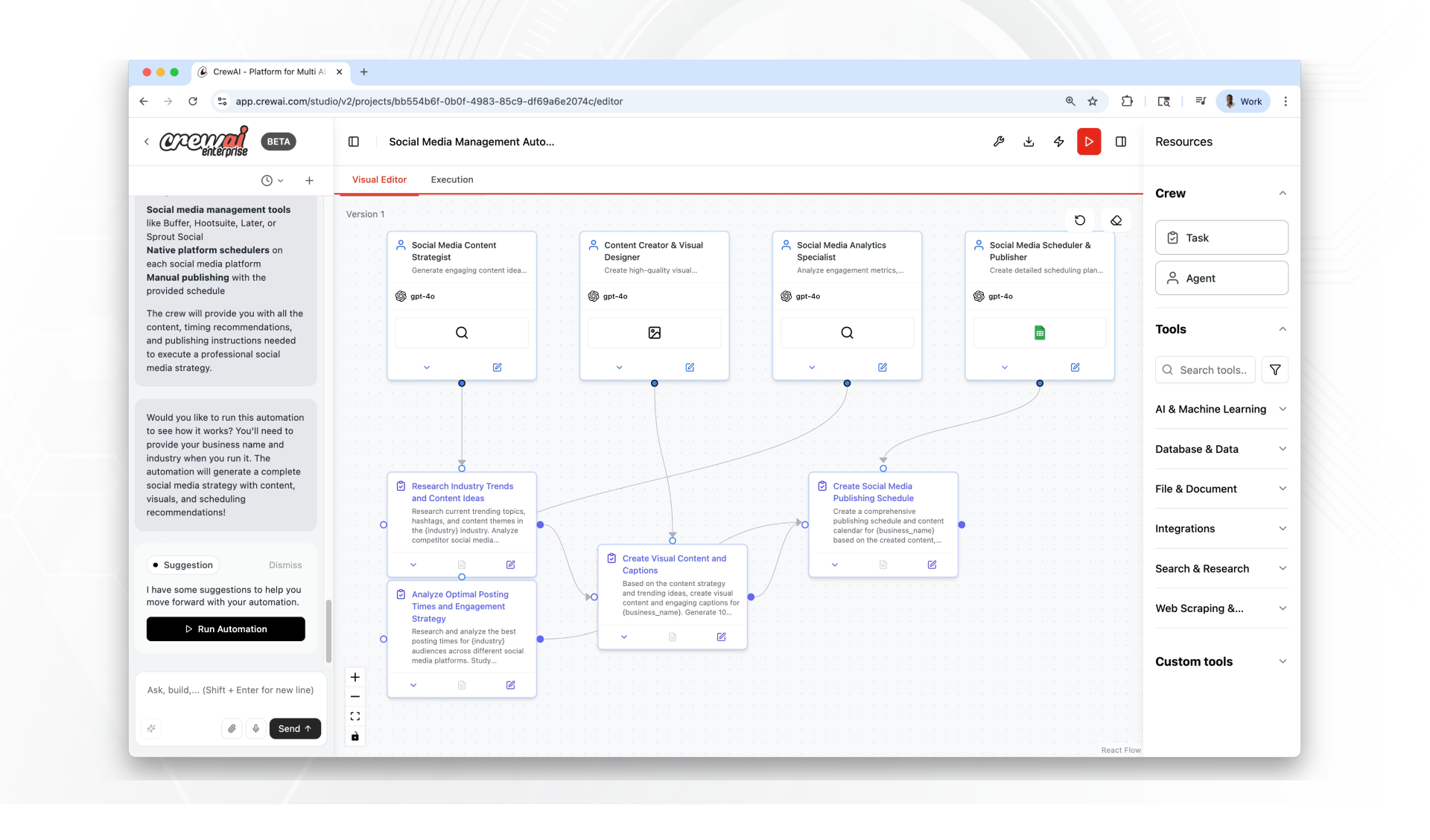
Where most platforms run a single agent per workflow, CrewAI coordinates an entire “crew” — a researcher, writer, reviewer, and publisher operating autonomously within one pipeline. Its dashboard gives teams visibility into what each agent is doing and when. As of 2025, over 100,000 developers have built on its open-source framework.
Key features:
- Role-based multi-agent architecture with collaborative task handoffs
- Supports all major AI models like Claude, Gemini, and Mistral
- Agent memory persistence for context-aware, long-running campaigns
- Pre-built marketing crews for research, content marketing, and SEO
Use cases: End-to-end content production pipelines; competitive intelligence; multi-step campaign planning; personalization at the account level to improve customer journey and reduce churn.
Best for: Enterprise demand generation teams and AI-savvy agencies building sophisticated multi-agent workflows.
Pricing: The open-source framework is free. CrewAI Enterprise: custom pricing with managed hosting and compliance features.
The Future of Marketing Runs on Agents
Marketing automation AI tools have moved the bar for what lean teams can accomplish. The right platform cuts manual execution, surfaces actionable insight from customer data, and keeps campaigns running across every channel without adding headcount.
Choosing the right tool depends on where your company is. Early-stage teams can benefit from assistive platforms, but scaling organizations need autonomous agents that own outcomes.