Stop Losing Kitchen Staff to Whoever Replied First
Every stage of hiring - from first reply to shift confirmed - runs without pulling you off the line.

Texts Back Before the Shift Changes
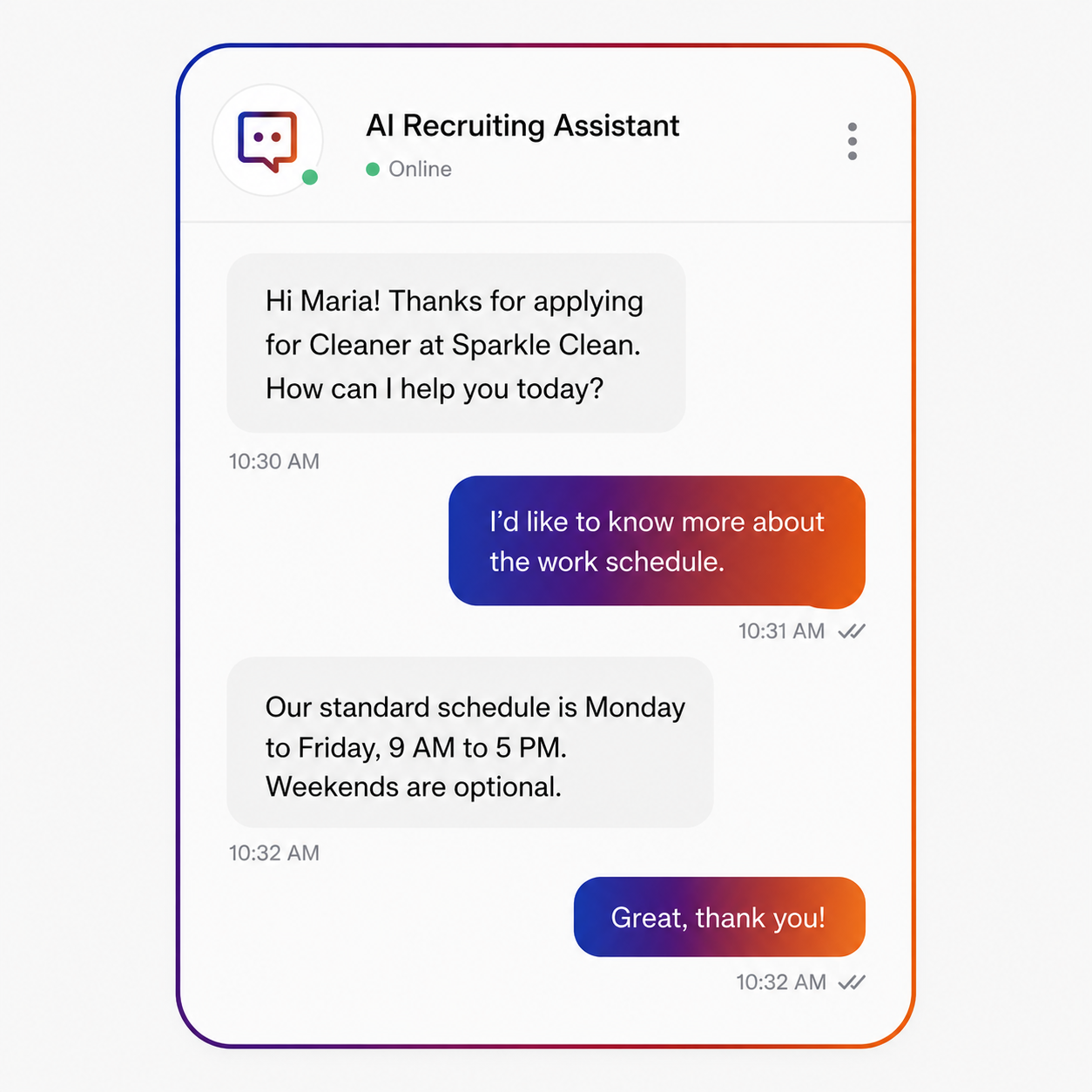
Instant application acknowledgment, channel confirmation, role context delivery (FOH, BOH, or management), applicant intent capture.

FOH, BOH, or Late Night — Shift Coverage Matched
Shift preference capture (breakfast, lunch, dinner, late-night), weekend and holiday coverage fit, full-time vs. part-time intent, split-shift and double-shift availability.

Interview Booked Before They Text Another Restaurant
Available slot offer, candidate selection, calendar block, confirmation to both candidate and hiring manager, automated no-show rebook flow.

Food Handler Certified and Legal Before Day One
Food handler or food manager certification collection and status check, legal right-to-work confirmation, age verification for alcohol service roles, tip-pool eligibility where applicable. Background-check jurisdiction-appropriate disclosure delivery, timestamped consent capture, document upload prompt, compliance log update.

First Call When a Shift Opens Up
Pre-screened candidate pool tracking, certification expiry watch, new-opening outreach for candidates who cleared screening but weren't hired, availability refresh, shortlist delivery.
Every Hiring Bottleneck in a Restaurant — Addressed
The Bottleneck
What the Agent Does


Managers stuck on the floor during the rush
Managers are on the floor during the lunch rush when applications come in. By the time anyone checks Indeed, the candidate has already accepted a shift at the restaurant down the street.

Sub-minute response at any hour
Every application gets a response within seconds — same speed at 11 a.m. service rush as at 11 p.m. close. No inbox to drain, no off-hours backlog.
Food handler checks fall on admin
Food handler certification checks fall on whoever is covering admin. Confirming card status, expiry, and jurisdiction takes time nobody has between covers.
Certification capture inside the conversation
Certification capture and validation happens inside the screening conversation. The agent collects card number and expiry, flags gaps before any manager sees the file.
Screening consistency drifts across shift managers
Screening consistency breaks down when delegated across shift managers. One manager cares about weekend availability; another doesn't ask. Unqualified applicants reach the interview stage.
One configured screening bar
One configured screening bar applied to every applicant, by every channel, regardless of which manager is on duty. Criteria are set once and held.
Pre-screened candidates disappear
A pre-screened server or cook who wasn't hired in round one disappears. When the next opening appears, the search starts from zero.
Continuous pool re-engagement
Continuous pool re-engagement. When a new position opens, the agent re-verifies certification status and current availability for every candidate already in the pipeline.
Applications scattered across job boards
Applications scatter across Indeed, Snagajob, walk-ins, and referrals. Each channel has its own response logic, and the audit trail lives in three different inboxes.
One flow, one record per applicant
One screening flow, one structured record per applicant. Every source routes into the same agent and produces the same output format.
Seasonal volume spikes overwhelm peak service
Seasonal volume spikes — summer, holidays, spring break — overwhelm the same team that's already managing peak service periods.
Scales instantly with volume
The agent scales instantly with volume. A hundred applications during a hiring push get the same response quality as ten on a quiet Tuesday.
From Your Current Process to a Live Recruiting Agent
No developer, no HR specialist, no long implementation project. Most restaurant operators have a working agent live within a week.
Your Restaurant Recruiting Agent in Action
Single canvas, certification validation, calendar booking, ATS write — no/low code.
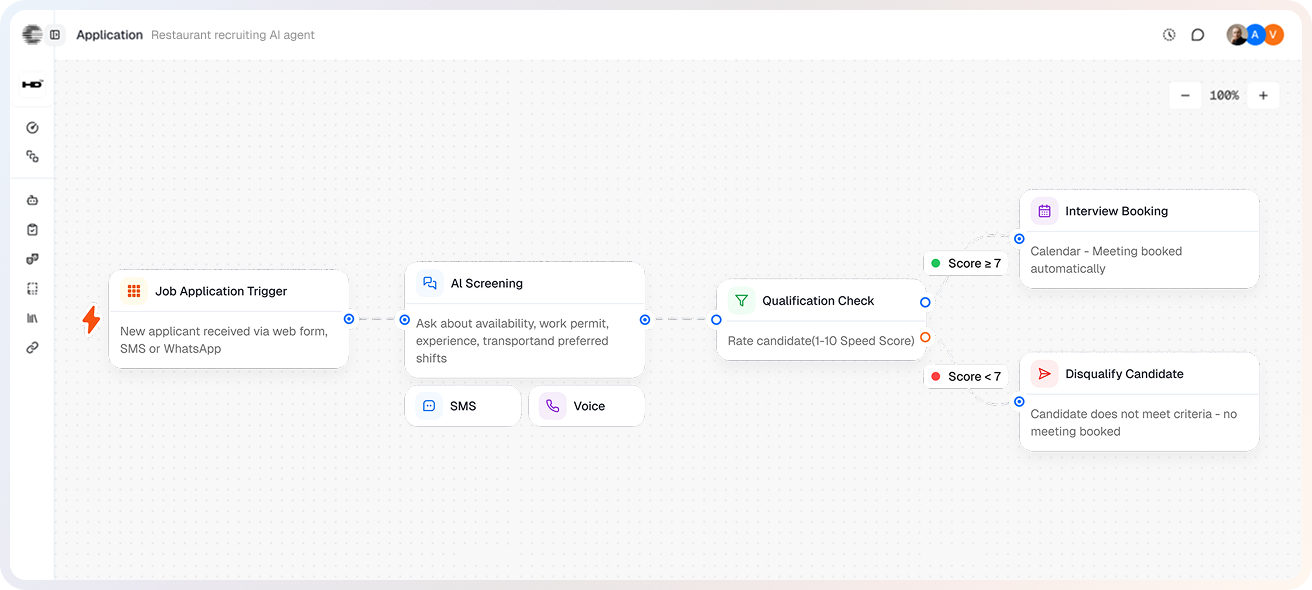
One Agent. Every Channel Your Applicants Actually Use.
Restaurant job seekers are mobile-first. The agent meets them where they already are, in the language they're most comfortable with.
SMS
The highest-response channel for hourly applicants. Text response rates run roughly 8x higher than email in high-volume hourly hiring (Carv, 2025). Full screening and interview booking over text alone.
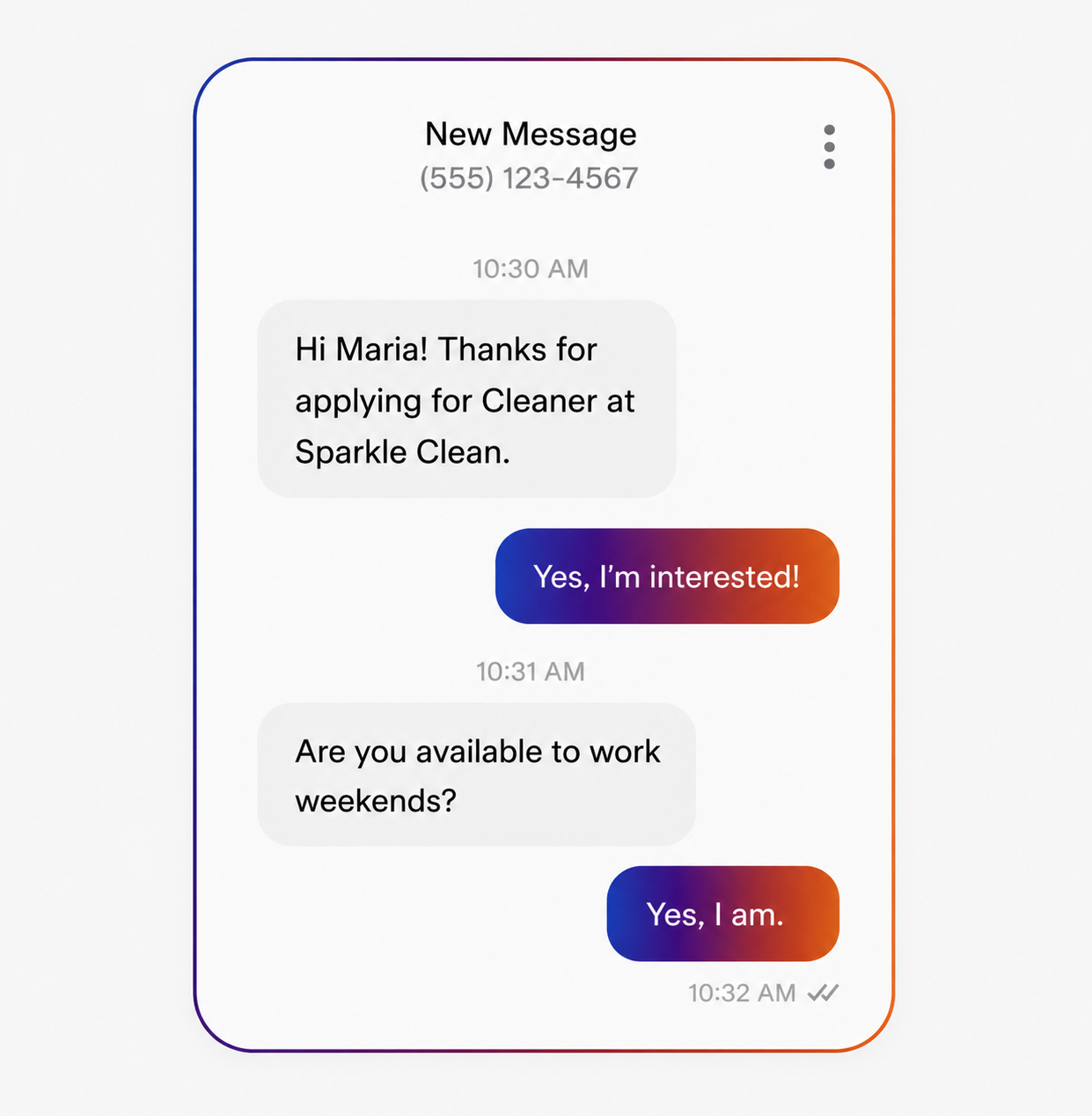
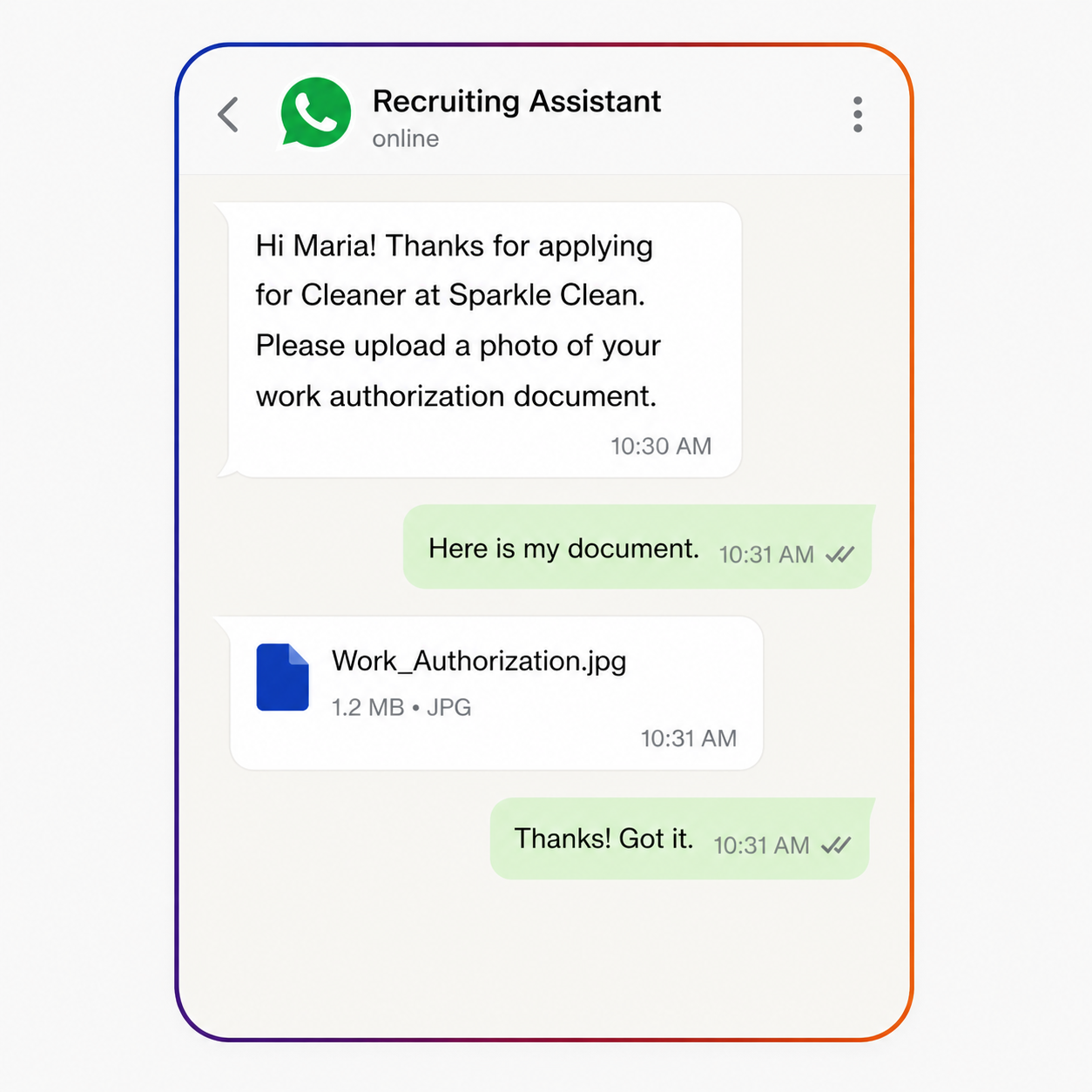
The default channel in many urban communities and immigrant populations where restaurant staffing concentrates. Certification photo upload and document submission handled inside the same conversation thread.
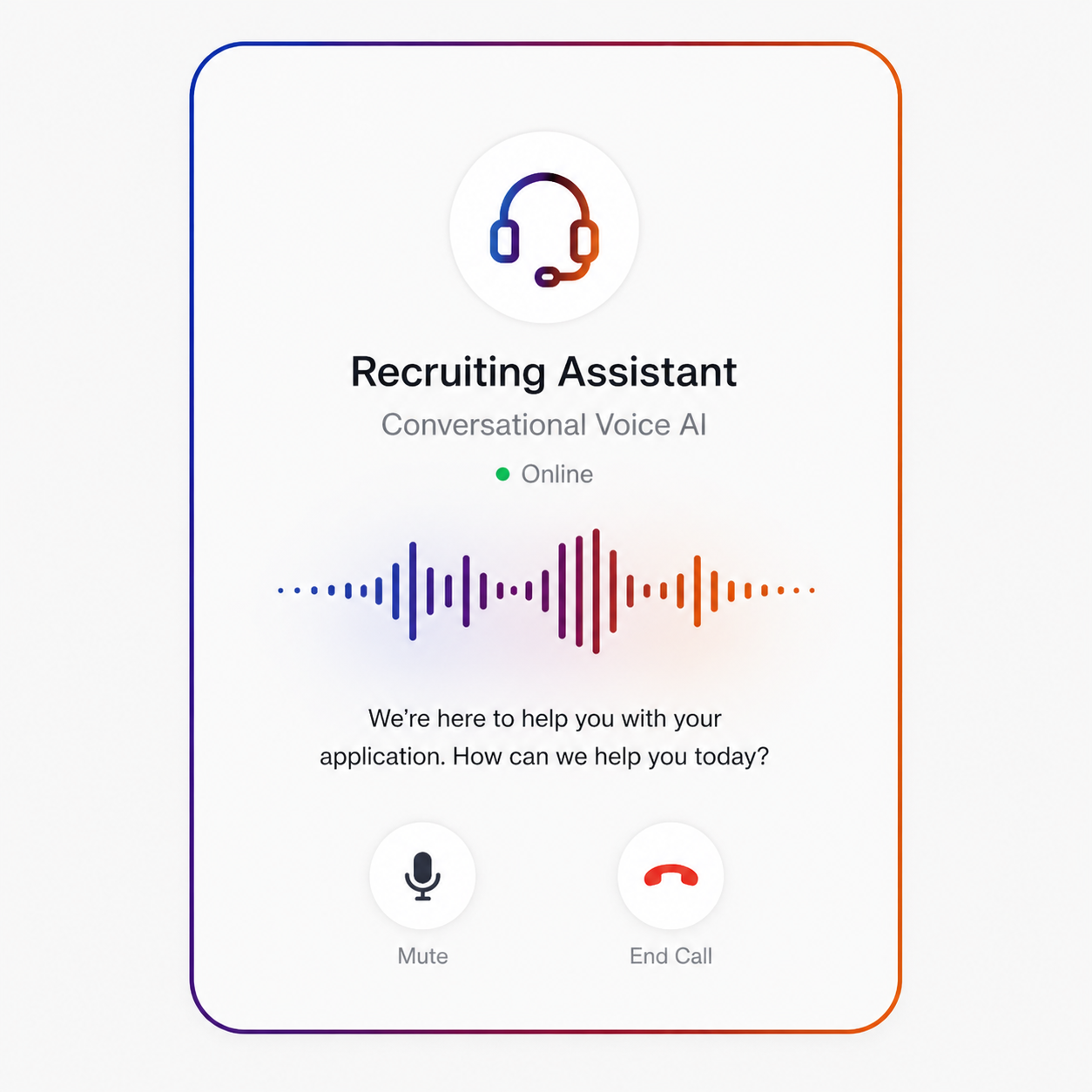
Conversational Voice AI
Inbound line for applicants who prefer calling, plus outbound voice follow-up for high-priority candidates who haven't responded to text. Useful for older applicants and those without reliable data plans.
Web & In-App Chat
Engages applicants who land on your careers page or apply through your website directly. Pre-screening starts before they leave the page — no form-fill drop-off.
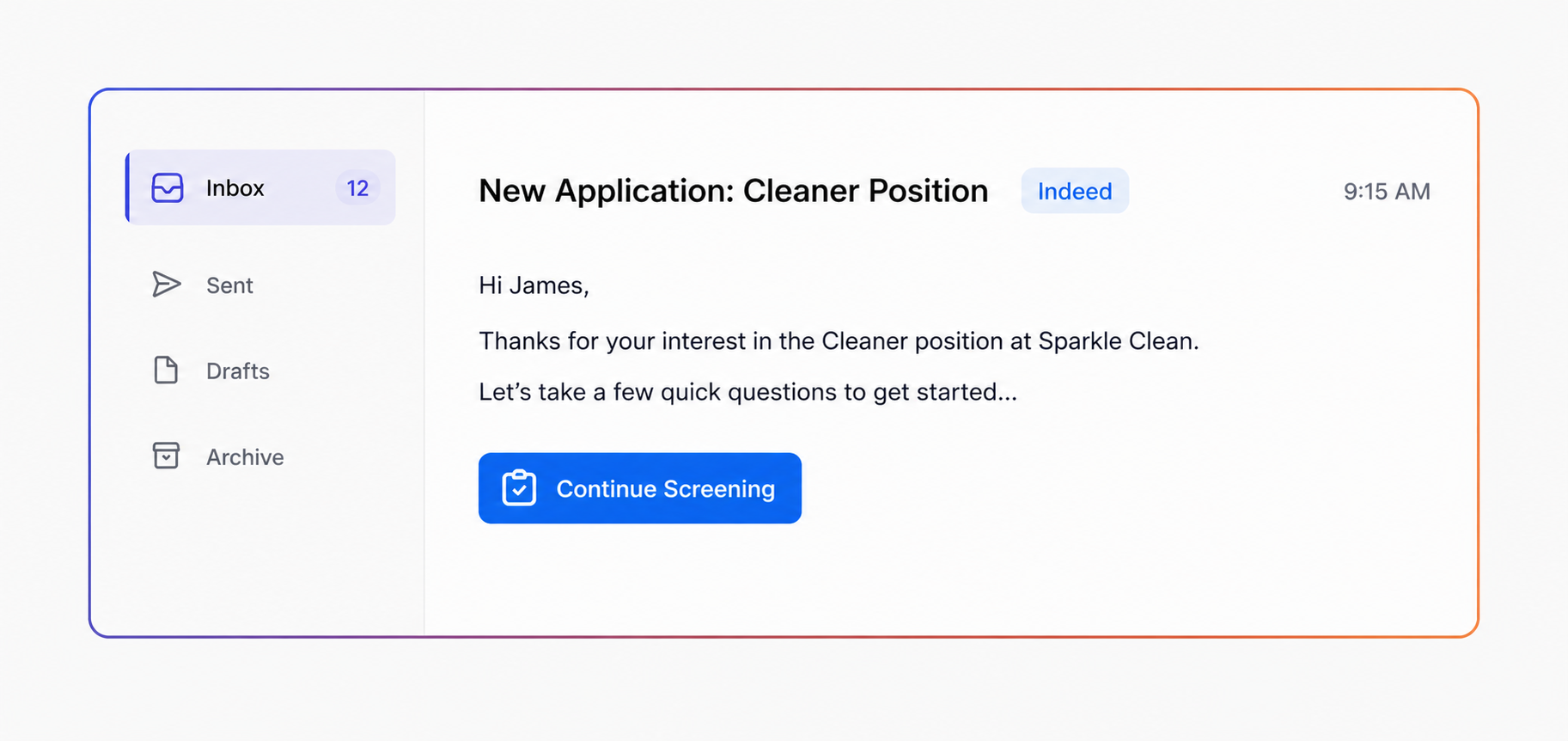
Covers job-board pipelines where applications arrive by email forwarding from Indeed, Snagajob, Poached, or ZipRecruiter. Screening, outreach, and interview confirmations automated end-to-end.
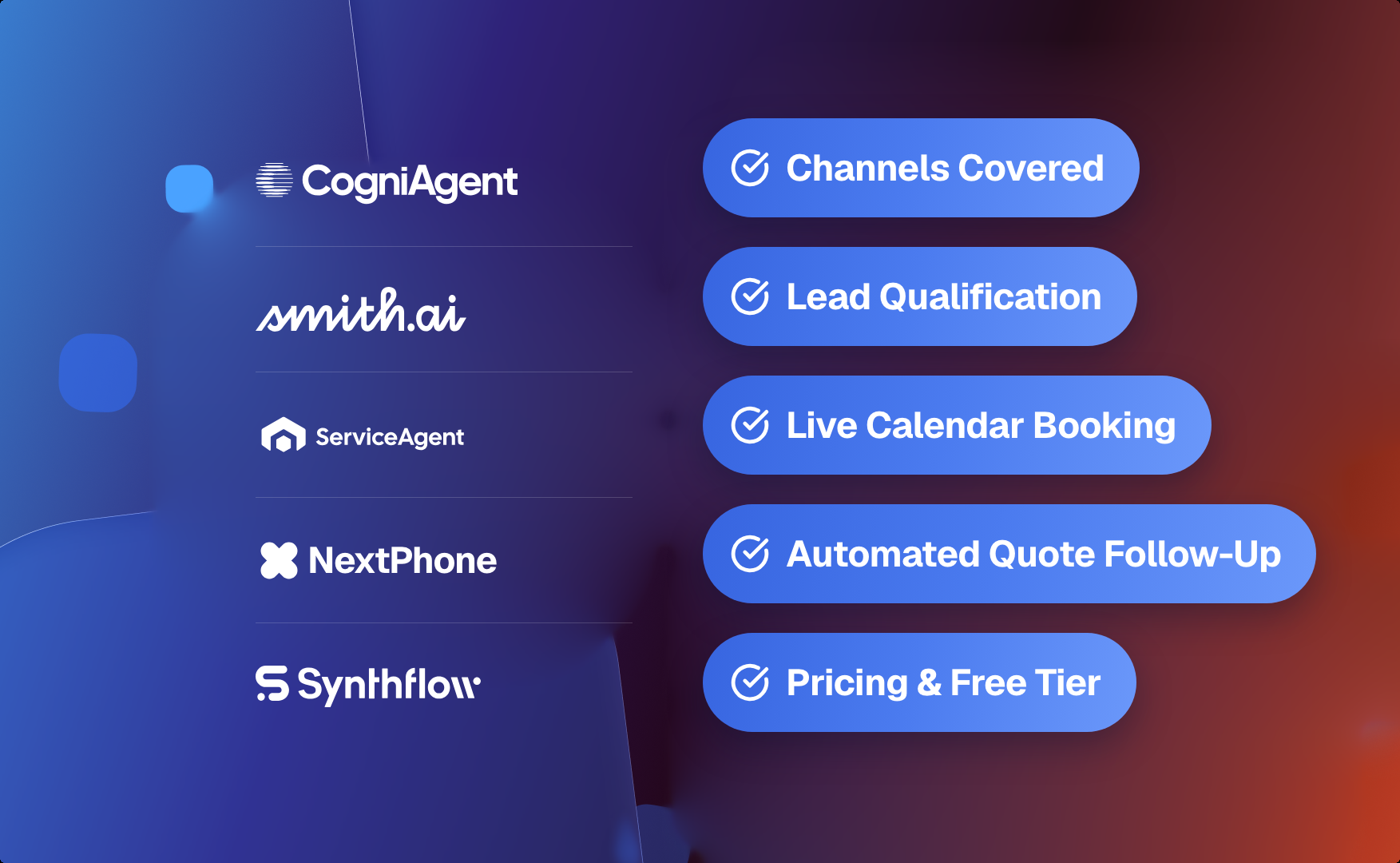
Five Capabilities That Make This Work for Restaurant Recruiting
Behind every applicant conversation, the platform is doing structured work — reasoning about role requirements, writing to your scheduling system, switching channels mid-screening, and keeping the candidate record complete throughout.
Integrations
One Agent Across Your Entire Restaurant Hiring Stack
2,700+ native integrations — connected in real time, not queued and synced after the fact.













 WhatsAppbusiness


What CogniAgent Does That Standard Hiring Chatbots Can't
Generic recruiting chatbots were built for office roles with predictable schedules. Restaurant hiring demands off-hours response, multi-role screening logic, certification checks, and a candidate pool that goes cold in hours — not days.

Standard Hiring Chatbots

- Business-hours response only — applicants who apply during the dinner rush or after close hear nothing until the next morning
- Collects answers and sends them on — ATS and scheduling updates happen later in batch, with no live system access during screening
- Single channel — typically web chat — missing the SMS and WhatsApp channels where most hourly applicants actually respond
- Treats every role the same — no logic for routing BOH vs. FOH vs. management roles through different screening criteria
- No re-engagement capability — candidates who cleared screening but weren't hired vanish from the pipeline
- Vendor-controlled flows — adjusting screening questions for a new menu season or a new role requires a support ticket

CogniAgent Recruiting Agent

- Response within seconds at any hour, on any channel — the same speed at 10 p.m. after the kitchen closes as at 10 a.m. prep
- Reads from and writes to your ATS, scheduling platform, and certification registry live during the conversation, not after
- SMS, WhatsApp, voice, web, and email from one canvas, with full applicant context shared across all channels
- Role-aware screening: line cook criteria differ from server criteria differ from shift supervisor criteria — configured once, applied correctly every time
- Continuous pool management: pre-screened candidates are re-contacted automatically when a new opening matches their profile
- You own and modify the agent — update screening logic, add roles, or change channels any time with no vendor approval cycle
The Measurable Shift From Week One
24/7
Application coverage across every channel — including late-night and weekend hours when restaurant applicants actively job-search.
80%
Reduction in manager hours spent on first-pass screening, follow-up calls, and application inbox management.
3x
Faster from application received to interview-ready candidate, replacing inbox triage with structured automated screening.
Zero
Screening drift across shifts, locations, or managers — one configured bar, applied identically every time.
Pricing
Pay only for what you use. Full visibility on every credit spent.
Pay-as-you-go
No subscription. No monthly fee.
Buy credits from $10
- 5,000 credits loaded on signup
- Full canvas + all AI features
- 2700+ integrations, templates
- Free messaging channels
- Up to 5 user seats
- Production deployment
- Human chat support*
- Credits never expire

* activates on first credit purchase
Enterprise
Custom plan. Annual subscription,
negotiated rate.
- Annual credit package
- Custom user seats
- SSO
- Bring your own LLM API keys
- Extended usage logs
- Assisted onboarding + training
- Agents built by CogniAgent team
- Premium support + SLA

Enterprise-Grade
Security & Compliance
Built for restaurants handling sensitive applicant data — food handler certifications, background-check consent, right-to-work documentation, and payroll details — across every jurisdiction where you operate.


Data Protection
End-to-end encryption in transit and at rest for certification records, consent logs, and applicant documentation. Configurable retention windows aligned to state, federal, and GDPR requirements.
Secure System Integration
Role-based access controls across your ATS, scheduling platform, and background-check provider connections. Encrypted channels for every read and write the agent performs mid-conversation.

Privacy Assurance
Applicant data stays yours. Conversation transcripts and screening records are never used to train public AI models. Bring-your-own API keys keep LLM calls inside your provider relationship.

Audit & Monitoring
Full activity logs for every screening conversation, certification check, consent capture, and ATS write. Time-stamped records support compliance reviews, dispute resolution, and multi-location audits.

![Best AI Tools for Auto Repair Shops [2026 Guide]](https://cogniagent-preview-def77a0f.nyc3.digitaloceanspaces.com/media/2026/07/Best-AI-Tools-for-Auto-Repair-Shops-2026-Guide.png)

Frequently Asked Questions about the
Restaurant Recruiting AI Agent
Job board and ATS chatbots collect answers and route them. Your agent reasons across those answers, validates food handler certification status inside the conversation, and re-engages candidates who stop responding. It also runs across SMS, WhatsApp, voice, and email from a single canvas — where most ATS chatbots are limited to web chat only.
The agent handles first contact, role-fit screening, certification capture, shift-availability matching, consent collection, interview scheduling, follow-up, and re-engagement. Your managers handle interview decisions, cultural fit assessments, and final offers. You configure a human handoff at any point — when a candidate asks something out of scope, the agent escalates with full conversation context attached.
You define the escalation triggers. Out-of-scope questions, sensitive topics, or unusual edge cases route to the named human contact — by SMS, email, voice transfer, or whichever channel you specify — with full conversation history attached. The agent never improvises outside its configured scope.
Yes. The platform connects to Toast, 7shifts, HotSchedules, When I Work, and others via the integration grid above, plus 2,700+ additional native connectors and full API access. Once a hire is confirmed, the onboarding flow can write the first shift and send the new employee their schedule and pre-shift briefing through the same channel used for screening.
Yes. A single agent configuration can run across multiple locations with location-aware routing — applicants are screened for the specific role, shift requirements, and certification rules of each site. Regional operators and franchise groups typically configure once and deploy across the network, without rebuilding per location.
You do. Transcripts, certification records, consent logs, and screening outcomes live in your account. They are never shared with third parties, never used to train public AI models, and can be exported or deleted on your timeline.
Three factors influence timing. First, how customised your screening criteria are — a standard FOH or BOH flow runs from a template in days, while more complex multi-role setups or franchise networks take additional configuration. Second, integration depth — live scheduling sync and ATS write-back each add an integration step. Third, channel scope — SMS-only deployments are faster than full SMS, WhatsApp, voice, and email coverage. Most restaurant operators land between five and fifteen working days.
Each agent action — a conversation turn, a certification API call, a calendar write, an ATS update — draws a defined credit cost from your balance. A typical text-only screening conversation runs roughly 10 to 20 turns before disqualification or interview booking. Voice and live API lookups cost more per action than text-only steps. The pricing page lists per-action costs in detail.
Yes. The same platform handles guest inquiry response, reservation management, order status updates, loyalty re-engagement, and other restaurant workflows — including deterministic automation for fixed-path processes. Most operators start with recruiting because volume and time pressure are highest, then expand to additional agents on the same canvas as confidence grows.

No results