Article Updated Dec 17, 2025
 13 min read
How to Use AI in Customer Service Automation to Delight Your Customers 24/7
Updated Dec 17, 202513 min read Updated Dec 17, 202513 min read
The phone line crackles with hold music, and your support inbox is a bottomless pit of the same five questions asked over and over. Sounds familiar? If you're running a customer support team, these issues, alongside the expectation of instant, 24/7 resolution, may paint a frustrating picture. This reality puts constant pressure on budgets, team morale, and, ultimately, customer experience and loyalty. But what if you could flip the script?
What if those repetitive customer queries could resolve themselves instantly, your support agents were freed to handle only the most rewarding and complex issues, and every customer felt uniquely understood, day or night? That's what AI in customer service automation promises: faster response times, higher customer satisfaction, and more time for your human agents.
But how does this work? When's the right time to implement an AI agent to improve customer interactions? Do you need technical expertise to implement artificial intelligence tools into your workflows? In this guide, we'll explore how AI for customer service workflow automation works, the best tools, when and how to choose them, and more.
When interacting with rigid chatbots, customers often type "HUMAN!" into the chat window to try to reach out to customer support agents. Some complex cases do require human intervention, but an AI chatbot working to supplement your team and answer customer inquiries shouldn't frustrate your audience. Best AI tools for customer service automation answer more than just routine inquiries. They understand context, learn from experience, and seamlessly hand off complex issues when needed.
Here's what that looks like:
Advanced chatbots use natural language processing to analyze the language (instead of just scanning the keywords) of the question and understand its true intent, even through mistakes and typos. The ability to instantly cross-reference the knowledge base delivers real-time answers, resolving a customer issue instantly, eliminating long wait lines.
Every time AI chatbots interact with your customers (whether they're solving common questions or conducting support operations), they learn. It analyzes thousands of conversations to identify common pain points, new trends in customer inquiries, and even the specific phrasing customers use.
Besides tending to customer needs, cross channel customer service AI agent integrates the questions with CRM, accesses customer data, and even uses sentiment analysis to detect if customers are frustrated by their word choice and tone. It connects all the channels (email, live chat, social media messengers, and more) to create a more consistent and informed experience.
AI in customer service automation significantly lowers operating costs by taking care of the majority of repetitive tasks, allowing your human agents to focus on their core competencies, managing complex, valuable, and emotionally delicate issues. A support ecosystem that is effective, scalable, and truly responsive to customer needs is produced by this human-AI synergy.
If you find yourself asking the question "What can AI actually do for my team?" you're not alone. It's easy to say that AI reduces operational costs in the long term, it reduces the wait times, and improves support experience, but without concrete examples and case studies, these sound just like surface-level benefits. Let's explore five powerful practical workflows that showcase how customer service automation AI can integrate into your existing customer service operations.
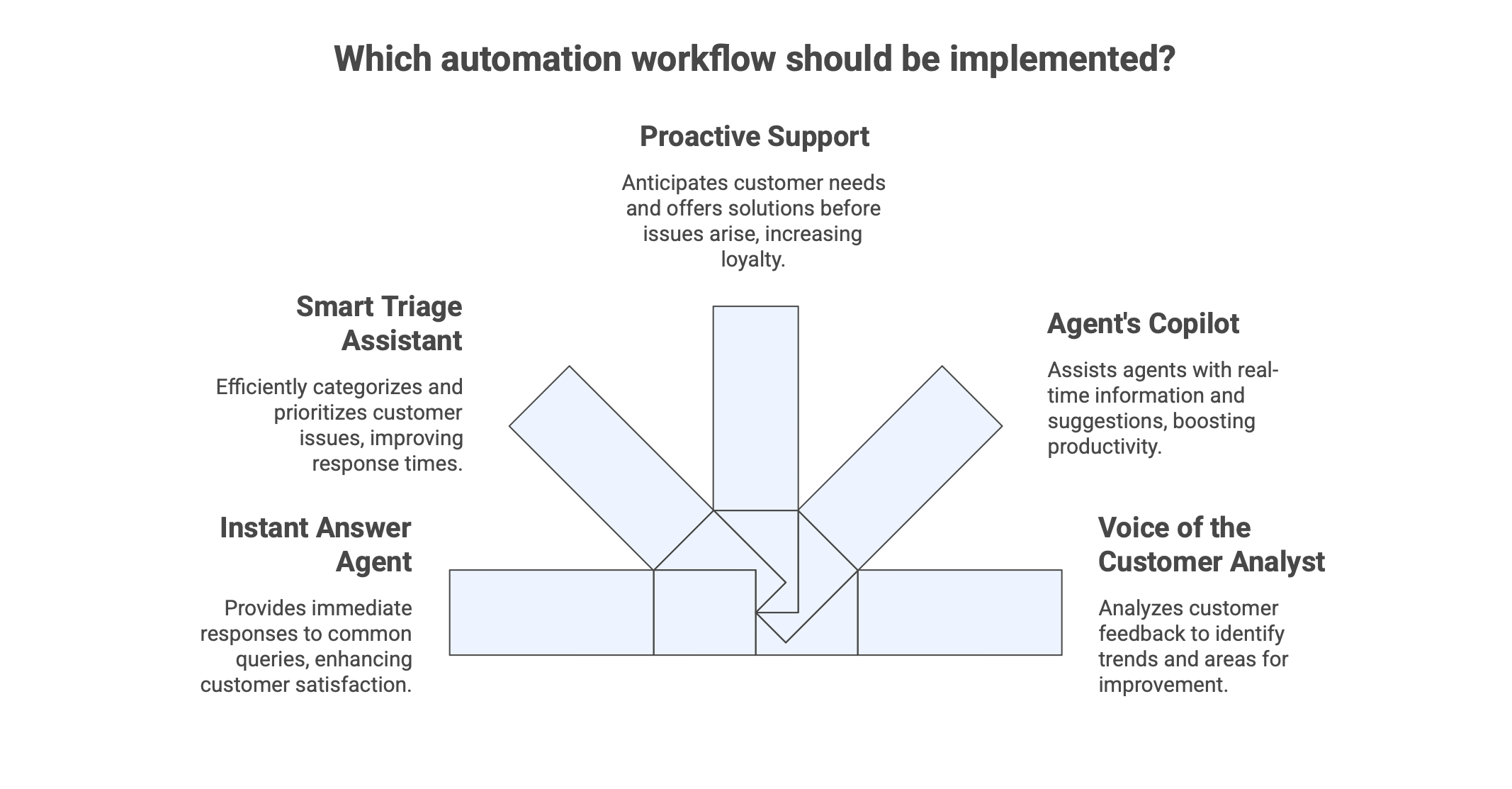
If your team keeps burning out on the same simple questions day after day, it's time to introduce an instant answer agent. It'll become your 24/7 first line of defense and automate responses to common inquiries. You can integrate this AI directly into your website, help portal, or help desk software. With the help of generative AI and natural language understanding, it pulls out pre-written texts, dynamically interprets questions, and generates accurate responses in real time.
💡 For example: A customer addresses your help portal with the question, "How do I reset my password for the dashboard?"
AI in customer service automation understands the intent behind the query and starts accessing knowledge base articles to find a step-by-step guide for password resets
Instead of dumping the article link, it summarizes the key steps in a friendly and conversational tone, "No problem! To reset your password, go to the login page, and click..."
The impact? The workflow eliminates long wait times for customers, regardless of business hours, and your agents are focused on more nuanced customer requests. You can employ your digital assistant to tackle similar routine tasks and see a direct boost in customer satisfaction scores.
Not all customer issues are simple routine questions. Some instances require intelligent systems like smart triage assistants that immediately handle every query with the right resources and the right context.
💡 For example: A customer writes a message: “I’m on a deadline and my project export has failed three times now. This is holding up our entire team”
The assistant will perform sentiment analysis to detect if there is frustration and urgency based on keywords like "deadline" and "failed"
It will classify the ticket as "Technical bug - high priority" and automatically pull the customer's account information to scan the past project history and recent similar bug reports
The assistant will then instantly route the ticket to a suitable technical support engineer, complete with all contextual data
Introducing such an assistant significantly streamlines operations and reduces internal handling time.
Why wait for a problem to happen? AI in customer service automation can help your team shift from reactive support to proactive care by identifying and addressing potential issues before the customer even has to ask.
💡 For example: Your analytics show that a user has had the same item in their cart for 55 minutes and has visited the shipping cost page three times
AI in customer service automation detects this pattern and triggers an automated proactive chat pop-up with the text, "Hi there! Noticed you're checking out our shipping options. We offer free shipping on orders over $50. Need help finding a promo code or have any questions?"
The customer will then decide whether they need additional help or if this information is enough
Proactive support helps reduce abandoned carts and demonstrates attentiveness. Sometimes customers need a little extra push or a helping hand to find the exact information they're looking for, even if your FAQs are written out perfectly.
AI in customer service automation obviously automates workflows and helps reduce routine task handling. But it can do more than that. Best AI customer service automation tools can act as a copilot for your human agents, helping your team and providing them with knowledge, efficiency, and memory that human brains physically don't have.
💡 For example: Your agent is on a live chat with a customer who's confused about setting up two-factor authentication (2FA)
While the human agent chats with the customer, Copilot can instantly scan the internal documentation and surface the specific guide for "2FA setup on an iOS device" or "2FA setup for Android users," etc.
By using generative AI, Copilot can suggest a response for the agent, allowing them to quickly review, personalize, and send the response
Copilots reduce average handle time and ensure consistent and accurate information is given to your customers. This drastically improves onboarding for new agents and improves overall service quality.
Customer feedback and insight are essential for improving service quality. However, it's impossible to manually sift through thousands of tickets, hoping to find relevant and helpful comments. AI in customer service automation helps your support team analyze all customer interactions and turn qualitative feedback into quantitative and actionable business intelligence.
💡 For example: Instead of your manager working days to read the tickets, AI in customer service automation sends automated weekly reports that highlight key metrics like:
This tool provides data-driven insights for product development and reveals training gaps for support teams. It can help you address widespread issues proactively, instead of handling them after customers complain.
Every investment made by leaders in customer service must yield observable, quantifiable results. Automation driven by AI is a strategic necessity that turns customer service from a cost center into a potent driver of expansion, productivity, and client loyalty. Here's how:
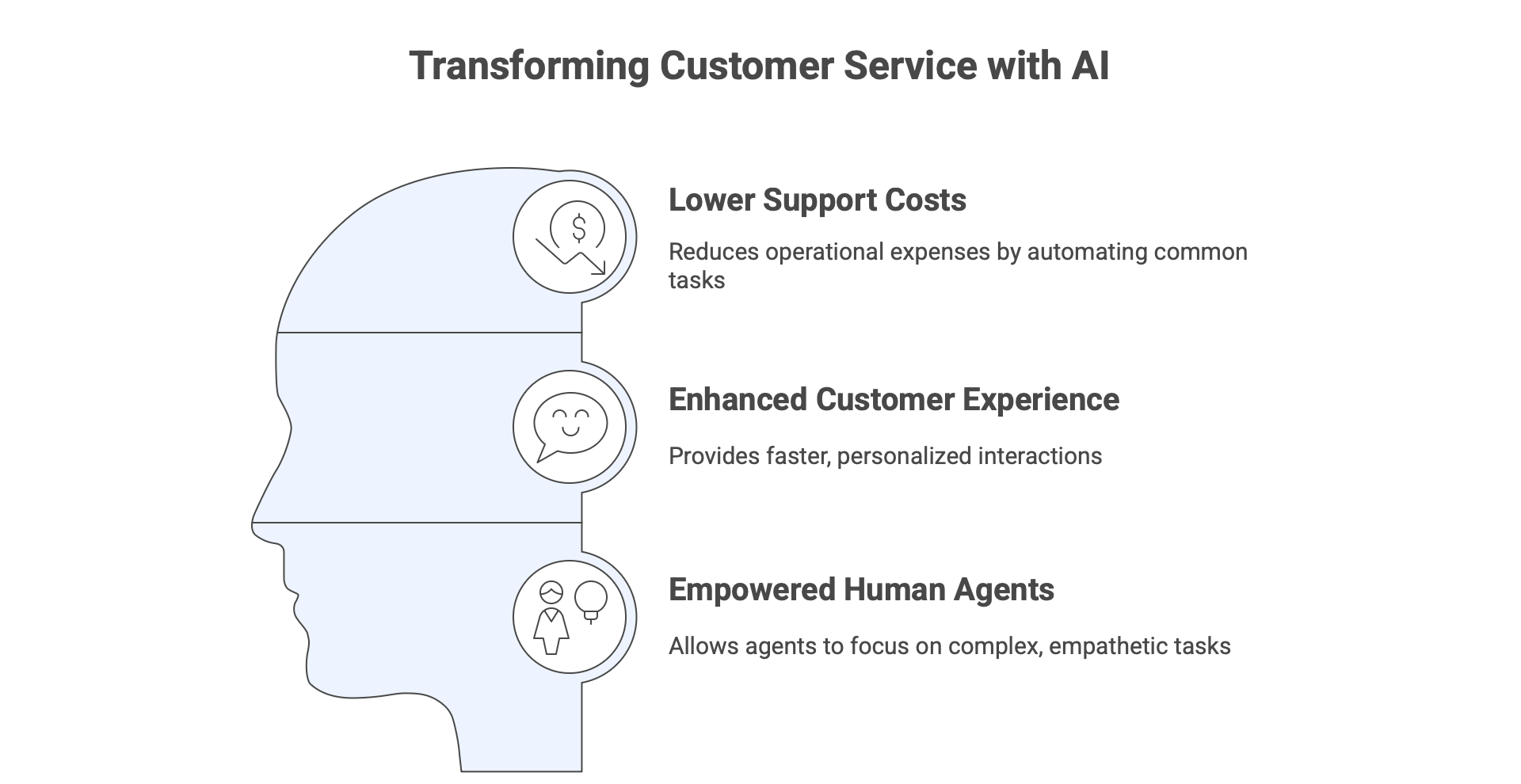
AI in customer service automation lowers the cost per interaction, which has an instant and long-lasting effect on your bottom line. AI directly reduces the number of tickets needing human intervention by immediately resolving a sizable percentage of common questions, including password resets, order status checks, and return policies. You save money on operating expenses related to staffing for more extended business hours, training, and scaling during busy times. As a result, the operation is leaner and more effective, with resources being distributed strategically rather than haphazardly.
The foundations of satisfaction in the experience-driven economy of today are accuracy and speed. AI-powered services provide both. Frustrating wait times are eliminated as customers receive prompt, accurate responses around the clock. Beyond speed, individualized interactions that help customers feel understood are made possible by generative AI. AI can offer proactive support and personalized recommendations by utilizing customer data and context, turning the standard support experience from a transactional requirement into a valued interaction.
The most excellent use of AI is in augmentation, not replacement, as is commonly believed. AI frees up your human agents to do what they do best—empathize, form connections, and solve difficult, valuable problems—by automating repetitive and routine tasks. This has a significant positive impact on team morale and service quality. Agents are now strategic problem solvers and brand ambassadors rather than exhausted order takers.
Any new technology adoption raises legitimate concerns. The secret to a successful implementation is acknowledging these difficulties. The good news is that every possible obstacle has an obvious and doable solution if the proper approach and resources are used.
|
Challenge |
Solution |
|
"Will the AI misunderstand customers?" The fear of the AI providing wrong answers and damaging customer trust. |
1. Support it with a robust Knowledge Base. 2. Implement continuous feedback loops. |
|
"We'll lose the human touch." The concern is that service will become impersonal and robotic. |
1. Adopt a human-in-the-loop model. 2. Empower agents with AI as a copilot. |
|
"Integration looks complex." The perceived difficulty of connecting AI with existing software and workflows. |
1. Choose a platform with pre-built integrations. 2. Start with a focused pilot. |
Choosing the appropriate AI platform is essential to transforming your customer service operations. The perfect tool should scale with your company, provide a noticeable return on investment, and integrate easily with your current systems. Here are five top options, with an emphasis on CogniAgent's special benefits.
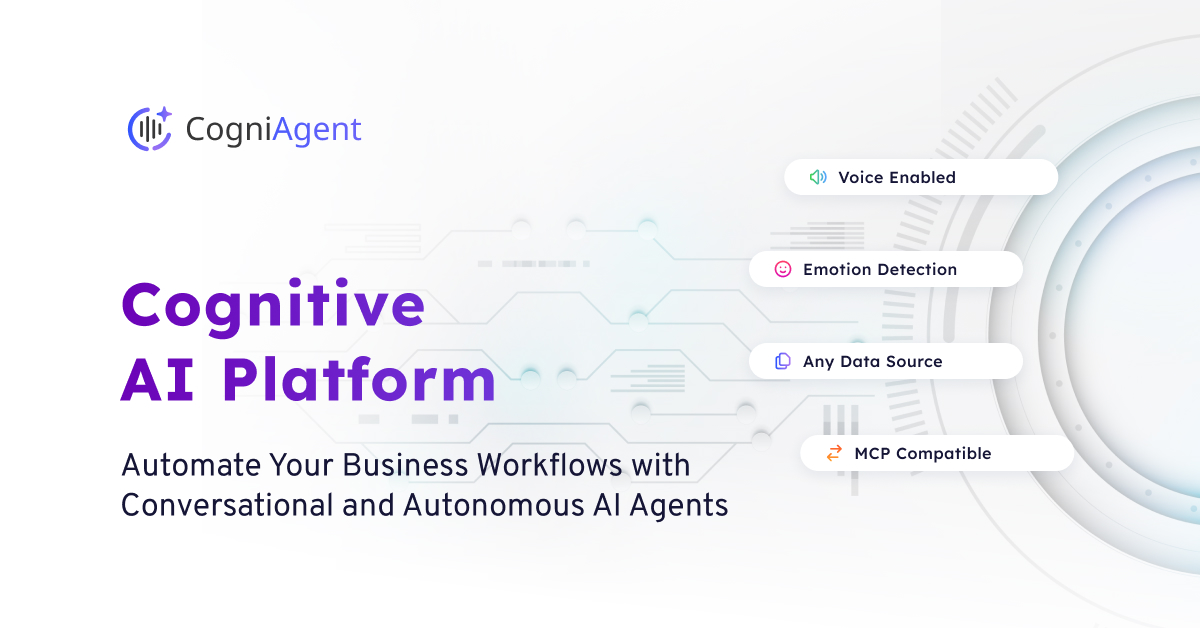
CogniAgent is a next-generation Cognitive AI Platform designed to handle real-world business chaos. Unlike simpler chatbots, it builds thinking AI agents that automate complex decision-making processes, maintaining performance and scaling as your business grows.
Why It's a Top Choice: It uniquely combines event-driven automation, structured conversations, and deep research, with autonomous agents that adapt to complexity instead of breaking. This makes it ideal for businesses that face unpredictable customer inquiries and need a system that can think, not just follow scripts
Key Differentiators:
Ideal For: Mid-size to large businesses and enterprises that need a robust, flexible solution to automate intricate, multi-step processes and provide a superior, voice-enabled customer experience
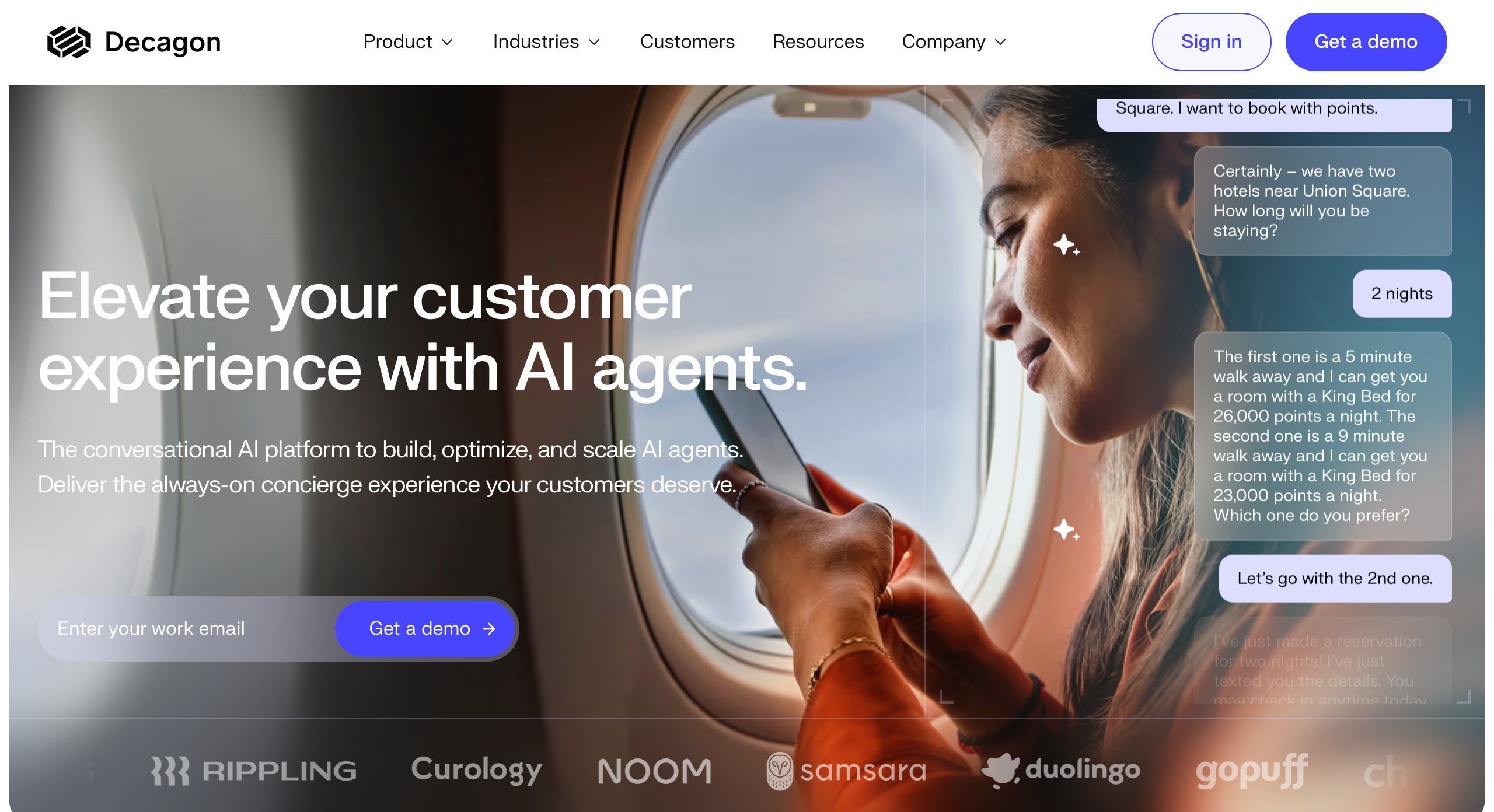
Decagon specializes in creating extremely complex, personalized AI assistants for big businesses. They place a strong emphasis on providing white-glove services to develop customized solutions that have a thorough understanding of a business's unique domain and procedures.
Sendbird is a communications API platform that facilitates voice, video, and chat conversations.
Fin (by Intercom) is a Generative AI chatbot built specifically for customer service.
Rasa provides an open-source framework for building contextual AI assistants.
How to use AI in Customer Service Automation to Delight Your Customers 24/7
The future of successful customer support teams starts with AI in customer service automation. It looks like automated routine tasks, reduced workload, and delighted customers. However, navigating this shift can be complex, with each platform offering a different mix of features and capabilities. The right choice depends on finding a partner that aligns with your ambitions and can handle unpredictable challenges.
CogniAgent is engineered to be that partner. It's a tool designed for the real world. It adapts and integrates deeply with your business to automate entire workflows.
If you're ready to experiment with AI in customer service automation, get started free or talk to our experts.