First Contact and Missed Call Recovery
Inbound voice answer, missed-call text-back within seconds, after-hours triage, online-form follow-up, channel switch confirmation, caller-intent capture.
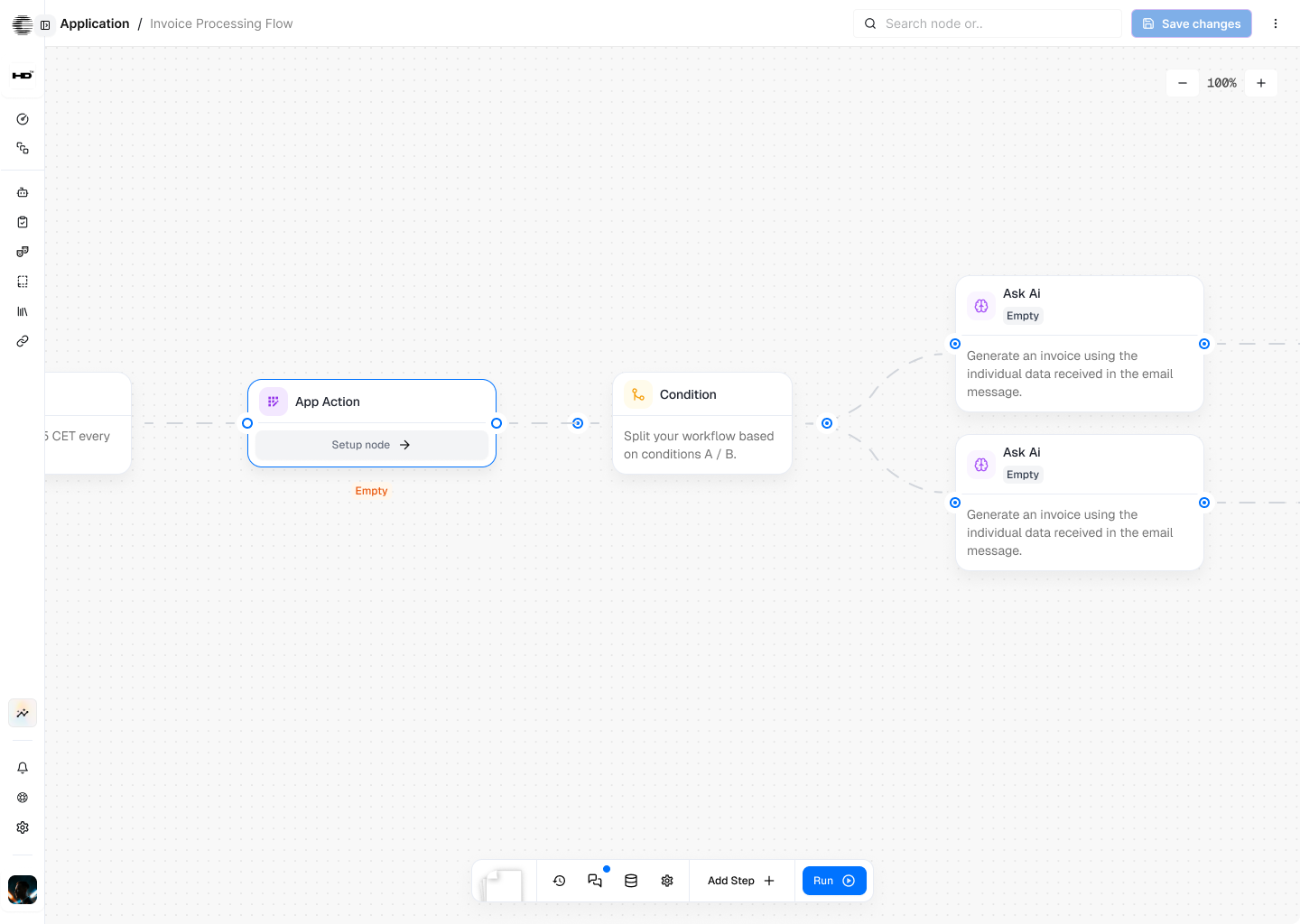
Every separate process in the lead lifecycle (from first text to post-service review) automated on a single canvas, with live access to your booking software, calendar, and CRM across every channel.
Inbound voice answer, missed-call text-back within seconds, after-hours triage, online-form follow-up, channel switch confirmation, caller-intent capture.
Property type and size, bedroom and bathroom count, square footage, pets and access notes, cleaning scope (recurring, deep, move in/out, post-construction), preferred frequency, photo upload of problem areas.
Service-area validation, recurring-versus-one-time intent, budget range check, repeat-customer recognition, residential or commercial routing, parking and key-and-alarm-code capture.
Instant flat-rate quote for standard scopes, hourly-rate disclosure for custom jobs, walk-through estimate scheduling for large commercial accounts, add-on menu (inside fridge, oven, windows, laundry), recurring discount surfaced.
Live cleaner availability, skill-and-zone matching, time-window selection, calendar block, customer and dispatcher confirmation, route-density optimization, backup-cleaner assignment.
24-hour and 1-hour reminders, cleaner-en-route alert with ETA and photo, access-code confirmation, real-time reschedule, no-show recovery, last-minute cancellation rebooking.
Same-day request flagging, post-event cleanups (move-out deadline, listing photo shoot, party recovery), emergency commercial response, on-call manager alert.
Open-quote reminders at day 1, 3, and 7, objection capture, recurring-plan reminder, dormant-customer reactivation, seasonal pre-spring and pre-holiday outreach.
One-time-to-recurring conversion offer, weekly, bi-weekly, monthly cadence selection, payment-on-file capture, auto-renewal reminders, priority-customer recognition.
Job completion check-in, cleaner rating capture, review-platform routing (Google, Yelp, Thumbtack), add-service prompt, referral-program invitation.
Cleaning operators miss 25 to 40% of inbound calls during business hours, and the heaviest call windows are evenings and weekends when the office is closed (Allclean, 2025). The annual loss for a small to mid-sized cleaning business is $80,000 to $250,000 once full lifetime value, referrals, and upsells are counted.
The agent answers voice calls live, texts back missed callers within seconds, and runs the same intake on online booking forms and email. Same response speed at 11 p.m. as 11 a.m. — no voicemail, no after-hours queue.
A 5-minute response is 21x more likely to qualify the lead than a 30-minute one (Harvard Business Review, cited Verse.ai 2025). Most cleaning companies still take hours to return a website inquiry, and 80% of voicemail callers hang up before leaving a message (Allclean, 2025).
The agent qualifies the request, captures the property details and frequency, and books the cleaning before the prospect has time to message the next listing on Yelp or Thumbtack.
50% of sales happen after the 5th follow-up, but 44% of businesses give up after the first attempt (InsideSales, cited industry-wide). Office staff don’t have time to chase every estimate, especially for one-time deep cleans that should convert to recurring.
The agent runs day-1, day-3, and day-7 nudges across the customer’s preferred channel, captures objections, surfaces the recurring discount, and routes live questions to a human estimator without dropping context.
Customers expect a reply on the channel they used. 63% of consumers say they would switch to a business that offered text messaging, and 98% of texts get read versus 6% of emails (Sakari, 2025). Most cleaning operators still treat web forms as overnight email.
A web booking, a text from a saved Yelp lead, a Thumbtack message, or a property-manager email all get the same intake-and-book treatment. The customer never has to switch channels to get an answer.
Bi-weekly upsells, recurring-discount offers, and renewal prompts all live in someone’s head or in a spreadsheet. Recurring revenue leaks every month a customer is left on a one-time plan.
A Virtual Employee tracks each customer’s cadence, runs the one-time-to-recurring conversion offer at the right moment, captures payment-on-file, and renews plans before the term lapses.
One person juggles inbound calls, cleaner routing, customer rebooking, and angry-callback recovery. The phone backs up every time something goes off-script.
The agent handles every routine intake, books to the live calendar, and only escalates when the situation actually needs a human. Your manager works on the exceptions, not the queue.
You don't need a developer or an automation specialist. Most cleaning operators have a working agent live within a week.
Single canvas, live booking lookup, calendar block, CRM write — no/low code.
Cleaning customers don't all reach out the same way. Younger residential customers text. Older homeowners call. Property managers email. Vacation-rental hosts message through portal apps. The agent meets each one on the channel they actually use.
The recovery channel for every missed call — text-back inside 60 seconds with “we just missed your call, what kind of cleaning are you looking for?” and a booking link. Also the default for cleaner-en-route alerts, 24-hour reminders, post-clean review requests, and recurring-plan reminders. 90% of texts are read inside 3 minutes — the highest-engagement channel cleaning companies have.

Inbound voice line that answers on the first ring, captures the property details, and books the appointment. Outbound voice for high-value commercial follow-ups, dormant-customer reactivation, and missed-call recovery for callers who don’t read texts. No menus, no hold music.

Engages site visitors directly on your service-area, pricing, and frequency pages. Pre-qualifies the request before the form-fill, completes the booking inside the chat without a callback, and recovers abandoned-form visitors with a follow-up text.

Covers property managers, multi-site commercial accounts, and lead-gen platforms (Yelp, Thumbtack, Angi, HomeAdvisor, Care.com, NextDoor) where the request arrives by email. Intake, quote, walk-through scheduling, and confirmation all handled by the agent.

For markets with WhatsApp-first customers — photo upload of problem areas, square-footage estimate from a floor-plan picture, or special-request notes right inside the conversation thread.

Behind every customer conversation, the AI receptionist is doing structured work — reasoning about scope, writing to your booking software, switching between SMS and voice, all while keeping the customer's profile intact. Here's what powers that.
2,700+ integrations — the agent reads live data and updates records inside the tools you already run, not afterwards.







 WhatsApp
business
WhatsApp
business
 Gmail / Outlook

 Slack / Teams









 Lead Ads

Standard answering services and chatbots take a message. An AI agent for cleaning companies has to actually run the lead — scope the job, look up the customer in your booking software, price the visit, and book a cleaner on a real calendar. The comparison below maps the gaps.
24/7
Inbound coverage across SMS, voice, web, email, and WhatsApp — including evenings, weekends, and during stacked job-site days when crews are on-site.
Sub-minute
First-response on every channel; the recovery text-back lands while the prospect is still on Google looking at the next listing.
21x
Higher likelihood of qualifying the lead with a 5-minute response versus a 30-minute one (Harvard Business Review, cited Verse.ai 2025).
40%
Top of the industry-typical missed-call window the agent recovers as bookings — revenue most cleaning operators currently lose to voicemail (Allclean, 2025).
Pay only for what you use. Full visibility on every credit spent.
No subscription. No monthly fee.
Buy credits from $10
* activates on first credit purchase
Custom plan. Annual subscription,
negotiated rate.
Security & Compliance
Built for cleaning operators handling sensitive customer data — home addresses, access codes, payment information, and recorded service calls.
End-to-end encryption in transit and at rest for call recordings, transcripts, photo uploads of property and access details, and payment-on-file records. Configurable retention windows aligned to GDPR rules.
Customer data stays yours. Conversations, call recordings, and CRM records are never used to train public AI models. Bring-your-own API keys keep LLM calls inside your provider relationship.
Role-based access across booking software, CRM, scheduling tools, and payment-processor connections. Encrypted channels for every read and write the agent performs mid-conversation, including PCI-scope-aware payment handoff.
Full activity logs for every call, text, booking, quote follow-up, and CRM write. Time-stamped records support compliance reviews, dispute resolution, and call-recording-consent audits.
AI Receptionist for Cleaning Companies
An answering service takes a message and forwards a ticket — your office manager still has to call the customer back, qualify the request, and book the visit. The CogniAgent AI receptionist runs the full lead from first text or ring to confirmed appointment, with live access to your booking software and calendar. It also runs across SMS, voice, web, email, and WhatsApp from the same canvas, where most answering services stop at voice.
The agent handles inbound voice and text answer, missed-call recovery, intake, qualification, flat-rate pricing on standard scopes, cleaner matching, calendar booking, confirmation and reminders, quote follow-up, post-service review requests, and recurring-plan upsell. Your office manager and estimator handle large commercial walk-throughs, complex contract negotiations, and exception calls. You can configure a human handoff at any node — any time the customer asks something out of scope, the agent escalates with full conversation history.
Configurable scope branches handle each case. One-time scopes (deep, move in/out, post-construction, vacation-rental turnover) get an instant flat-rate or per-square-foot quote and a same-week booking. Recurring customers get a frequency picker (weekly, bi-weekly, monthly), payment-on-file capture, and an auto-renewal cadence. The agent also runs the one-time-to-recurring conversion offer when a customer’s third one-time clean lands — that’s where most operators leave revenue on the table.
The agent flags commercial requests, captures square footage, frequency, scope (day porter, after-hours, restroom-only, full janitorial), and service-area, then either books a walk-through with your estimator or quotes from your standard pricing matrix if the request fits a templated scope. Property-management portfolios get bulk-quote intake routed straight to a human handler.
Yes. The lead-handling funnel is structurally identical across cleaning types — capture scope, validate area, quote, book, remind, follow up, upsell. The variables change (residential captures bedrooms and bathrooms; commercial captures square footage and frequency; vacation-rental captures turnover deadline and access codes; post-construction captures site address and debris-haul scope; specialty captures the specific service — carpet, window, pressure washing, disinfection). You configure the variables once in the template; the agent runs the same flow whether the request is a weekly maid clean, an Airbnb turnover, a deep-clean move-out, or a 50,000-square-foot office contract.
Yes. CogniAgent connects to all of the above natively, plus 2,700+ more integrations and full API access. The agent reads the live customer record, writes the job, books on the cleaner’s actual calendar, and updates the job status when the visit is confirmed — no double entry, no end-of-day sync.
You do. Call recordings, transcripts, photos, payment metadata, and CRM records live in your account. They aren’t shared with third parties, aren’t used to train public AI models, and can be exported or deleted on your timeline.
Three factors. First, how custom your intake and pricing logic is — a standard residential maid workflow runs from a template, while custom flat-rate menus, hourly-rate rules, and multi-location dispatch take additional configuration. Second, integration depth — live ZenMaid or Jobber write, calendar block, and payment-processor handoff each add an integration step. Third, channel scope — SMS-only deployments are faster than full SMS + voice + web + email + WhatsApp coverage. Most operators land between five and fifteen working days.
First-touch drops from a typical hours-long window to seconds. The 25 to 40% of calls that the average cleaning operator misses during business hours — and the heavy evening and weekend traffic that goes straight to voicemail (Allclean, 2025) — get answered live or recovered by automatic text-back inside 60 seconds.
Each agent action draws a defined credit cost from your balance. A turn in conversation, a booking-system lookup, a calendar write, a CRM update, and an outbound SMS or voice minute each have a set cost. A typical text-only intake-and-booking conversation runs roughly 8 to 15 turns; a voice call covers the same ground with per-minute voice cost on top. The pricing page lists per-action credit costs in detail.
Yes. The same platform handles cleaner recruiting and hiring, customer service for active jobs, supply ordering coordination, contract-renewal outreach, and other workflows — including pure rule-based deterministic automation for fixed-path processes. Most cleaning operators start with lead handling because the missed-call cost is the most visible, then layer on additional agents on the same canvas as confidence builds.

No results