First Contact
Application acknowledgment, channel switch confirmation, role context delivery, candidate intent capture.
WHAT COGNIAGENT AUTOMATES
Candidate screening automation built once and applied across every post and every applicant — single canvas, live system access, all channels.
Application acknowledgment, channel switch confirmation, role context delivery, candidate intent capture.
Guard card or SIA license collection, expiration validation, armed or unarmed endorsement, right-to-work confirmation.
Shift preference capture, overnight and weekend fit, site location radius, vehicle and transport status.
Disclosure delivery, consent capture with timestamp, document upload prompts, compliance log update.
Calendar slot offer, candidate selection, calendar block, candidate and supervisor confirmation, no-show rebook.
Pre-screened pool tracking, license-expiry watch, new-post outreach, availability refresh, shortlist delivery.
Hire confirmation, payroll detail capture, uniform sizing, first-shift briefing, ATS and scheduling-system update.
WHY THIS MATTERS NOW
The same person running posts also reviews applications. A significant share arrive after-hours — by Monday, the licensed candidate has been screened by a competitor first.
The agent reaches every applicant within seconds. Same response speed at 11 p.m. as at 11 a.m. — no inbox to drain, no off-hours queue.
Every applicant needs guard card or SIA validation, expiration check, and endorsement type confirmed before they’re worth a callback.
The agent collects license number, type, and expiry, and queries the guard register where APIs are exposed. Disqualifications happen before any human sees the file.
Different sites, different shifts, different supervisors apply the bar inconsistently. Unqualified applicants reach the interview stage.
You define the criteria once; the agent applies it identically regardless of who’s covering the desk.
A guard cleared for one post but not hired vanishes from the pipeline. When the next vacancy opens, screening restarts from zero.
A Virtual Employee re-verifies license validity and current availability when a new post opens, surfacing the right candidates without restarting screening.
Indeed, ZipRecruiter, LinkedIn, Guardpass, direct referrals, and walk-ins all need their own response logic. Audit trail is patchy at best.
Every application source funnels into the same agent, producing a single structured candidate record per applicant.
You don't need a developer or an automation specialist. Most security operators have a working agent live within a week.
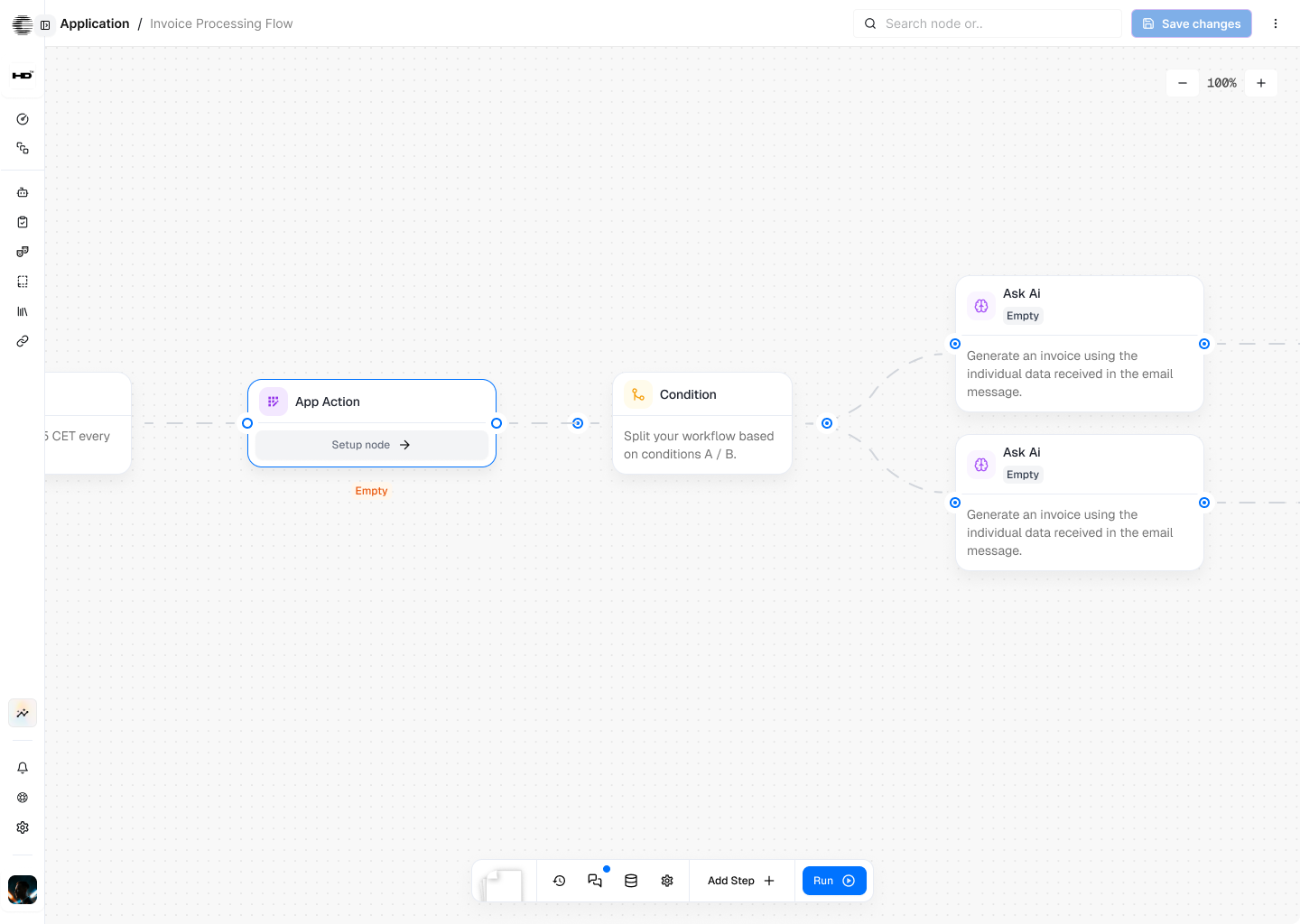
Single canvas, license verification, calendar booking, ATS write — no/low code.
Guard candidates don't all communicate the same way. The agent meets each one where they are — text-first, voice-first, or in the language they're most comfortable using.
Inbound line for candidates who prefer to call, plus outbound voice follow-up for high-priority applicants who haven’t responded to text. Useful for older applicants and candidates without consistent text data.

Engages candidates who land on your career site directly in the chat window. Pre-screening starts before they leave the page; no form-fill drop-off.

The default channel for guard candidates in urban markets and in immigrant communities where security hiring concentrates. Document upload (license photo, ID) handled inside the same thread.

Covers job-board pipelines (Indeed, ZipRecruiter, LinkedIn, Guardpass) where the application arrives by email forwarding. Screening, outreach, and interview confirmations automated.

The highest-response channel for hourly applicants — text response rate runs roughly 8x higher than email in high-volume hourly hiring. Full screening and interview booking over text alone.

Behind every candidate conversation, the platform is doing structured work — reasoning about license rules, writing to your ATS, switching between SMS and WhatsApp, all while keeping the candidate's profile intact. Here's what powers that.
In real time, across 2,700+ tools. One agent that reads, updates, and acts inside your entire hiring stack











 WhatsApp
business
WhatsApp
business


Standard recruiting chatbots are built for office hiring. An AI hiring agent for security guard companies has to handle off-hours applications, license verification, and pipeline re-engagement — the comparison below maps the gaps.
24/7
Application response coverage for every channel candidates use, including overnights, weekends, and across multi-site shift hand-overs.
80%
Reduction in supervisor hours spent on first-pass screening admin.
3x
Faster from application to interview-ready candidate, with structured screening replacing inbox triage.
Zero
Drift in screening criteria across sites, shifts, or supervisors — one configured bar, applied every time.
Pay only for what you use. Full visibility on every credit spent.
No subscription. No monthly fee.
Buy credits from $10
* activates on first credit purchase
Custom plan. Annual subscription,
negotiated rate.
Security & Compliance
Built for security operators handling sensitive candidate data (license numbers, background-check consent, immigration documentation) in regulated environments.
End-to-end encryption in transit and at rest for license data, consent records, and candidate documentation. Configurable retention windows aligned to state, federal, GDPR, or UK GDPR rules.
Candidate data stays yours. Conversations and screening records are never used to train public AI models. Bring-your-own API keys keep LLM calls inside your provider relationship.
Role-based access across ATS, register lookup, and background-check provider connections. Encrypted channels for every read/write the agent performs mid-conversation.
Full activity logs for every screening conversation, license check, consent capture, and ATS write. Time-stamped records support compliance reviews and dispute resolution.
Security Guard AI Recruiting Agent
The chatbot in your ATS collects answers and routes them. CogniAgent reasons across the answers, validates license data against the register inside the conversation, and re-engages candidates who go quiet. It also runs across SMS, WhatsApp, voice, and email from the same canvas, where most ATS chatbots stop at web chat.
The agent handles first contact, license capture and validation, shift-fit screening, consent collection, interview booking, follow-up, and re-engagement. Your team handles interview decisions, fitness for armed posts, and final offers. You can configure a human handoff at any node — any time the candidate asks something out of scope, the agent escalates with full context.
You configure the escalation triggers. Out-of-scope questions, sensitive topics, or unusual edge cases route to the named human contact. The handoff happens by SMS, email, voice transfer, or any channel you want, with full conversation history attached. The agent does not improvise on questions outside its defined scope.
Yes. CogniAgent connects to Celayix, TrackTik, Deputy, When I Work, and others via the integration grid above, plus 2,700+ more native connectors and full API access. Once a candidate is hired, the onboarding flow writes the first shift and briefs the candidate. Uniform requirements go through the same channel used for screening.
You do. Conversation transcripts, license records, consent logs, and screening outcomes live in your account. They aren’t shared with third parties, aren’t used to train public AI models, and can be exported or deleted on your timeline.
Three factors. First, how custom your screening logic is — a standard guard-card or SIA workflow runs from a template, while specialist roles like close protection or executive escort take additional configuration. Second, integration depth — automated guard license verification against state registers, real-time ATS sync, and live calendar booking each add an integration step. Third, channel scope — text-only deployments are faster than full SMS, WhatsApp, voice, and email coverage. Most operators land between five and fifteen working days.
Each agent action draws a defined credit cost from your balance. Examples include a turn in conversation, a register API call, a calendar write, and an ATS update. A typical text-only screening conversation runs roughly 10 to 20 turns before either disqualification or interview booking. Voice and live API lookups cost more per action than text-only steps. The pricing page lists per-action credit costs in detail.
Yes. The same platform handles inbound lead qualification, customer service, onboarding, renewal outreach, and other workflows — including pure rule-based deterministic automation for fixed-path processes. Most security operators start with recruiting because the volume and time-pressure are highest, then layer on additional agents on the same canvas as confidence builds.

No results





![Top AI Receptionists for Cleaning Services [2026]](https://cogniagent.ai/wp-content/uploads/2026/07/Top-AI-Receptionists-for-Cleaning-Services-2026-300x185.webp)

![Best AI Tools for Auto Repair Shops [2026 Guide]](https://cogniagent.ai/wp-content/uploads/2026/07/Best-AI-Tools-for-Auto-Repair-Shops-2026-Guide-300x185.png)