




If you’re wondering what are the benefits of using AI in eCommerce, the short answer is that AI is helping retailers personalize shopping experiences, automate tedious operations, and make smarter decisions. In fact, adoption is already high: one recent 2024 survey of 624 online retailers found 54% are using AI tools (like ChatGPT) to create or translate content, yielding faster content creation, more output, and lower costs.
Companies are seeing tangible benefits of AI in eCommerce, from increased efficiency to higher sales. But it’s important to explore these advantages with a realistic lens – understanding both the upsides and the considerations (we promise not to oversell!).
In this article, we’ll break down the benefits of using AI in eCommerce across key areas like customer experience, marketing, operations, and security – all backed by the latest research as of 2026.
What Are the Benefits of Using AI in E-Commerce?
Before jumping into details, let’s summarize the benefits of using AI in e-commerce at a high level. Recent research and industry surveys point to several core advantages:
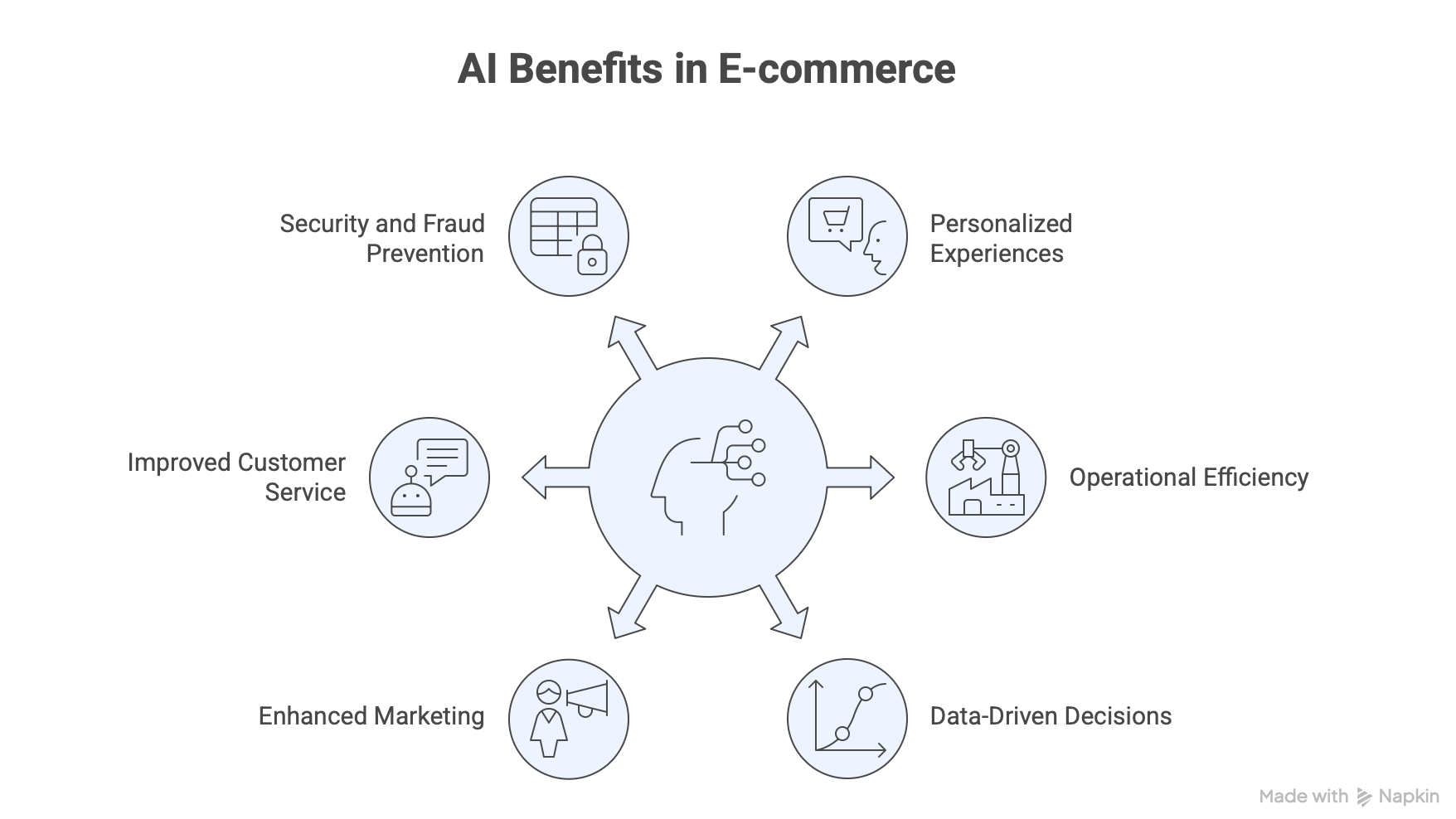
- Personalized Customer Experiences. AI enables highly tailored product recommendations, promotions, and shopping journeys. This personalization boosts customer engagement and sales. For example, personalized recommendation systems significantly increase purchase intent by highlighting relevant products to customers. Top retailers leveraging AI-driven personalization have seen revenue growth ~10 percentage points higher than those who lag, translating to an estimated $570 billion in potential incremental growth by 2030.
- Operational Efficiency & Automation. Implementing AI can streamline back-end processes and reduce manual effort. 69% of eCommerce companies that adopted AI report increased efficiency and faster work processes. AI helps with demand forecasting, inventory management, and warehouse automation – all of which improve operational effectiveness in supply chains. In short, one major benefit of AI in eCommerce is doing more with less, faster.
- Data-Driven Decision Making. AI systems can analyze vast data to support better decisions in pricing, merchandising, and planning. AI-driven dynamic pricing, for instance, can adjust prices in real time based on demand and competition, increasing profits while reducing the need for manual pricing work. Likewise, AI-based analytics improve demand forecasts and help optimize stock levels, leading to fewer stockouts or overstocks.
- Enhanced Marketing and SEO. AI helps marketers target the right customers with the right message. About 20% of online retailers now use AI for digital marketing tasks (like audience targeting and ad management). Generative AI can also create search engine optimized product descriptions at scale – leading to higher Google rankings, more traffic, and higher conversion rates for product pages.
- Better Customer Service. AI-powered chatbots for customer support and virtual assistants can handle customer inquiries 24/7, providing instant support. This improves customer satisfaction and reduces burden on human support teams. Studies show that well-designed AI chatbots significantly enhance customer satisfaction and loyalty in eCommerce settings. (We’ve all appreciated a quick answer from a chatbot instead of waiting on hold, right?)
- Security and Fraud Prevention. Another benefit of using AI in eCommerce is stronger fraud detection and security. Machine learning algorithms excel at spotting suspicious patterns in transactions far faster than humans. These AI systems proactively identify and reduce fraud risks by detecting anomalies in real-time, helping protect both retailers and customers. With online fraud attempts on the rise, AI has become a crucial tool to keep eCommerce platforms safe.
10%+
revenue lift from AI-powered personalization
25%+
increase in customer satisfaction with AI chatbots
2x
profit gains from AI-driven dynamic pricing & automation
Personalized Customer Experiences and Marketing
One of the most visible benefits of AI in eCommerce is the dramatic improvement in personalization. In traditional online shopping, every customer saw the same content.
AI-powered recommendation engines are a prime example. These systems analyze customer behavior and preferences (clicks, past purchases, search queries, etc.) to suggest products a shopper is likely to love. The result? Shoppers discover more relevant products and often buy more.
Beyond just product suggestions, AI enables personalized promotions and marketing campaigns. Retailers can use AI to segment customers into very specific groups and target them with custom offers or content.
Boston Consulting Group highlights that returns on personalized offers can be up to 3× higher than mass promotions. Despite this, many companies still under-invest in personalization – which means those who do invest stand to gain a competitive edge.
The benefits of using AI eCommerce automation for marketing are higher conversion rates and basket sizes, because customers are seeing more of what they actually want.
AI-Generated Content and Enhanced Search
Content is king in eCommerce – whether it’s product descriptions, images, or how easily customers can find what they want. AI is making a huge impact in this arena by generating content at scale and improving the findability of products through smarter search. Let’s unpack these benefits.
Automated content creation
Writing hundreds or thousands of product descriptions and category pages is a massive task for any retailer. AI language models (like GPT-3.5 and other generative AI) can shoulder much of this workload. According to a 2024 industry survey, 42% of online retailers now use AI to create product information (such as product text for their websites).
This has multiple benefits: it saves human writers a ton of time, it reduces personnel costs, and it allows the site to have rich content for every item.
Site search and product discovery
Traditional keyword-based search on eCommerce sites can be frustrating (“Did you mean…?”). AI is changing that through natural language processing and even visual search capabilities. Large Language Models (LLMs) are being integrated into online shop searches to better understand queries and context.
In fact, three-quarters of online retailers believe AI-based search will become the standard within the next 2–5 years. Instead of relying on exact keyword matches, an AI-powered search engine can understand a query like “comfortable shoes for running a marathon” and deliver results that actually fit the intent (even if the product descriptions don’t literally have all those words).
The benefits of using AI in eCommerce search include more accurate results, the ability to handle long conversational queries, and even the option for voice search or image-based search.
Intelligent Customer Service (Chatbots and Virtual Assistants)
We’ve all interacted with customer service chatbots by now – those pop-up chat windows that offer help on websites.
AI chatbots and virtual shopping assistants can engage customers in real-time, answering common questions about products, orders, returns, and more. The immediate benefit is availability: unlike human agents who require sleep and breaks, AI chatbots are available 24/7 and can handle multiple queries simultaneously.
This means a shopper who has a question at midnight can get help instantly, rather than sending an email and waiting 24 hours for a response. Speedy responses make customers happier and more likely to complete a purchase instead of abandoning their cart out of frustration.
Speaking of costs, automation of customer service through AI can save a lot of human labor for simpler tasks. Instead of needing a large call center to answer “Where is my order?” or “What’s your return policy?” questions all day, a retailer can let the AI handle those routine queries. This frees up human support agents to focus on more complex or high-value customer issues (or simply allows a leaner support team).
Operational Efficiency and Automation
Behind the scenes of every eCommerce website is a complex operation: managing inventory, processing orders, handling fulfillment and logistics. AI is increasingly the secret sauce optimizing these back-end processes.
Supply chain and inventory management
By analyzing historical sales data, seasonal trends, and even external factors like weather or social media buzz, AI algorithms can forecast demand for products with far more accuracy than traditional methods. This means retailers can stock the right products in the right quantities at the right time.
Retail giant Amazon famously employs AI-driven demand forecasting to anticipate what products will be needed where, even implementing “predictive shipping” where items are re-positioned to warehouses closer to regions where they’re likely to sell next.
The benefit is less overstock (tying up cash in inventory that doesn’t move) and fewer stockouts (missing sales because a hot item ran out). For customers, it means items are more likely to be available and delivered faster.
Warehouse and fulfillment automation
AI powers the robotics and optimization systems that can sort products, pack orders, and route shipments most effectively. For instance, some warehouses use AI-driven robots to fetch items off shelves for each order, following the shortest path and coordinating in real-time to avoid congestion.
It’s no wonder that in the Harvard Business Review Analytic Services survey of eCommerce organizations, 70% of respondents said implementing AI in operations was very or extremely important – and those who had adopted it reported 69% improved efficiency and faster processes.
Dynamic pricing and inventory optimization
We touched on dynamic pricing earlier: using AI to adjust prices in real-time. From an operations standpoint, this isn’t just about charging more when demand is high; it’s also about reducing excess inventory and maximizing revenue.
The benefit is a more agile operation that responds quickly to market conditions – something traditional rule-based pricing or periodic manual adjustments struggled to achieve.
Data-Driven Decision Making (Analytics, Forecasting, and Pricing)
AI is giving companies superpowers when it comes to analyzing data and guiding decision-making. This is a slightly more abstract benefit than, say, “faster packing” or “more sales from personalization,” but it underpins many of the advantages we’ve discussed.
First, consider the sheer amount of data even a mid-sized online retailer generates: website click streams, marketing campaign data, transaction records, customer reviews, supply chain logs, and more. Buried in this mountain of data are insights about customer behavior, market trends, and operational bottlenecks.
Traditional analytics might summarize the data in reports, but AI can go further by finding complex patterns and making predictions that humans might miss.
Demand forecasting
AI models (especially those using machine learning on time-series data) have proven to be highly effective at forecasting sales for different products under various conditions.
The benefit of accurate forecasts is better decisions around purchasing and inventory – you know what to buy, when to run promotions, or how to allocate budget.
Research by Rana et al. (2022) emphasized that AI capabilities in forecasting contribute directly to better performance in eCommerce operations. Better forecasts = smarter decisions up the chain.
Pricing strategy
Beyond dynamic pricing automation, AI can assist in setting overall pricing strategies by analyzing customer elasticity (how sensitive customers are to price changes), competitor pricing data scraped from the web, and even macro factors.
An AI might reveal that a slight price drop on certain popular items could dramatically increase customer acquisition, which pays off in the long run, while suggesting price increases on niche items where you have a unique supply.
These are nuanced decisions that AI can support with data-driven scenarios, helping executives move from gut feeling to evidence-based strategies. Indeed, businesses are starting to use AI tools as a kind of decision support system – a smart assistant that provides recommendations or identifies anomalies (“Hey, product XYZ is trending on TikTok, consider featuring it on your homepage”).
The benefit here is more effective use of marketing budgets and personalized approaches, tying back to the earlier section on marketing.
Security and Fraud Prevention
eCommerce has opened up wonderful conveniences for shoppers, but it also opens the door to fraud and security challenges. Stolen credit cards, fake accounts, account takeovers – these threats are very real for online stores. Fortunately, one of the benefits of using AI in eCommerce is a stronger defense against fraud and cyber threats. AI’s ability to analyze patterns at scale makes it ideal for spotting fraud that would slip past traditional methods.
Fraud detection in eCommerce often involves sifting through millions of transactions to find the proverbial needle in a haystack – the one fraudulent transaction among thousands of legitimate ones. AI excels at anomaly detection: it can learn what normal purchasing behavior looks like for each user and each context, and then flag when something falls outside of that pattern.
AI isn’t just limited to credit card fraud detection. It’s also used to detect account takeovers (noticing if a user suddenly logs in from a new location and orders something unusual), fake reviews or bots, and voucher abuse. Modern e-commerce platforms use AI to differentiate between human behavior and bots scraping the site or attempting brute-force attacks.
Another aspect is false positives – i.e., accidentally flagging or blocking legitimate transactions. Traditional fraud rules can be overly broad, sometimes causing good customers to be declined (which is obviously bad for business and customer experience). AI can help reduce false positives by making more nuanced decisions. It might score each transaction on a risk probability instead of a binary yes/no based on one rule.
Challenges and Considerations (Staying Realistic)
We’ve highlighted many benefits of AI in eCommerce, but in the spirit of not overselling, it’s important to acknowledge that implementing AI is not without its challenges and caveats. Adopting AI effectively requires addressing certain issues – from data privacy to talent – to truly realize those benefits. Let’s briefly discuss a few considerations eCommerce teams should keep in mind:
Data Privacy and Quality
AI systems thrive on data – lots of it, often personal. However, using customer data for AI (like personalization) must be done in compliance with privacy laws (GDPR, CCPA, etc.) and in a way that maintains customer trust.
In a recent industry study, 55% of companies cited data privacy concerns as a barrier to AI adoption. Additionally, AI is only as good as the data it’s trained on; poor or biased data can lead to flawed AI outcomes (like recommending the wrong products or, worse, discriminatory decisions). eCommerce firms need clear data governance and possibly strategies to anonymize or aggregate data for AI use.
Talent and Expertise
Building and integrating AI solutions requires skilled professionals – data scientists, ML engineers, etc. There’s a known shortage of AI talent, and about 49% of organizations reported a lack of specialized AI expertise as a challenge to implementing AI.
Smaller eCommerce businesses might find it daunting to hire and retain such talent. This is where partnering with AI solution providers or using off-the-shelf AI services can help, but internal understanding is still needed to deploy and maintain these systems.
Strategic Alignment
Simply throwing AI at a problem doesn’t guarantee a benefit. Nearly half (48%) of companies in one survey said they lacked a clear AI strategy. AI projects need to be aligned with business goals (e.g., “reduce fulfillment cost by 10%” or “increase conversion rate on product pages”), and there should be a roadmap for integration.
Without strategy, companies risk investing in AI tools that don’t move the needle or are too siloed to have broad impact.
Customer Trust and Ethical Issues
Some AI applications carry risk of customer pushback if not handled carefully. For example, dynamic pricing is great for profits, but if customers feel they’re being unfairly charged different prices or if the pricing isn’t transparent, it can erode trust.
Research on AI-driven pricing notes potential negative impacts on perceived fairness and trust if pricing feels discriminatory. Similarly, overly aggressive personalization can cross the line into “creepy” if customers feel their data is being used in uncomfortable ways. And chatbots, if not clearly identified as bots, can confuse or frustrate users. Ensuring ethical use of AI and maintaining a human touch when needed is crucial.
ROI and Maintenance
AI isn’t a one-and-done plug-in that magically works forever. Models require maintenance, retraining with new data, and monitoring to ensure they keep performing well. Companies should be prepared for ongoing investment. It’s wise to start with pilot projects that clearly demonstrate ROI (return on investment).
Fortunately, many of the benefits we cited (like efficiency gains, higher conversion rates, reduced fraud losses) can be measured, so it’s possible to track whether the AI is delivering value above its cost. But patience and iteration are often required; AI might not hit 100% performance on day one, but can improve over time.
By considering these factors, eCommerce teams can approach AI adoption with eyes open. The benefits of using AI in eCommerce are indeed impressive, but capturing them requires thoughtful implementation. It’s all about leveraging AI as a tool – not a magic wand – and combining it with human insight and good business practices.
Final Thought
In conclusion, AI is like the new electricity powering modern eCommerce – often invisible to shoppers, but lighting up the entire system. The benefits are compelling and within reach, provided one approaches AI adoption with a balance of enthusiasm and realism. With robust planning and ethical use, AI can indeed be a friendly ally (not a sci-fi overlord!) that helps eCommerce businesses thrive and innovate.
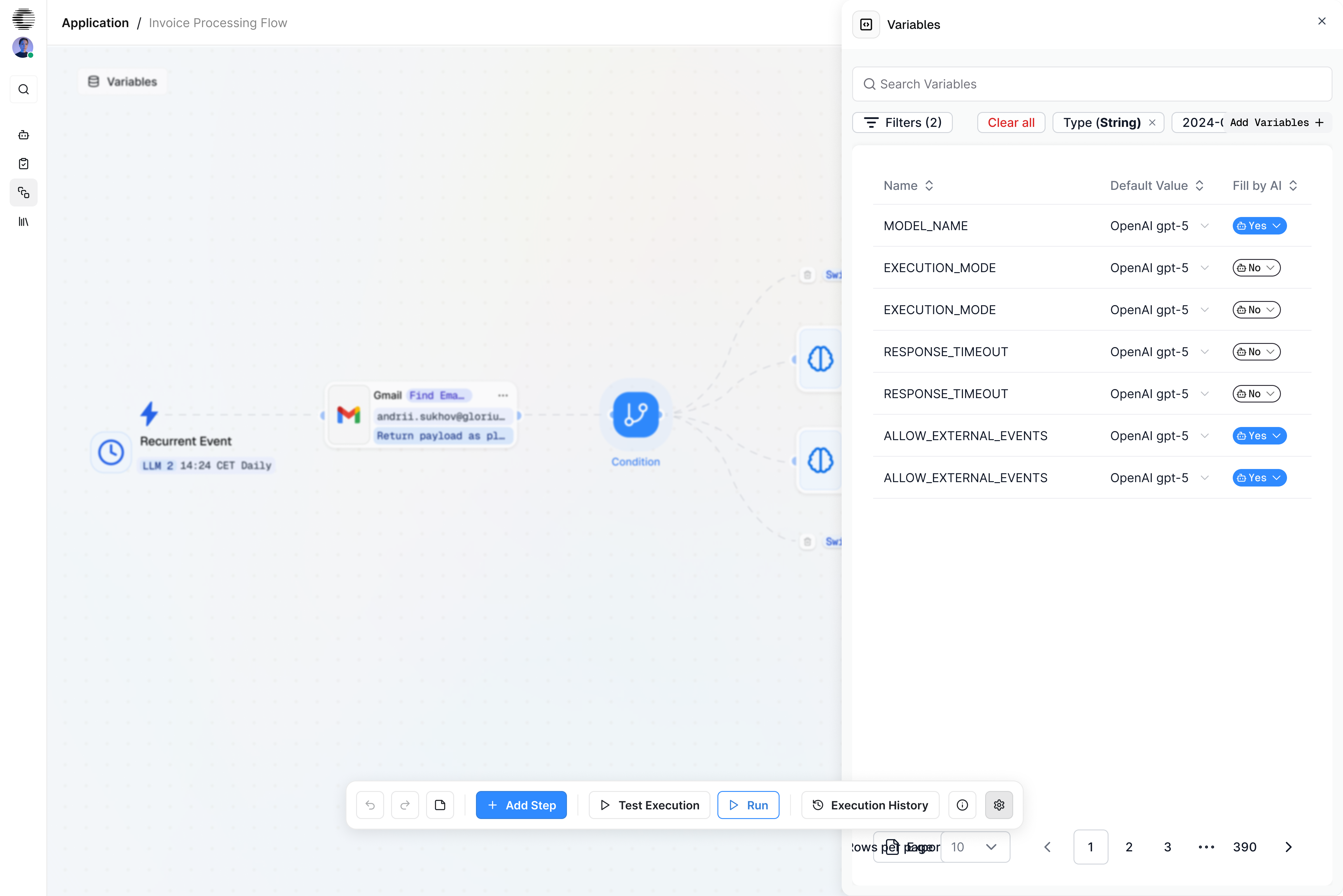
If you’re exploring solutions that can help you actually implement the benefits of AI in your eCommerce business, meet CogniAgent – an AI agent builder designed specifically for online retailers.
What CogniAgent Can Do for Your eCommerce Business
- AI customer support agents that instantly resolve the majority of common inquiries
- Personalized product recommendation agents to boost conversions and AOV
- AI sales assistants that guide shoppers and reduce friction across the buying journey
- SEO-friendly content agents for product descriptions, category copy, and marketing assets
- Workflow automation agents for repetitive operational tasks (order tagging, routing, catalog updates)
- Smart search or discovery agents using natural language and product understanding
- Fraud & risk alert agents that monitor unusual patterns in real-time
- Easy integrations with Shopify, WooCommerce, CRMs, ERPs, support tools, and more
If you want to experience how AI can enhance your operations and help you achieve these benefits, book a demo and let’s explore how CogniAgent can support your growth.