



If you work in B2B eCommerce, you already know the truth: Your customers expect speed. Your team is buried in manual work. And your internal systems are… let’s say, less than modern.
That’s exactly why AI has become such a big deal in the B2B space. Companies are starting to realize that smart automation can take over repetitive tasks, streamline messy workflows, and give customers the fast, accurate service they want, without burning out your sales or ops teams.
In this article, we’ll unpack how AI in B2B eCommerce (especially AI-powered chatbots) is reshaping how companies manage quotes, complex orders, and everyday customer requests. You’ll see what’s changing, how the tech actually works, and why it’s becoming a competitive advantage rather than a cool experiment.
Why B2B eCommerce Needs AI
B2B eCommerce differs significantly from B2C. B2B orders often involve:
- large catalogs with hundreds or thousands of SKUs;
- custom pricing (volume discounts, negotiated prices);
- varied delivery requirements (partial shipments, multiple locations);
- special contract terms (payment terms, credit limits); and
- repeated and customized ordering cycles per customer/account.
Handling quotes, processing orders, and responding to complex requests in such environments manually often leads to bottlenecks, errors, delayed responses, and frustrated customers.
AI-enabled chatbots (far more advanced than earlier rule-based bots) offer a way to automate large parts of this complexity. As described by industry experts, AI chatbots for B2B can go beyond “simple support” tasks and manage intricate workflows such as validating order details, managing dynamic pricing, automating invoice generation, and handling exceptions.
According to a recent report, the global AI-enabled eCommerce market is valued at around US$ 8.65 billion in 2025, with predictions to reach US$ 22.6 billion by 2032.
Moreover, many B2B eCommerce businesses are evaluating or already integrating AI into their operations: adoption has surged significantly in recent years.
These trends signal that implementing AI isn’t a fringe advantage, but a central strategy for competitive B2B eCommerce companies aiming to scale, increase operational efficiency, and improve buyer experience.
What AI Chatbots Actually Do for B2B Companies
Let’s break it down into the three areas where AI is making the biggest impact: quotes → orders → complex support requests.
1. Quote Generation (Instant, Accurate, and No Email Chasing)
Every B2B company knows how painful quoting can be. You chase info, you build spreadsheets, you ask the pricing team to verify margin rules – it’s a whole saga.
AI completely flips this process. Here’s what chatbots can now do:
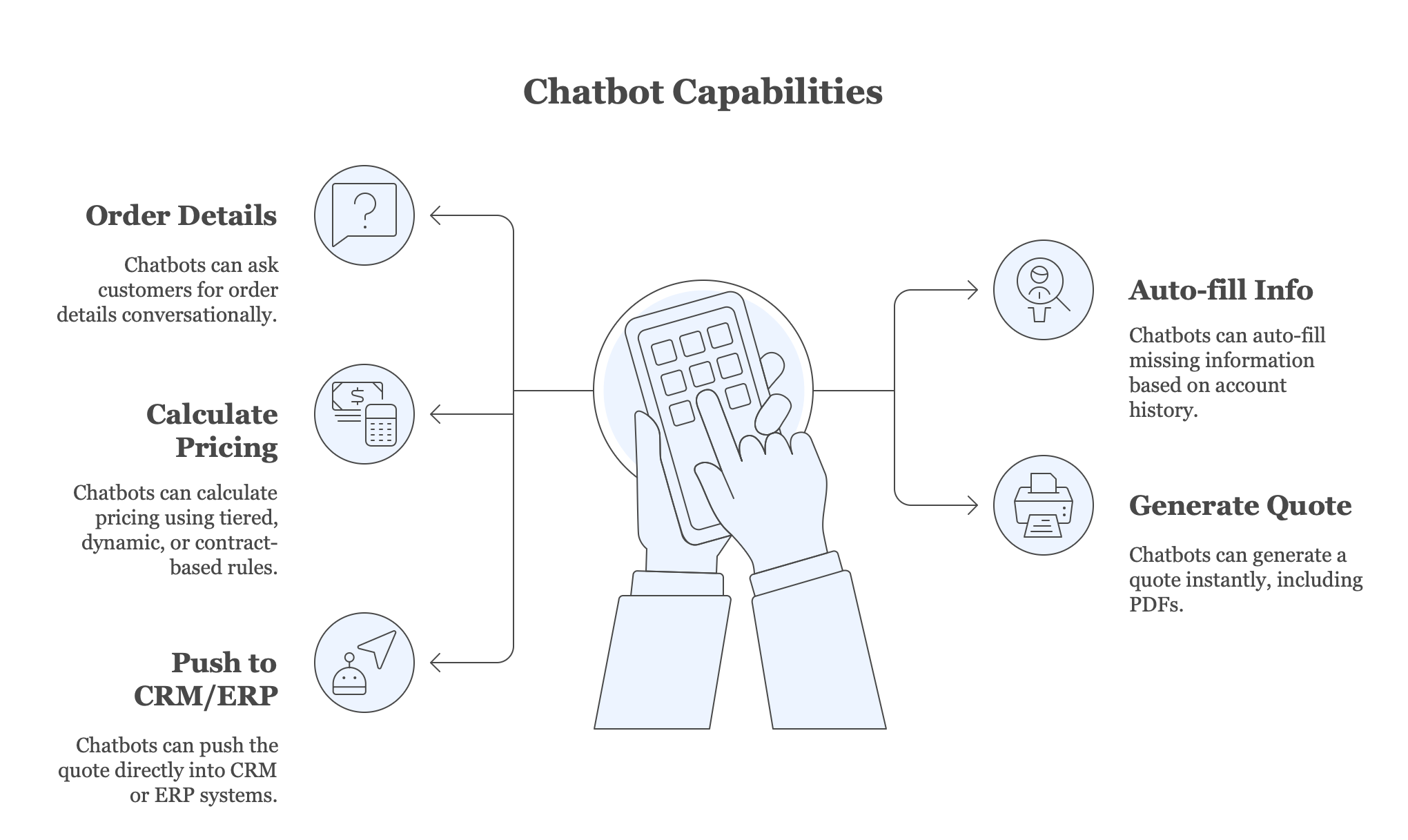
- Ask customers for order details conversationally
- Auto-fill missing info based on account history
- Calculate pricing using tiered, dynamic, or contract-based rules
- Generate a quote instantly (PDFs included)
- Push it directly into CRM or ERP
Why this matters? Faster quotes = more closed deals. And fewer mistakes = fewer “Oops… let me resend that” situations.
2. Processing Complex Orders (Without Re-Keying Anything)
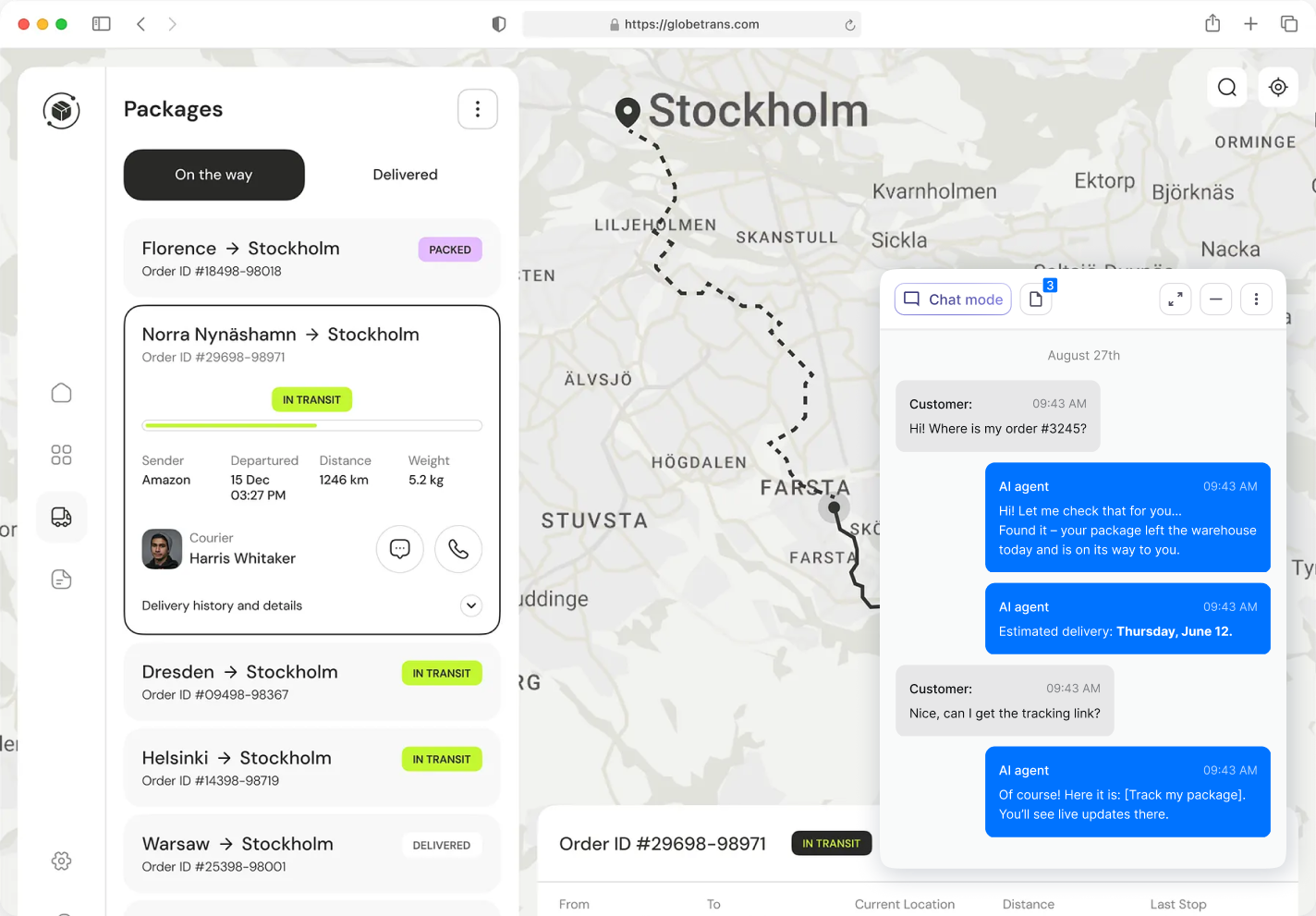
B2B orders aren’t a simple “Add to Cart.” They come in emails, PDFs, Excel sheets, or long verbal descriptions like: “I need the same thing as last time, but 200 more, and ship half to Chicago.”
AI chatbots and AI agents can:
- Parse orders from emails or uploaded documents
- Validate SKUs, pricing, quantities
- Check contract terms or credit limits
- Flag order anomalies (e.g., weird quantities or unfamiliar SKUs)
- Auto-create the order in ERP or OMS
Big takeaway? This removes so much manual work that teams suddenly have time for, well… actual work.
3. Handling Complex Customer Requests (Not Just FAQs)
This is where AI really shows its value. In B2B, customers constantly ask things like:
- “Where’s my order?”
- “Can we split this shipment?”
- “Can you resend the invoice?”
- “Do you have that product in a different spec?”
- “Can we reorder what we purchased last quarter?”
AI chatbots can handle these with ease because they have real-time access to:
- Order history
- Inventory data
- Shipping status
- Pricing tables
- Customer-specific preferences
Bonus benefit: Chatbots never sleep. They answer instantly, even if the buyer’s in another time zone sending emails at 2AM.
Benefits of Using AI Chatbots in B2B eCommerce
Here’s a breakdown of the main advantages realized by B2B eCommerce companies deploying AI chatbots:
| Benefit | Impact / Outcome |
| Faster response & 24/7 support | Buyers get instant answers any time, improving satisfaction and reducing delays. |
| Reduced manual workload & errors | Automation of quotes, order entry, validation, invoicing – fewer data-entry mistakes, more consistent processing. |
| Better scalability | Handle many more clients/orders concurrently without proportional headcount growth. |
| Consistent pricing & quoting logic | Ensures standardized pricing, volume discounts, contract compliance, especially important in large catalogs or many customer tiers. |
| Improved customer experience & satisfaction | Clients appreciate speed, clarity, professionalism, building trust and loyalty. |
| Operational cost savings & efficiency gains | Reducing manual labor, errors, and delays – overall cost reduction; freeing staff for more strategic tasks. |
| Data-driven insights & personalization | Chatbots can tap into buying history, behavior patterns, account segmentation to suggest relevant products or offers, increasing average order value and customer retention. |
Challenges and Considerations of AI in B2B eCommerce
Adopting AI chatbots in B2B eCommerce is highly beneficial, but not without caveats. Implementing such solutions requires thoughtful planning and maintenance. Some common challenges:
- Integration complexity. B2B firms often have legacy systems (ERP, CRM, order management, PIM) — integrating chatbots seamlessly requires careful mapping of data flows.
- Data quality and consistency. AI is only as good as the data behind it. Disorganized catalogs, inconsistent SKUs, or messy order history can lead to errors or failed automations.
- Need for customization & logic. Off-the-shelf chatbots may not address complex B2B use cases (volume discounts, contract terms, bundles). Customization, rules + AI + business logic, is often required.
- Security, privacy, and compliance Chatbots often access sensitive data: client info, order history, prices, contracts. It’s essential to ensure compliance, secure data transfer, and privacy safeguards. Academic research points to security risks when chatbots embed external scripts or rely on third-party domains.
- Balancing automation and human touch. For highly complex requests, custom deals, or customer relationships, automation may not suffice. Companies must design workflows that allow smooth escalation to human agents when needed.
Therefore, successful adoption of AI chatbots in B2B eCommerce requires more than installing a bot, it requires a thoughtful strategy, integration, continuous monitoring, and hybrid workflows (AI + human).
Best Practices When Deploying AI Chatbot Solutions in B2B eCommerce
Here are the recommended best practices for companies looking to adopt AI chatbot solutions in B2B eCommerce:
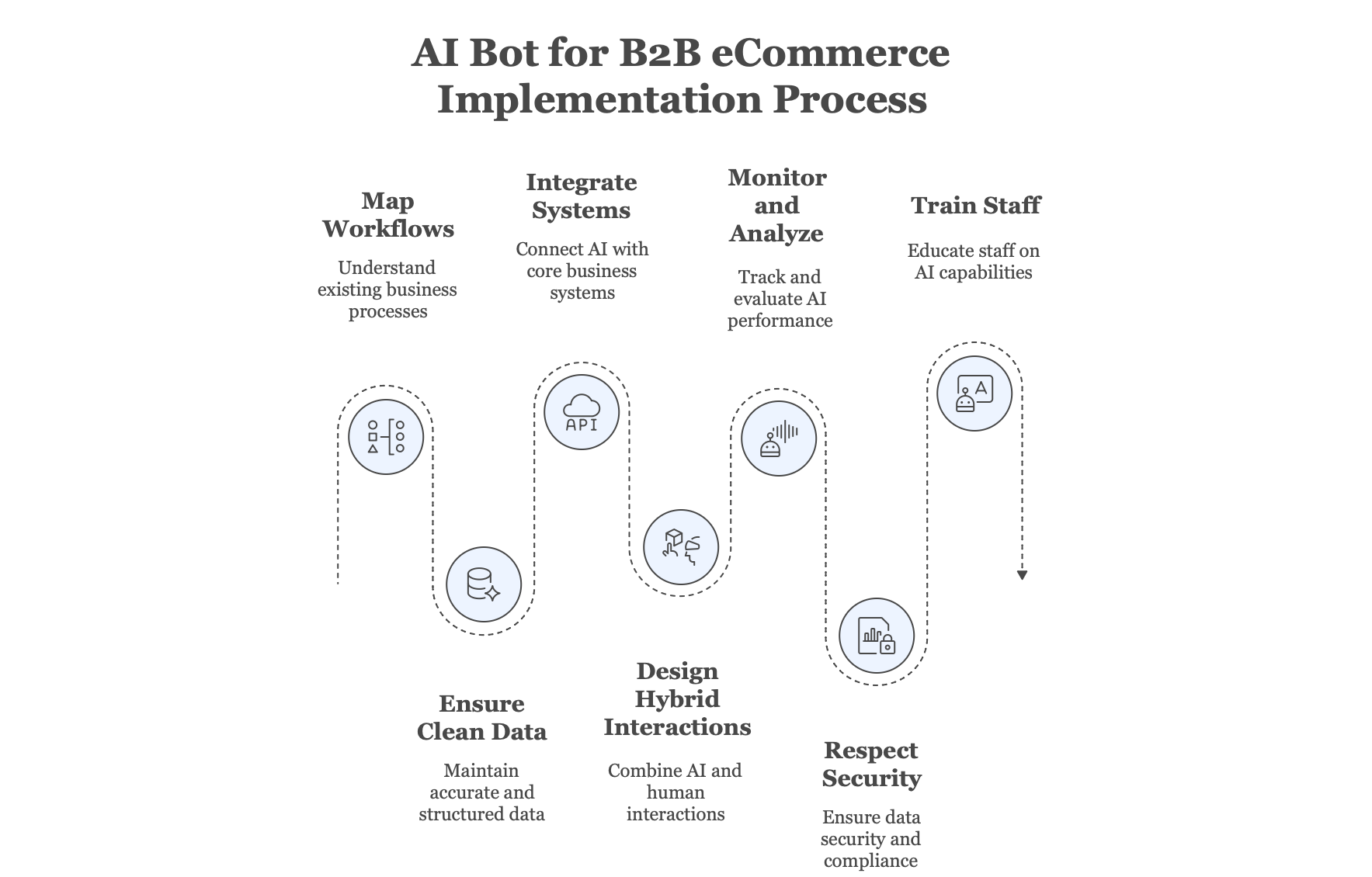
- Map your workflows thoroughly. Understand your quoting process, order flows, exceptions, discount logic, invoicing, and support needs before building the bot.
- Ensure clean, structured data. Maintain accurate SKU catalogs, price books, customer tiers, contract data, and order history. Good data hygiene is critical for AI performance.
- Integrate with core systems. CRM, ERP, order management, PIM — so the bot can pull and push data seamlessly.
- Design for hybrid interactions. Use AI to handle routine or predictable tasks (quotes, common orders, FAQs), but allow smooth escalation to human agents for complex or high-value cases.
- Monitor, analyze, and iterate. Track metrics: quote response time, order errors, customer satisfaction, conversion rate, lead time, cost savings. Use these to refine the bot and underlying processes.
- Respect security & privacy. Ensure data encryption, secure authentication, and compliance with regulations (especially if dealing with sensitive customer data, financial terms, or personal information).
- Train staff and set expectations. Ensure your internal teams understand what the bot can and cannot do; clarify escalation processes; define roles.
Adopting these practices helps maximize ROI from AI chatbot investments and reduces the risk of failed projects.
How to Evaluate and Choose AI in B2B eCommerce
Given the stakes and complexity, selecting the right AI chatbot solution is critical. Here are the criteria to evaluate potential solutions:
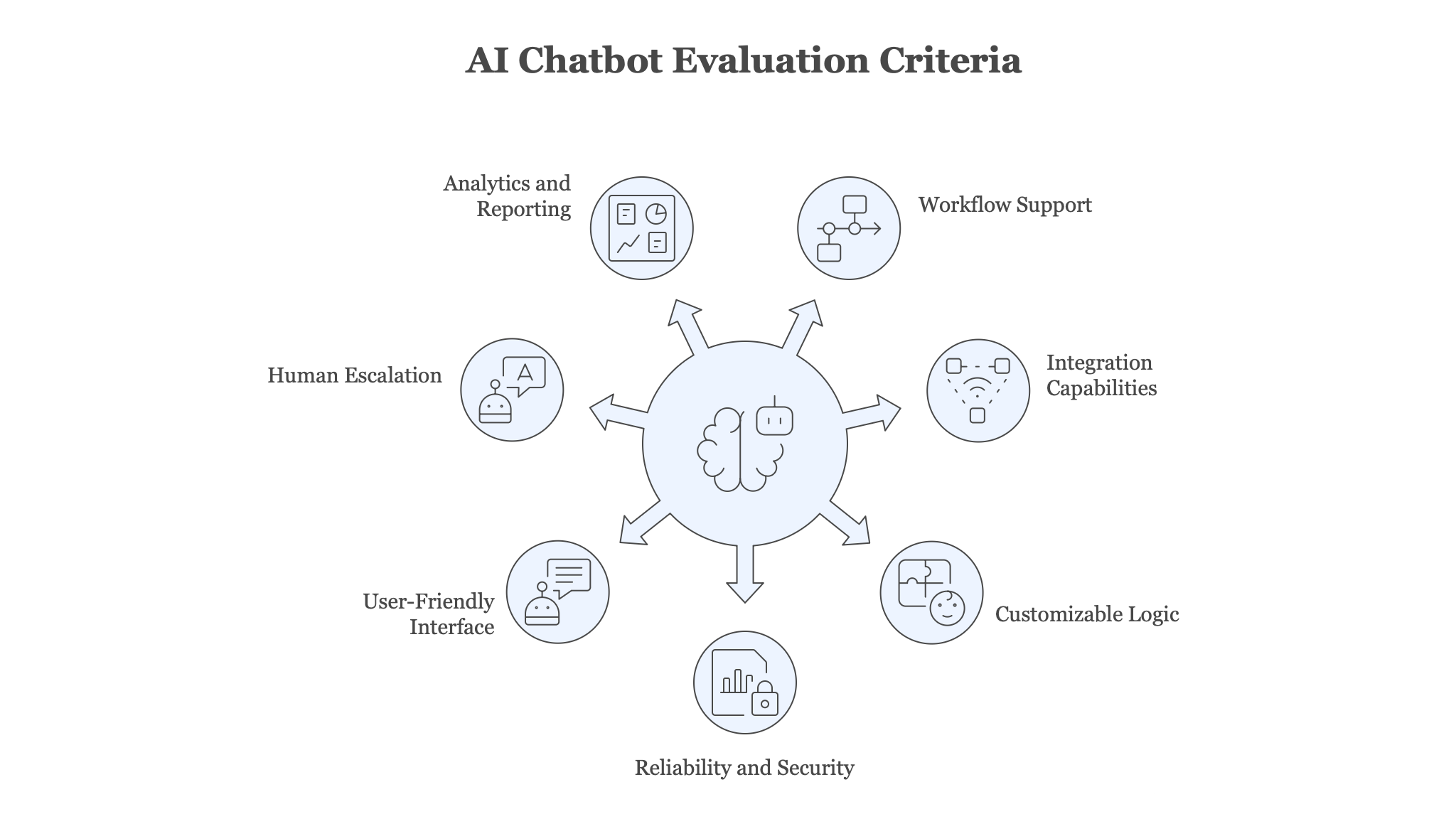
- Support for complex workflows. Does it handle quoting, order parsing, invoice generation, order validation, multi-step workflows, and approval flows?
- Integration capabilities. Can it integrate with ERP, CRM, PIM, order management, inventory, and invoicing systems, ideally via APIs or connectors?
- Customizable business logic. Ability to encode discount rules, contract terms, tiered pricing, bulk order logic, and shipping/delivery rules.
- Reliability, scalability, security. Can handle large volumes securely, ensuring data privacy and compliance.
- User-friendly conversational interface. NLP capabilities, ability to understand business-specific terms, SKUs, abbreviations, and handle real-world deviations.
- Fallback and human-in-the-loop options. For complex cases, custom deals, and exceptions — smooth escalation to human agents.
- Analytics and reporting. Ability to log all interactions, produce insight into order volume, common queries, bottlenecks, and error frequency, enabling continuous improvement.
- Long-term maintainability. Easy to update business logic, pricing rules, product catalogs; ability to retrain/adjust the AI as the business evolves.
How CogniAgent Helps Create AI Chatbot Solutions in B2B eCommerce
If you’re exploring AI chatbot solutions in B2B eCommerce and are curious about how to implement robust chatbot solutions tailored to your business, CogniAgent offers a comprehensive suite of tools and services designed exactly for that.
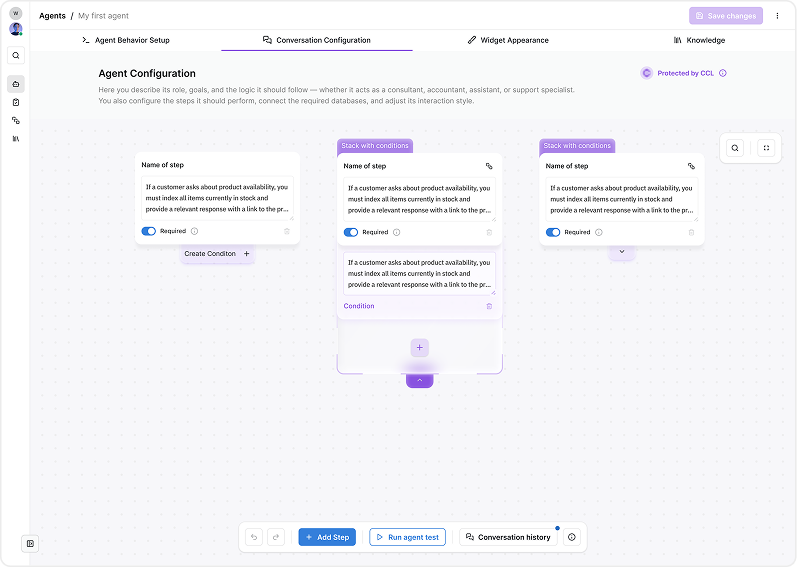
- CogniAgent’s AI Agent Builder enables businesses to build custom cognitive agents that understand business-specific language, product catalogs, pricing rules, and order workflows.
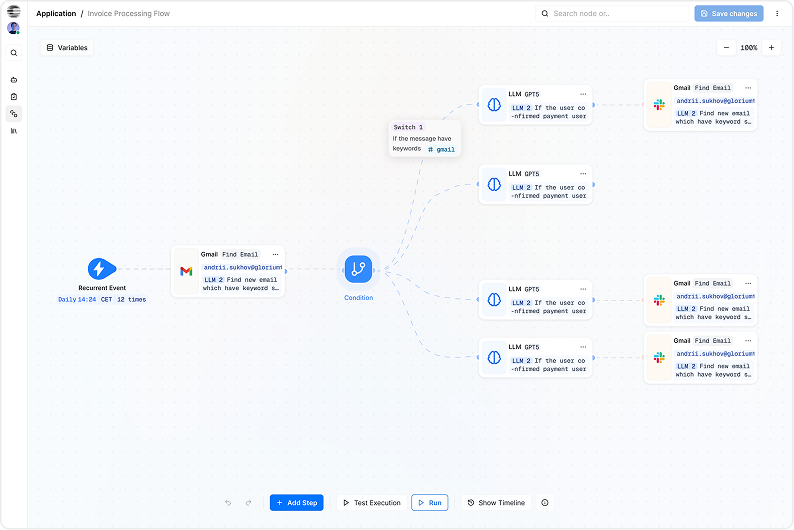
- The conversational AI for eCommerce offering ensures seamless integration with existing systems (ERP, CRM, order management), allowing chatbots to handle quoting, ordering, invoice generation, and customer support.
- With CogniAgent’s Cognitive AI and AI-driven business workflow automation capabilities, companies can process large and complex orders, validate data intelligently, handle exception cases, and deliver consistent, accurate results, while reducing manual workload.
- Beyond standalone chatbots, CogniAgent brings a wide range of AI use cases for eCommerce together into unified, end-to-end workflows. From quoting and ordering to customer support, personalization, and analytics, it helps businesses automate every step of the digital commerce experience.
Conclusion
What used to require armies of sales reps, order processors, and support staff can now be handled, at least in large part, by AI-powered chatbots. For companies dealing with complex quotes, bulk orders, customized pricing, and heavy catalogs, AI in B2B eCommerce is not just a trend — it’s a strategic imperative.
By implementing AI chatbot solutions in B2B eCommerce, businesses gain speed, accuracy, scalability, cost efficiency, and, perhaps most importantly, a competitive edge.
If you are considering this transformation, a partner like CogniAgent can make the difference, helping you build tailored, enterprise-grade AI chatbot solutions that handle quotes, orders, complex customer requests, and more, turning your eCommerce platform into a highly efficient, intelligent sales and service engine.
Ready to see how AI can streamline your quotes, orders, and customer workflows? Try CogniAgent for free and experience the difference.