



It’s 2 AM. A customer is finalizing a purchase on your website, but a question about your return policy stops them at the last step. In the past, this moment would have resulted in an abandoned cart, a frustrated customer, and a support ticket that wouldn’t be seen until business hours. But that’s no longer the case.
Today, your customer would be greeted with a helpful window saying, “Hi there! Have a question about returns? I can help.” They’d type their question, and in a matter of seconds, they’d receive a friendly answer, not a canned response but a specific answer that directly addresses their concern. The cart would be completed, the customer would feel heard and valued, and they would drift off to sleep with a positive impression of your brand without waiting a minute.
This is what modern AI customer service looks like.
This advanced tech is transforming customer support. It’s changing from deflecting tickets to actively improving the entire customer experience. By providing instant, accurate answers across all support channels, these AI systems dramatically reduce resolution time, turning potential moments of frustration into opportunities to build trust and loyalty. The result is a dramatic increase in customer satisfaction.
The benefits of a conversational AI platform for customer service teams extend far beyond the immediate interaction. These tools can empower your support team, handle routine questions, and soften the blow on your human agents, allowing them to focus on their expertise and more complex, high-value issues that require a bit more personal touch than simple FAQs.
We created this article to walk you through the leading conversational AI solutions for customer service teams and provide the expert insight you need to choose the right technology for your business.
Why Do Companies Invest in Conversational AI for Customer Service?
Conversational AI for customer service is an advanced type of AI that allows computers to comprehend, process, and react to human language in a fluid, natural manner, making the conversations comfortable and human-like. It uses natural language processing (NLP) and natural language understanding (NLU) to capture the intent behind customer inquiries (even through typos or colloquial language), which traditional chatbots can’t, they rely on strict, pre-defined scripts. This allows it to conduct dynamic, helpful customer conversations across various ways and channels, providing a far more intuitive and effective form of customer engagement.
Businesses are spending more money on this technology as a strategic asset that changes their support function rather than just as a toy. The advantages are numerous and affect every aspect of business operations, from customer satisfaction to financial performance.
1. 24/7/365 availability
Customer problems don’t only arise between 9 and 5 in our constantly connected world. Without the prohibitive expense of scaling your human resources linearly, conversational AI for customer service offers 24/7 support, guaranteeing that assistance is available whenever your customers need it.
Because of this continuous availability, you can reach and help clients from various time zones and schedules, transforming after-hours into a chance to wow and keep customers—all without requiring a live chat agent to work the night shift.
2. Instant resolution for tier-1 queries
Repetitive, straightforward common problems like checking the status of an order, changing a password, or requesting business hours account for a sizable percentage of customer inquiries. These repetitive tasks are handled instantly by conversational AI for customer service, which reduces wait times from minutes or hours to just a few seconds.
Customers can get the instant answers they want by automating these use cases, and your support staff can concentrate on more difficult tasks because they won’t have to answer the same questions over and over again.
3. Support resource optimization
Conversational AI directly lowers operating costs while improving service. An AI agent’s cost per interaction is significantly lower than a human agent’s. Because routine customer inquiries are handled much less frequently, businesses are able to strategically reallocate their human support budget.
Resources can be allocated to training specialized customer service agents to handle complex issues rather than hiring large teams to handle volume. This will ultimately improve support quality while controlling support costs.
4. Frictionless, immediate, and on-demand customer service
Customers of today demand quick and simple service. Instant engagement, less friction, and letting users self-serve on their own terms are all ways that conversational AI delivers. Even a consistent, brand-consistent tone of voice can be maintained by advanced AI, which makes interactions seem less transactional and more organic.
Increased customer satisfaction and loyalty are directly correlated with this proactive approach to problem-solving.
5. Handling peaks without panic
Customer inquiries can skyrocket during a service outage, holiday sale, or product launch. Hiring enough support staff to manage these brief spikes is not easy. With no performance deterioration or response time increase, conversational AI can handle thousands of concurrent conversations on your website, mobile apps, and social media platforms.
It guarantees that even during your busiest times, your service quality stays constant at a high level.
6. Turning conversations into strategy
The wealth of data conversational AI offers is arguably one of the most underappreciated advantages. Every conversation is recorded and examined, providing unmatched consumer insights. Customer feedback can be used to identify common problems, frequently asked questions, and new trends.
Decisions regarding knowledge base content, product enhancements, and service offering gaps are all influenced by these insightful findings, which are priceless. Your AI and overall business strategy can be continuously improved with the help of this intelligence, which is derived from actual customer interactions.
7. Creating a unified support ecosystem
The smooth integration of a conversational AI agent with your current business systems unlocks its full potential. An advanced AI platform integrates with your CRM, help desk software, payment gateways, and other backend systems; it doesn’t work in a vacuum.
This enables the AI to access real-time customer data to provide personalized responses (such as checking the status of an order straight from the database) and to seamlessly escalate to human support with complete context when agent intervention is necessary, resulting in a seamless and effective customer journey.
The 10 Best Platforms to Build Conversational AI for Customer Service
Choosing a suitable conversational AI platform can be challenging when the market is saturated. Your unique business requirements, available technical resources, and strategic objectives will determine which option is best for you. We’ve put together a list of the top 10 platforms to aid in your decision-making:
1. CogniAgent
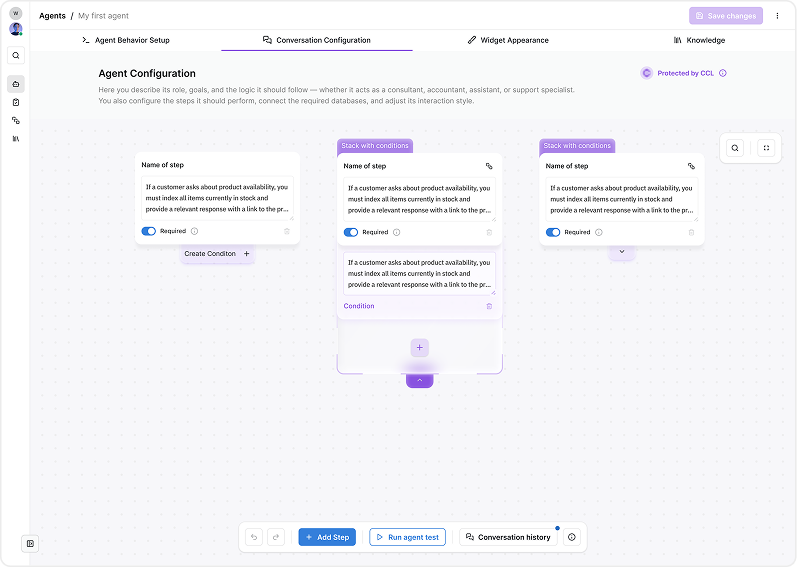
CogniAgent is a cutting-edge platform that goes beyond chatbots to develop cognitive and autonomous AI agents. It is designed for companies that require an AI workforce that is genuinely intelligent, sympathetic, and seamlessly integrated and that can automate intricate processes in operations, support, marketing, sales, and research.
Best for: Businesses of all sizes seeking a powerful, all-in-one platform with unmatched emotional intelligence, voice capabilities, and rapid deployment
Key differentiators:
- Workflow Automation. Automatically run repetitive tasks based on real business triggers. Create workflows from plain-text descriptions with minimal or no coding, and connect everything to your existing tech stack, including eCommerce, ERP, CRM, and more.
- Conversational AI. Build AI chatbots that handle natural sales and support conversations, manage sudden topic shifts without losing context, ask clarifying questions instead of guessing intent, and adapt fluidly as customer needs change.
- Autonomous AI Agents. Orchestrate multiple specialized AI models that collaborate, iterate, and take action together. They can use external tools, search the web, tap into your integrations, and process files to automate operations across your entire organization.
- Fast, no-code deployment that gets your AI agents up and running in just five minutes, with no expert support required.
2. Cognigy
Voice and omnichannel deployment are key components of the Cognigy enterprise-grade low-code platform that focuses on developing AI-powered customer and employee service experiences.
Best for: Large enterprises needing a scalable, secure solution for both customer and internal agent support.
Key features: High scalability, specialized AI for customer service, strong voice capabilities, and a low-code interface for faster development.
Considerations: Enterprise-focused pricing and implementation can be complex for smaller teams.
3. Rasa
Rasa is a powerful open-source framework for building contextual AI assistants that gives developers full control over the AI model and dialogue management.
Best for: Developer-led teams that require maximum flexibility and control and want to avoid vendor lock-in.
Key features: Open-source core, highly customizable NLU, designed for complex, contextual conversations.
Considerations: Requires significant in-house machine learning and development resources to build and maintain.
4. Gorgias
Gogrias is an AI-powered customer support platform designed especially for e-commerce (mainly Shopify and Magento) that automates support tickets within a helpdesk setting.
Best for: E-commerce businesses using Shopify that want AI deeply integrated into their helpdesk.
Key features: Native e-commerce platform integrations, auto-responds to standard tickets, suggests macros, and answers for agents.
Considerations: Its AI functionality focuses more on ticket automation than on building standalone, branded conversational agents.
5. Bland AI
Bland AI is a developer-focused API platform made especially for creating and implementing large-scale, realistic-sounding AI phone calls.
Best for: Developers and businesses that need to build and programmatically integrate AI-driven voice calls into their workflows.
Key features: Powerful voice-specific API, high-quality voice models, built for scalability and programmatic control.
Considerations: Primarily a voice API, not a full-suite chatbot platform; requires development work to implement.
6. Ada
An entirely automation-first, no-code Ada platform that prioritizes brand alignment and optimizing customer deflection through AI-powered interactions.
Best for: Brands that want to empower their customer service teams (non-technical) to build and manage AI automations.
Key features: Extremely user-friendly interface, strong personalization for brand voice, and automated performance tracking.
Considerations: Less customizable for complex, unique integrations without developer support.
7. Chatbase
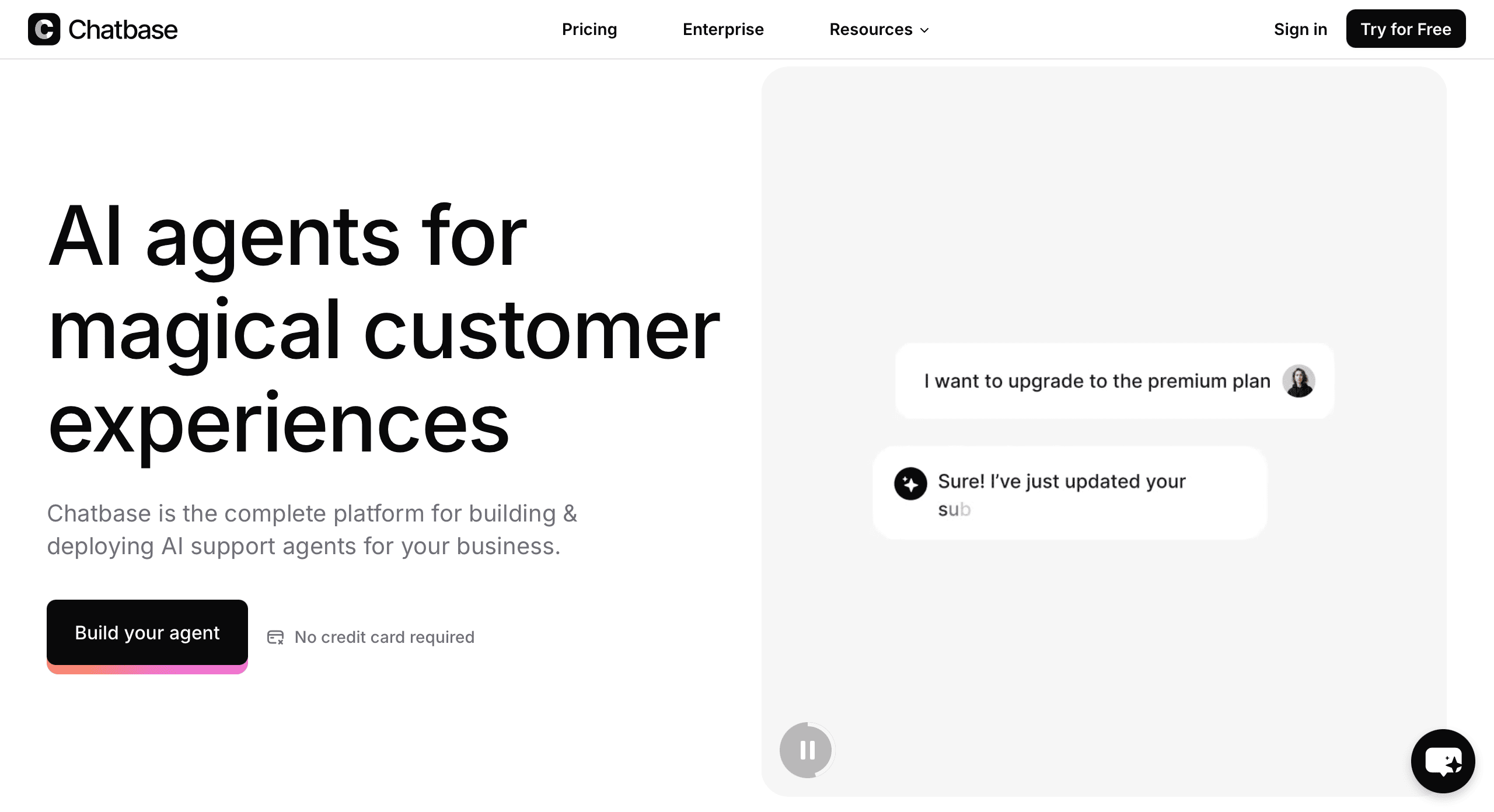
With only a link, Chatbase’s specialized tool makes creating AI chatbots trained on particular data, such as your website or documents, simple.
Best for: Businesses and individuals needing to quickly create a customized, data-trained Q&A chatbot with minimal effort.
Key features: Simple setup by crawling a website or uploading files, custom data training, ChatGPT-powered responses.
Considerations: More limited in complex workflow automation and enterprise integrations compared to full-scale platforms.
8. Intercom’s Fin
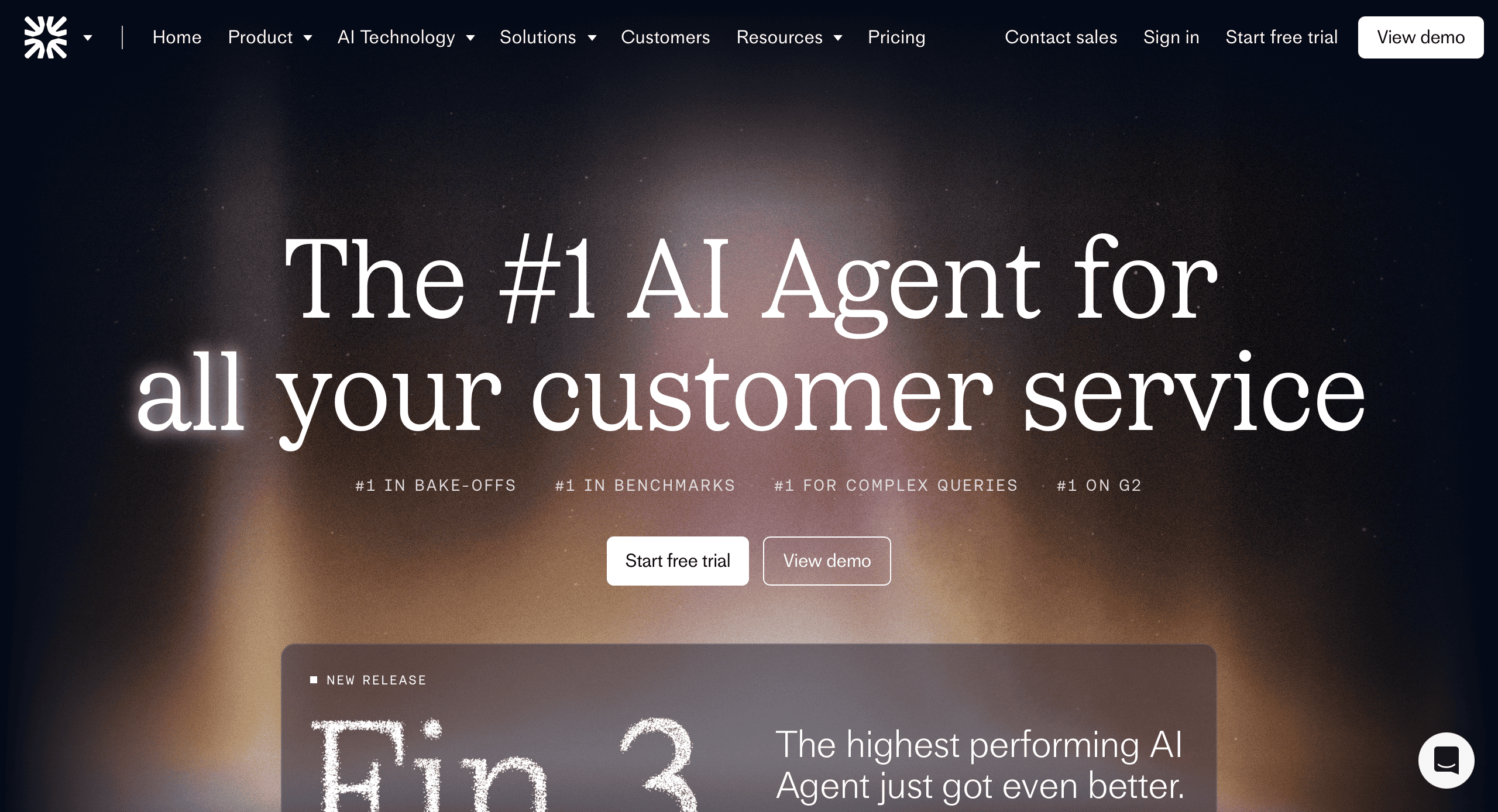
Fin AI chatbot that is fully integrated into the Intercom platform and intended to assist human agents in automating support and qualifying leads.
Best for: Sales and support teams using Intercom who want AI that feels like a natural part of their workflow.
Key features: Auto-trains on Intercom articles, resolves queries, and creates support tickets.
Considerations: A closed ecosystem; you must use Intercom for all related functions.
9. Decagon
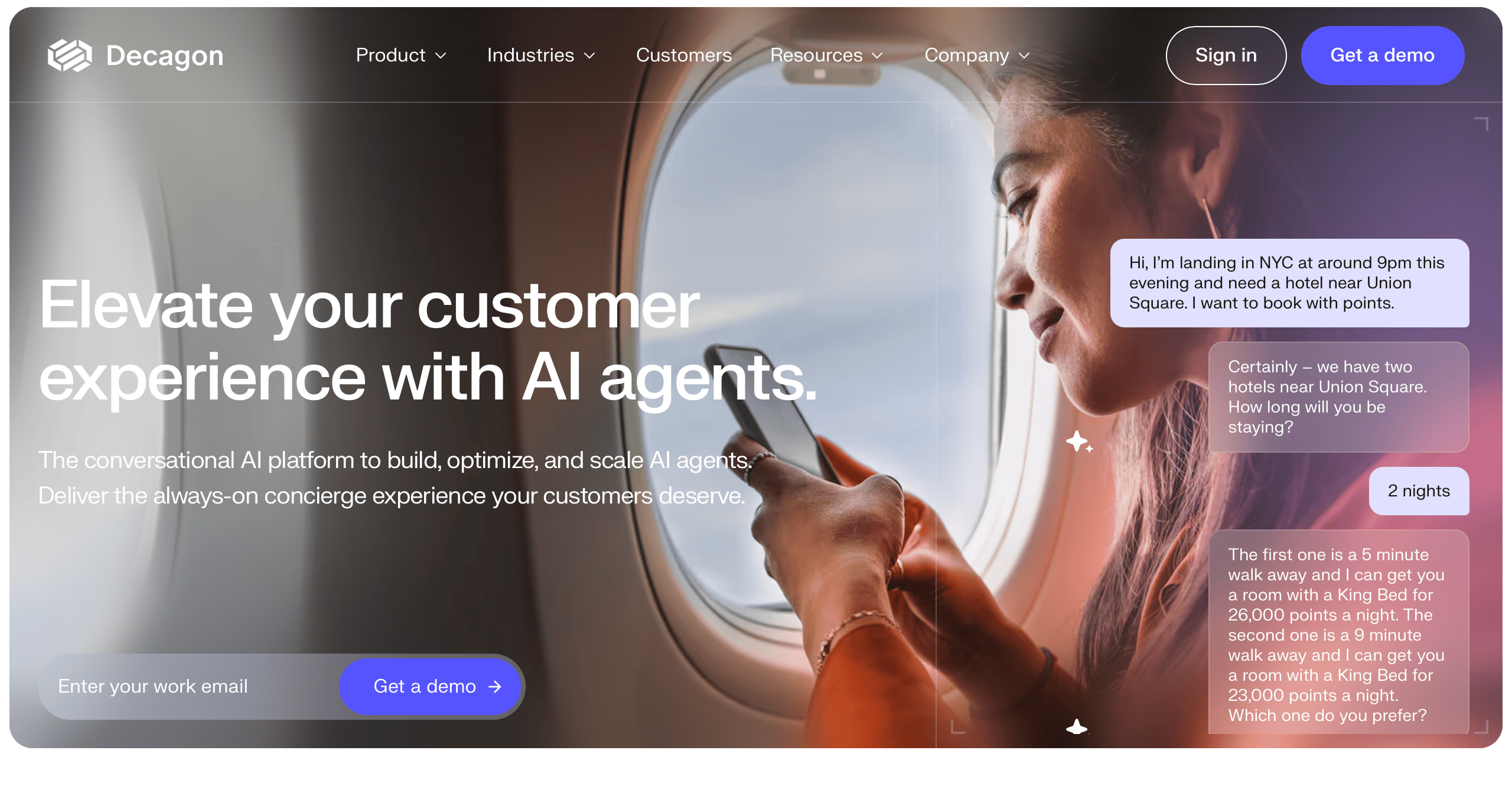
Decagon AI platform that specializes in creating and implementing conversational agents and AI models specially trained for particular enterprise use cases and sectors.
Best for: Enterprises with unique data and specific domain knowledge must build custom-trained, highly specialized AI agents.
Key features: Custom model development, domain-specific AI training, focus on enterprise-grade security and deployment.
Considerations: It involves a custom development and training process, which is less of an out-of-the-box SaaS solution.
10. Sendbird
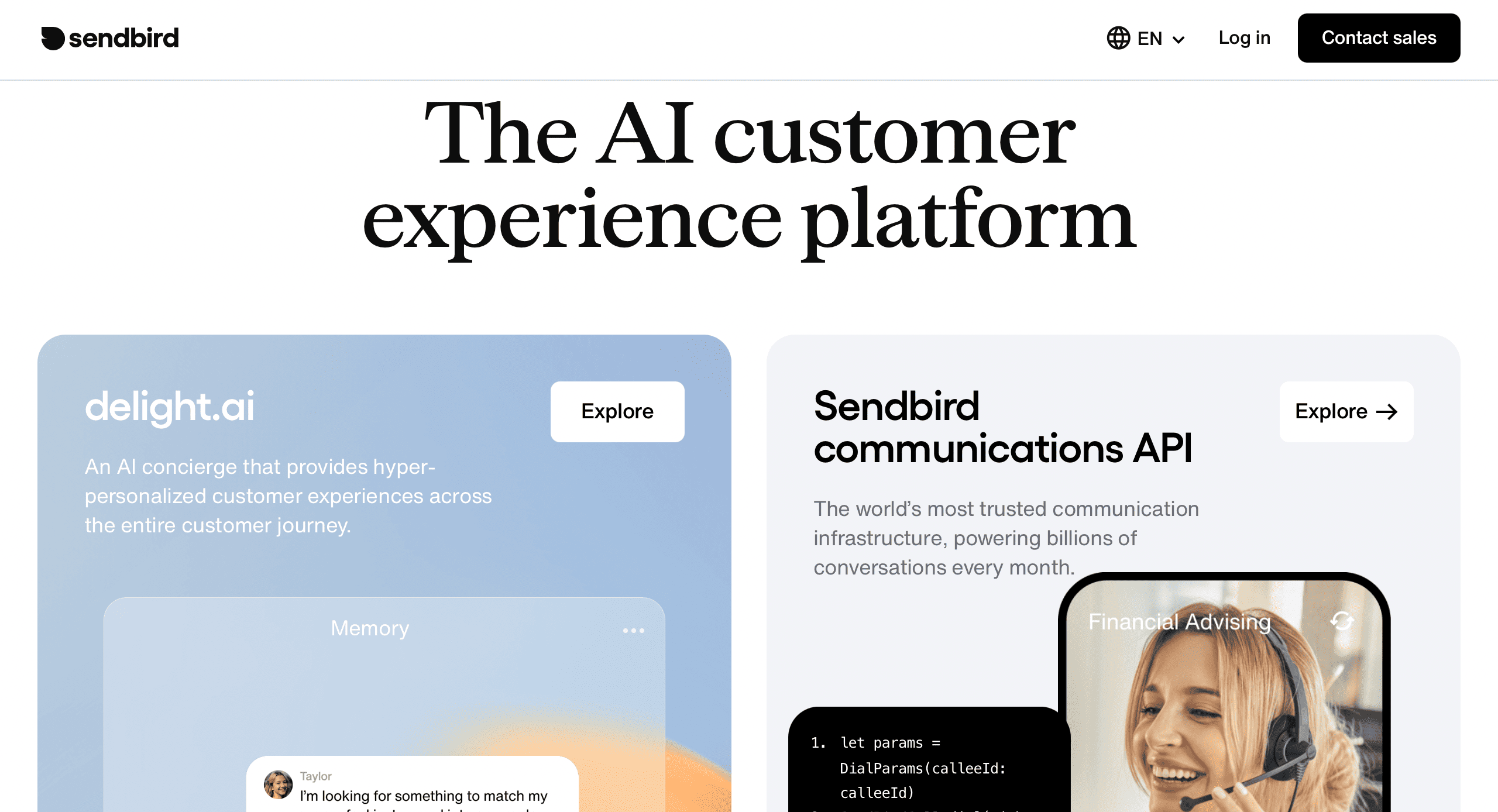
Sendbird is a communications platform that offers voice, video, and chat APIs uses AI to create more intelligent in-app dialogues.
Best for: Companies that need to embed AI-powered chat, voice, or video directly into their mobile or web applications.
Key features: Omnichannel in-app messaging API, now with AI chatbot capabilities, built for product integration.
Considerations: Its AI features are part of a broader communications suite focused on in-app experiences.
How to Choose the Right Platform (Key Evaluation Criteria)
Your customer relationships and financial performance will be impacted for years by your strategic choice when choosing the platform for your conversational AI for customer service. It’s simple to become overwhelmed by the abundance of robust AI tools. We recommend that you look past dazzling demos and concentrate on how a platform will function in the real world.
These are the main factors that we recommend all leaders consider:
1. Audit your workflows and start mapping AI capabilities to business goals
Auditing your current support flow should be your first step. Which routine tasks and common problems take up the most of your team’s time? A robust platform will be excellent at automating these, offering prompt answers to common questions, order status, and password resets. The most effective conversational AI customer support platform, however, will also have the capacity to learn and adjust, managing progressively more difficult tasks over time. “How does your AI learn from interactions to improve its accuracy and scope?” is a question to pose to vendors.
2. Prioritize the agent and customer communication
The most significant customer service conversational AI empowers people rather than replaces them. Analyze the platform’s assistance to your support staff. Seek out smooth handoff procedures that avoid customers repeating themselves by transferring all context from the AI to a human agent. This results in a cohesive support journey that significantly raises customer satisfaction and efficiency.
3. Demand actionable intelligence
Any simple bot can respond to inquiries. Conversational AI for customer service, on the other hand, adds significant value beyond the dialogue. Selecting a platform that turns basic chat logs into useful customer insights is essential. Is it able to track sentiment trends, uncover feedback regarding your products, and identify new pain points? This information is invaluable for enhancing your knowledge base, services, and even your product plan.
4. Scrutinize integration and scalability
The quality of a platform is determined by its connections. We advise you to prioritize solutions that provide smooth integration with your current IT stack, including your databases, help desk, payment systems, and CRM. This gives the AI access to real-time data so it can respond appropriately to consumer inquiries and take action, such as processing a return or updating a ticket. Additionally, make sure the platform can grow to accommodate your busiest times without experiencing a decline in performance.
5. Calculate the true total cost of ownership
Look past the sticker price, even though cutting operating costs is the primary motivator. Consider the entire cost of ownership, including the time needed for implementation, team training, and any additional integration fees. The most transparent vendors provide a free trial so you can see for yourself the platform’s benefits without committing. This practical experience is crucial for determining your company’s actual fit and possible return on investment.
6. Never underestimate the power of a test drive
Lastly, we strongly advise getting a hands-on experience with the technology. There is no negotiating a free trial. Take advantage of this opportunity to test the dashboard’s usability, the speed at which you can create flows, and the artificial intelligence’s ability to comprehend complex queries. This is the most effective method for figuring out whether a platform is the right partner for your quest for outstanding automated service.
Using these professional criteria, you can go beyond hype and select a platform that improves your customer experience, adds real business value, and lays the groundwork for future support.
Expert Insight: Implementation Best Practices
Selecting the appropriate technology is only one aspect of starting a successful conversational AI for customer service teams. The implementation process is where strategy meets execution. We’ve compiled the best practices that distinguish underutilized chatbots from high-performing AI agents based on our experience implementing these systems.
To make sure your deployment maximizes value and provides a remarkable conversational AI customer experience, heed this expert advice.
- Start with a clear goal. Never deploy AI just for the sake of it. Establish clear, quantifiable goals right away, like “Reduce ticket volume for password resets by 60%” or “Achieve a 90% containment rate on tier-1 queries.” This focus guides every subsequent decision.
- Design the human-in-the-loop process first. Carefully plan the handoff procedure before launching. To stop clients from repeating themselves, make sure the AI can smoothly escalate complicated issues to support agents while transferring the full context of the conversation.
- Train your AI tool on your unique data. The AI is only as smart as the information you give it. Provide it with your product manuals, knowledge base articles, frequently asked questions, and even previous support tickets. This goes beyond general answers and grounds its responses in the language and solutions unique to your business.
- Adopt a mindset of continuous improvement. A “set it and forget it” tool is not what your AI agent is. We advise you to set up a regular review cycle to examine conversation logs, find misunderstandings, and retrain the model. Conversational AI systems that learn and change over time are the best for customer service.
- Start narrow and then expand. Don’t try to automate every customer interaction on day one. Start with a high-volume, clearly defined use case (such as order tracking). Show that you can succeed there, gain knowledge from the experience, and then progressively increase the AI’s capacity to manage increasingly difficult tasks.
Ready to Transform Your Customer Service? CogniAgent is Your Next Strategic Step
Handling a saturated market of conversational AI for customer service teams is complex. Each offering a unique mix of features, integrations, and pricing. The best tool is ultimately the one that fits your business goals and technical capabilities.
While many powerful solutions are available, CogniAgent emerges as the best platform for conversational AI in customer service for businesses that refuse to compromise. It is more than just a chatbot builder; it is a full-fledged, self-sufficient AI workforce. CogniAgent provides a smooth, genuinely human-like experience with its unmatched voice capabilities, real-time emotion detection, and special adaptive problem-solving that manages both simple and complicated situations.
FAQ
How do we ensure the AI accurately represents our brand’s voice and tone?
A strong conversational AI platform for customer support should allow you to customize the tone and personality of your responses. To accomplish this, the AI is trained on your unique brand materials, such as marketing content, support documentation, and website copy. Whether your brand voice is friendly, professional, or humorous, the best platforms let you customize and improve the AI’s responses to guarantee consistency.
How does conversational AI handle a handoff to a live human agent when needed?
A seamless escalation protocol is essential to any successful conversational AI for customer service. When a customer requests to speak with a human, the AI should be able to identify its limitations. In order to avoid the customer having to repeat themselves and to guarantee a seamless experience, when escalating, it must send the complete conversation history and context to the human agent within your help desk software.
Can conversational AI for customer service operate across multiple channels like web, WhatsApp, and phone?
Yes. Omnichannel functionality is a standard feature of conversational AI for customer service. You can use a single AI agent on your website, mobile app, voice channels, and social media messaging platforms.
How do we train the Conversational AI for customer service on our specific products, services, and internal knowledge?
Training conversational AI for customer service starts by connecting the platform to your data sources (uploading documents, providing access to the help center, etc.). The AI will use this information to ground its responses and provide accurate information.