



It’s a holiday weekend, 2:17, and your website is busy with a flash sale – Inbox full, a customer in a different time zone can’t find the sizing chart, another one is stuck at the register, and another one is waiting for a tracking update. This isn’t just a worst-case scenario; it’s a reality that many ecommerce leaders face, resulting in abandoned carts and dissatisfied customers.
You can manage through the holiday season, but the problem still stands. And every moment a customer waits is a moment they might click away to a competitor who answers faster. But what if you had a new kind of team member? Someone who works every second of every day, never takes breaks, and can assist your personnel with simple but repetitive tasks?
For modern ecommerce founders and CX leaders, an AI chatbot for ecommerce has become a strategic necessity. In a recent study by Intercom, 73% ecommerce leaders state that they believe customers will expect more AI-assisted services in the next five years, and 66% of them are planning to leverage AI and automation to increase the efficiency of their teams.
AI chatbots have become an indispensable layer that automates service, recovers revenue, and frees your team to do what only humans could do before: build relationships and solve complex problems. But how do you differentiate fluff from the real deal? How do you find a true AI chatbot for ecommerce and not a glorified FAQ retriever?
In this guide, we’ll cut through the hype and show you exactly how a true ecommerce AI chatbot works, what problems it solves, and how you can choose the one that suits your business best.
What Does an AI Chatbot for Ecommerce Look Like?
If you think of a “chatbot” and picture a clunky, frustrating pop-up offering only rigid, pre-set buttons like “Track Order” or “Talk to Agent,” you’re remembering the past. Those were rule-based bots, and their limitations are exactly why many leaders remain skeptical.
The modern AI chatbot for ecommerce is fundamentally different. It’s not a decision tree; it’s a conversational partner.
A true enterprise AI chatbot solution for ecommerce connects directly to your vital business systems, including catalog, order management system, customer database, and help center. That’s how it can solve actual issues instead of giving simple answers to FAQs.
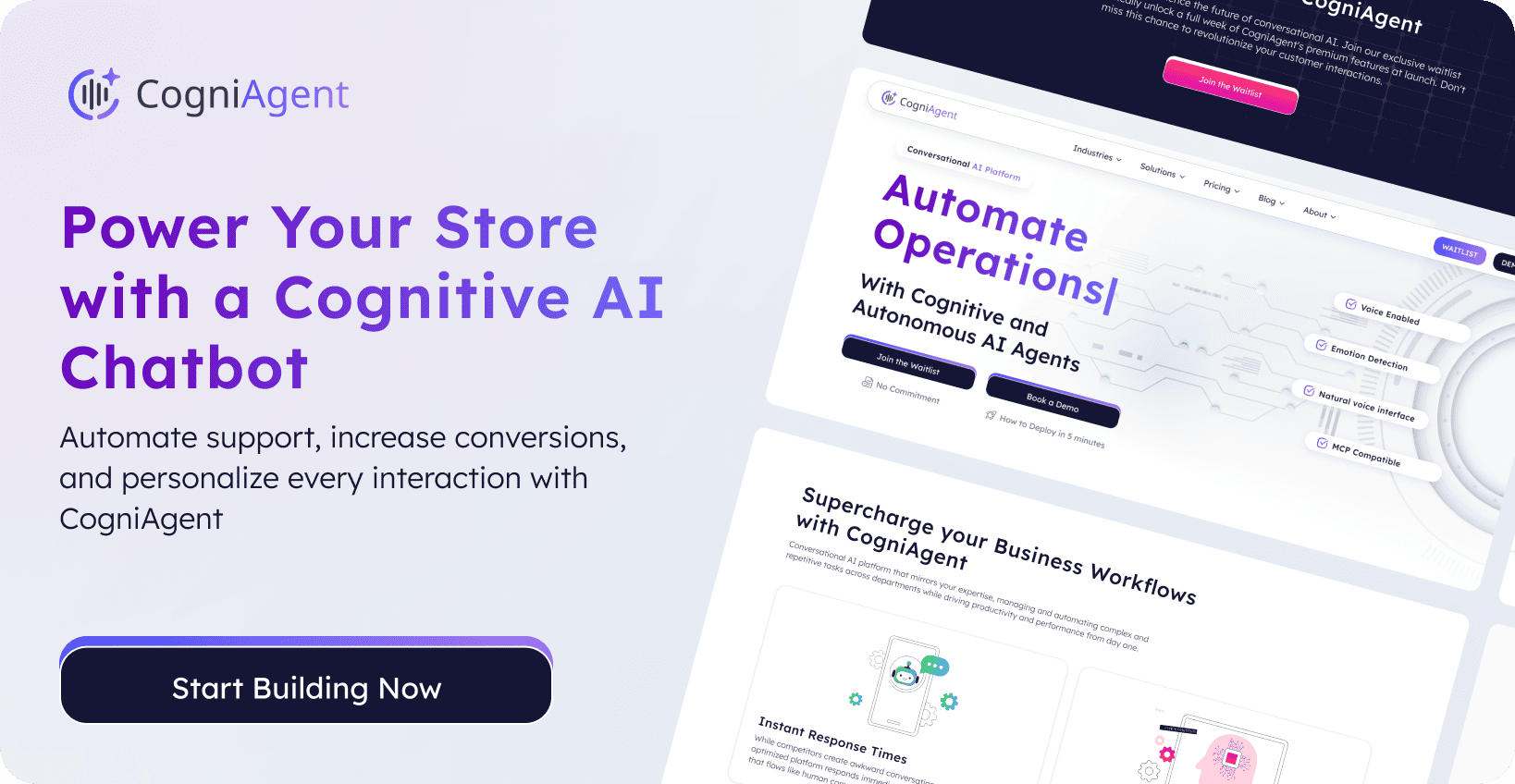
Here’s what it might look like if you adopt an AI chatbot for an ecommerce website:
- A site visitor can ask, “Can you show me patio furniture that’s in stock and will ship to my location by next weekend?”
- Your AI chatbot understands the complex request, including product type, stock filter, shipping timeline, and more.
- It understands the tone of the request and queries your inventory and shipping logistics systems.
- Once that chatbot has all the necessary information (in a few seconds), it generates a personalized answer with a human-like tone and accurate delivery estimates.
How an ecommerce AI chatbot works
You don’t need to be an engineer to understand the powerful ecommerce automation behind AI chatbots for ecommerce. It’s quite simple if you think of it as a well-coordinated team inside your website.
NLP: The brain behind true conversational commerce
Natural language processing allows your chatbot to understand the meaning behind each question. If a visitor types in your chatbot, “My order hasn’t arrived yet,” or “That thing I bought last week is late,” it understands that the query is about tracking the order. There’s no simple keyword matching; NLP provides the tool with a human-like understanding, allowing it to deliver accurate answers, unlike the frustrating button-clickers of the past.
The knowledge integrations
NLP is almost like the magic behind the scenes, but understanding is useless without information. That’s why connections are critical. An AI chatbot solution for ecommerce has access to your core systems:
- Product catalog and inventory to answer questions like “Is this in stock in size large?”
- Order management system to fulfill queries like “Track my order #45012” or “Can I change my shipping address?”
- CRM and customer history to personalize interactions and talk to the visitor like an acquaintance. For example, “Welcome back, Alex. Looking for more running shoes like the ones you bought back in March?”
- CMS and help center to pull information from your existing knowledge base for FAQ answers.
This connection turns your AI agent for ecommerce into a tool that uses its brain and knowledge to reason and act.
Action and personalization
This is where you can see the true difference between basic chatbots and an AI chatbot platform for ecommerce. Powerful bots can retrieve necessary data, reason through logic, and take action. And the final layer that creates a true conversational tone is the voice.
Legacy ecommerce chatbot tools pull pre-written, canned responses. The most advanced systems, like CogniAgent, use generative AI:
- Instead of robotic, “Item #SKU123 is in stock,” it generates a human-like, brand-appropriate response: “Great news, Alex! The product is in stock in your size and ready to ship. It’s been super popular this season!”
- It enables ecommerce personalization by weaving in customer data. For example, “Based on your love for drip coffee, you might really enjoy our new single-origin Ethiopian beans to go with your French Press.”
This personalized and engaging conversation is what drives ecommerce conversion optimization, turning casual browsing into confident and loyal buyers.
What Problems Does an AI Chatbot Solution for Ecommerce Solve?
Companies are increasingly turning to AI to streamline operations, and the data validates this shift: in 2024, the chatbots and virtual assistants segment was the dominant AI application, capturing the largest market revenue share at 28.1%.
So, what problems does an AI chatbot platform for ecommerce solve that have sparked such high interest in ecommerce leaders?
| Pillar | The Problem | The Solution | The Tangible Result |
| Faster Customer Support | Repetitive queries overwhelm teams, causing delays and burnout. | Provide instant, 24/7 automated support for common questions. | • Deflect most routine tickets.
• Faster resolutions. • Happier customers and agents. |
| Driving Sales & Recovering Revenue | Lost sales from cart abandonment and missed upsell opportunities. | Proactive engagement guides shoppers and recovers abandoned carts. | • Higher conversion rates.
• Increased order value. • Recovered revenue. |
| Streamlining Operations | Manual tasks hinder scalability and efficiency. | Automate workflows like order updates and lead qualification. | • Improved operational efficiency.
• Scale support without adding staff. |
Top 5 Enterprise AI Chatbot Solutions for Ecommerce
Let’s compare five leading enterprise AI chatbot platforms so you can better understand what each platform can deliver for your business.
#1. CogniAgent
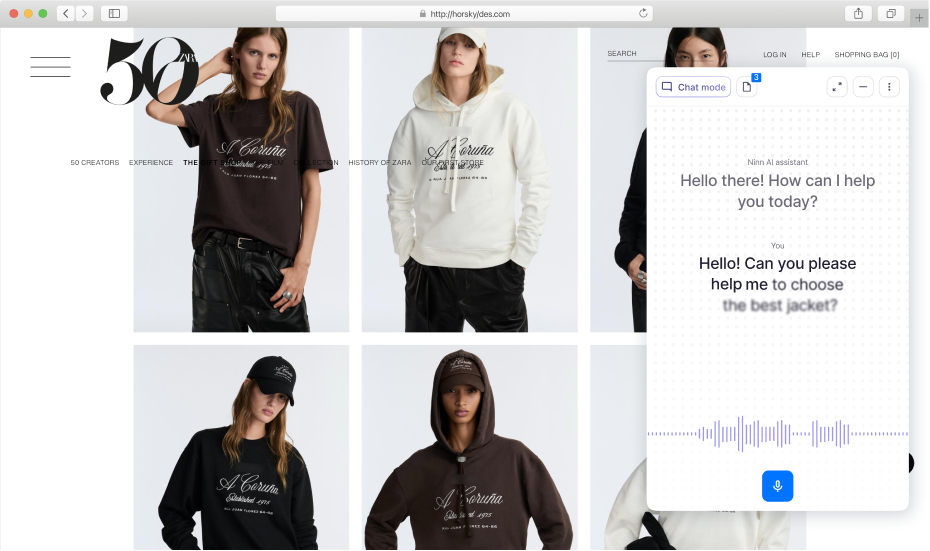
Best for: Mid-market and enterprise brands seeking to transform customer operations with an AI that can think, act, and empathize.
Key features:
- Solves complex, multi-step customer problems through logic and decision-making.
- Takes action directly in your systems, like updating orders or processing returns, without human intervention.
- Detects sentiment and adapts tone for more human-like, empathetic conversations.
- Maintains consistent, context-aware conversations across website, social, and voice channels.
| Pros | Cons |
| Automates complex processes end-to-end for real business outcomes. | May require internal process changes to adopt the cognitive agent model. |
| Delivers an emotionally intelligent, loyalty-building customer experience. | Advanced features are more powerful than needed for basic FAQ-only use. |
| Breaks down operational silos by unifying sales, support, and marketing. | |
| Scales efficiently with transparent, usage-based pricing. |
Pricing: Transparent, usage-based tiers: Free Starter plan; Pro plan at $33/month; Business at $181/month; and custom Enterprise packages.
#2. Ada
Ada helps businesses make automated chatbots that answer questions directly from their knowledge base and connected systems, which keeps support tickets from piling up. It features a marketer-friendly interface for training the AI, making it easy for non-technical teams to provide personalized support on a larger scale.
Best for: Customer-focused brands of all sizes seeking a user-friendly, marketing-led automation tool, primarily for support deflection and personalized customer interactions.
Key features:
- Easily teaches the chatbot your brand voice and knowledge.
- Deflects common inquiries with AI-generated, personalized answers.
- Engages customers with targeted, automated messages.
- Provides clear data on deflection rates and bot performance.
| Pros | Cons |
| Excellent for scaling personalized support deflection. | Primarily focused on support, with less emphasis on sales automation. |
| Intuitive, no-code interface for non-technical teams. | Workflow automation is less advanced than specialized platforms. |
| Strong focus on maintaining a consistent brand voice. |
Pricing: Custom pricing based on usage and scale. Typically starts for mid-market businesses.
#3. Kustomer
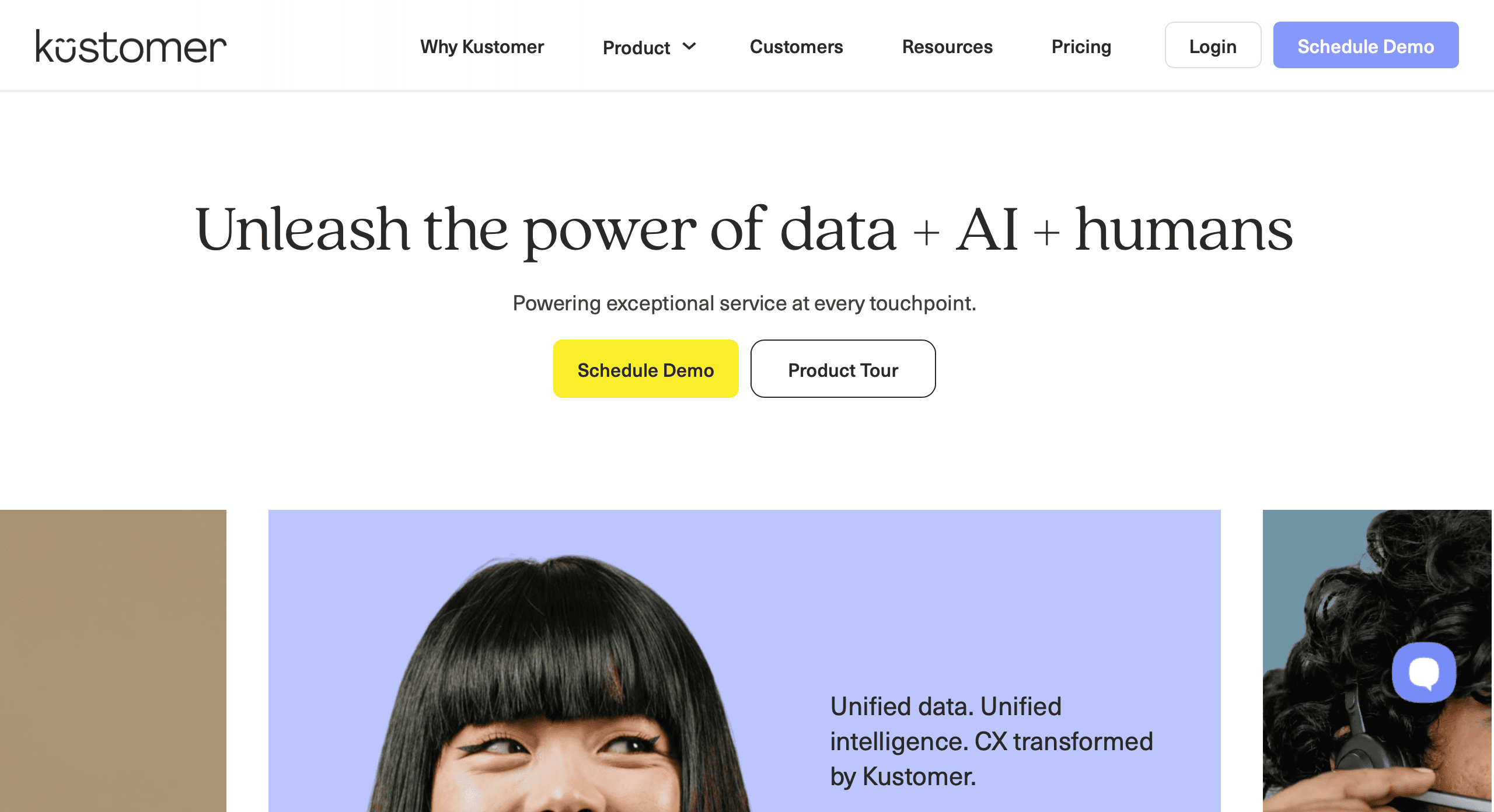
Kustomer is an omnichannel CRM and customer service platform with built-in AI capabilities, designed for high-volume DTC brands. It focuses on automating workflows within the helpdesk and suggests agent responses. If you need to integrate AI within CRM, Kustomer is a great tool.
Best for: High-volume DTC brands that want AI chatbots deeply embedded within a powerful, all-in-one CRM platform.
Key features:
- Aggregates all interactions from every channel into one view.
- Manages and automates workflows across email, social, chat, and SMS.
- Suggests macros and knowledge base articles to help agents reply faster.
- Powers help centers and chatbots from within the CRM.
| Pros | Cons |
| Powerful single-view CRM at its core. | The chatbot is part of a larger, costly CRM suite. |
| Seamless omnichannel conversation management. | Can be complex for brands only seeking a standalone chatbot. |
| AI enhances agent productivity within existing workflows. |
Pricing: Custom enterprise pricing. Requires commitment to the full Kustomer CRM platform.
#4. Gorgias
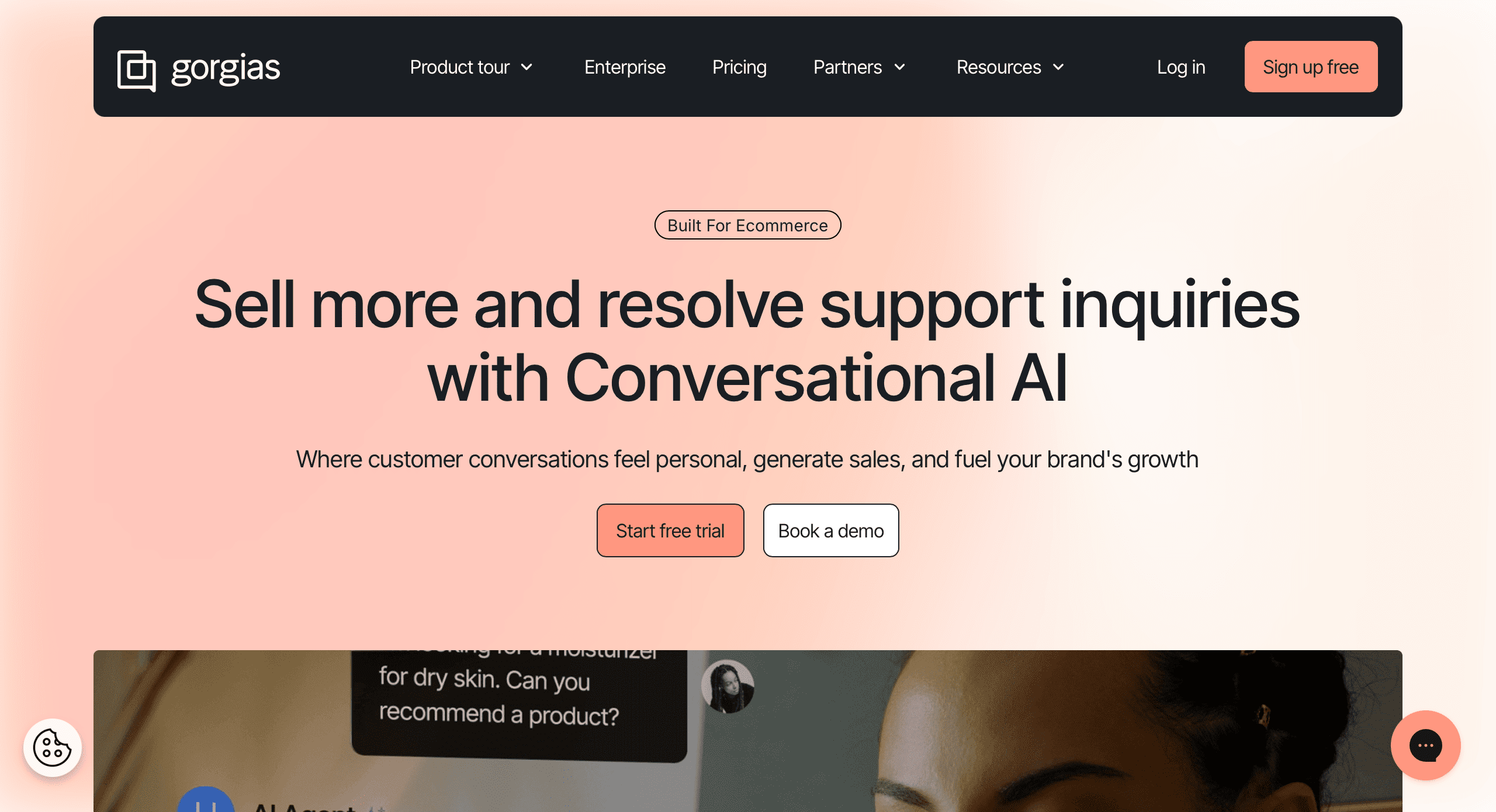
Gorgias is a native platform for ecommerce, primarily Shopify. It brings together support tickets from different sources and uses AI to help agents respond more quickly. The tool cuts down on manual work (like auto-tagging and applying macros) instead of completely replacing the human agents.
Best for: Shopify-centric SMBs and growing brands that want a simple, all-in-one helpdesk with basic automation.
Key features:
- Centralizes emails, live chat, SMS, and social messages.
- Automates repetitive agent tasks and applies saved responses instantly.
- Offers chat widgets with some automated trigger responses.
- Lets agents view orders and process returns without leaving the ticket.
| Pros | Cons |
| Excellent, fast ticketing experience for Shopify stores. | Automation is largely rule-based, not cognitive AI. |
| Reduces agent handling time with smart shortcuts. | Limited as a standalone, proactive sales tool. |
| Useful, shallow integrations for common ecommerce actions. |
Pricing: Tiered pricing from $10/month to $900+/month, based on ticket volume and features.
#5. Zowie
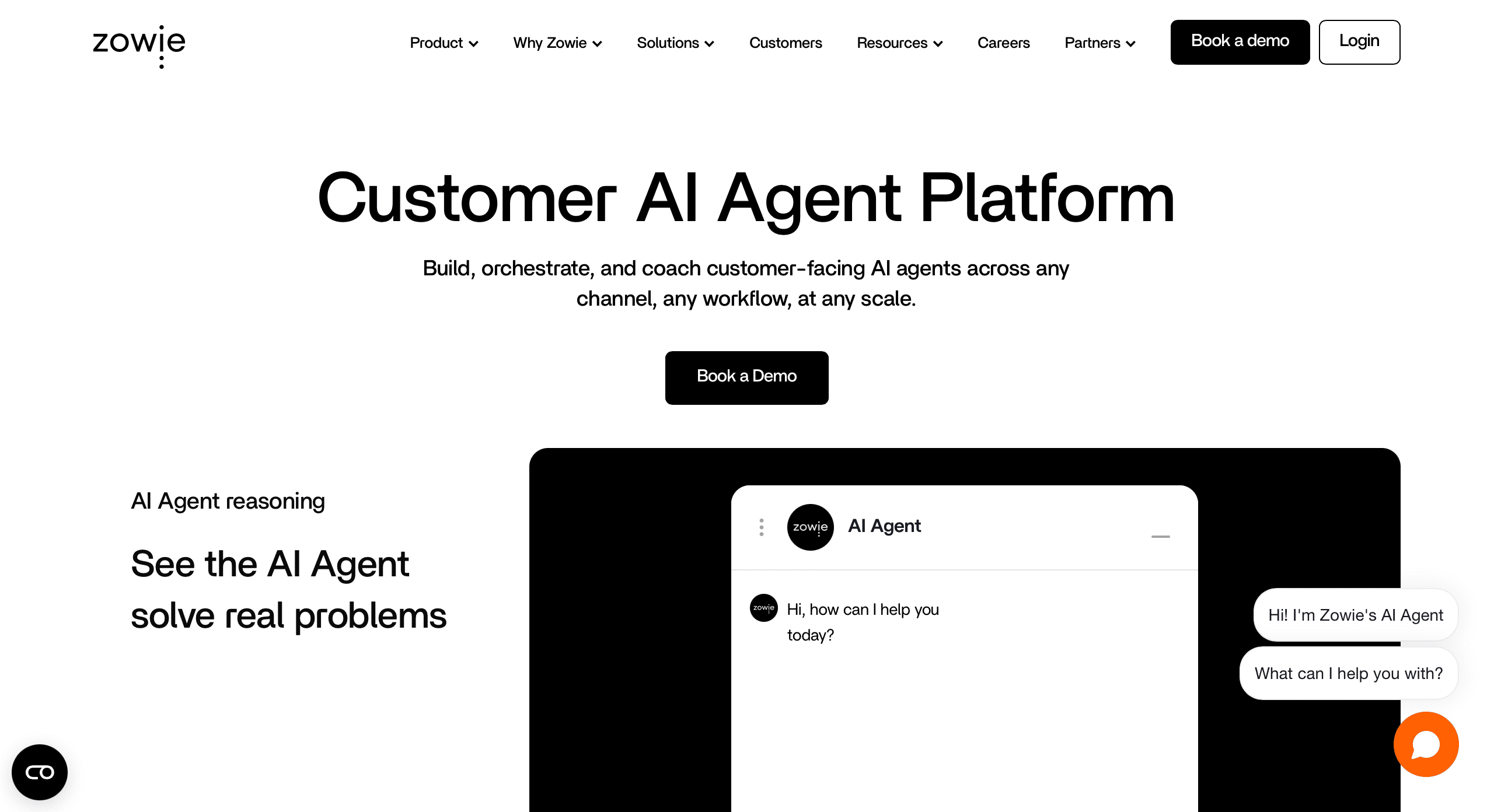
Zowie, formerly known as Chatbot.com, is an ecommerce platform that automates customer service and helps drive sales. This tool has a pre-built understanding of ecommerce intent and features that help with visual product recommendations and cart recovery within the chat. It’s a “plug-and-play” solution that allows you to see fast deflections and sales impact.
Best for: Ecommerce brands, from mid-market to enterprise, seeking a specialized, out-of-the-box chatbot.
Key features:
- Understands common ecommerce intents and language out of the box.
- Recommends products with images and links directly in chat.
- Sends personalized messages to shoppers who abandoned their cart.
- Transfers complex chats to agents with full context.
| Pros | Cons |
| Fast time-to-value with ecommerce-specific training. | Less customizable for highly complex, unique workflows. |
| Strong focus on visual commerce and cart recovery. | May not offer deep cognitive reasoning or emotional intelligence. |
| Balanced approach between support and sales. |
Pricing: Custom pricing based on order volume and business size.
Ready to Build Your 24/7 AI Sales & Support Team?
So, what kind of AI partner do you need for your team? Your customers expect instant and personalized service at every hour, there’s no way around it. Your business demands efficient growth. The right platform is everything. To grow and expand your operations, you need more than a scripted bot that frustrates customers and drives them to demand to speak with a human agent.
You need CogniAgent:
- It gives answers, thinks, and takes action. It can process returns, update orders, and qualify leads directly within your systems.
- It detects frustration, urgency, and excitement. It adapts the tone and prioritizes issues.
- It connects your entire tech stack, including storefront and CRM.
All it takes is 5 minutes to set up, and you can always request a demo to check if CogniAgent is the right fit.
FAQs
What’s the realistic setup and training time for an enterprise AI chatbot solution for ecommerce?
Setting up CogniAgent takes 5 minutes, but with integrations and knowledge base connection, the whole process may take up to 2-4 weeks.
How do I measure the ROI for my AI chatbot for an ecommerce website?
We recommend tracking the following core metrics: deflection rate and first-contact resolution for customer service; conversion rate lift, abandoned cart recovery revenue, and average order value for sales; and reduction in average handle time and agent productivity gain for operations.
What happens when the chatbot doesn’t know an answer?
The best AI chatbot for ecommerce (if it’s configured properly) should gracefully deflect to a human agent via live chat or ticket creation. CogniAgent, for example, provides the agent with the full conversation history, intent, and necessary details for a seamless handoff.