

If you’re a business leader, tech strategist, or decision-maker trying to understand which type of AI can best serve your organization, this guide is for you. The two most talked-about categories, generative AI and cognitive AI, play very different roles. While generative AI excels at creating content and communication, cognitive AI focuses on reasoning, judgment, and autonomous decision-making. In this article, we’ll help you understand their differences and how to choose the right one for your business strategy.
Gen AI is the voice, and cognitive AI is the brain. But when to use which tech? How do you know your business will do with only generative AI and doesn’t need a conversational AI agent like CogniAgent? How can you be sure that you didn’t overspend on agentic AI and could’ve gone with AI systems that perform simple, specific tasks? In this article, we’ll explore the differences and collaboration capabilities of cognitive vs generative AI.
Generative AI vs Cognitive AI: Complex Tech in Business Terms
Terms like “deep learning” and “natural language processing” can sound intimidating to a non-technical person. To translate this into a language we all understand, it helps to think of generative AI as the master communicator and creator, and cognitive AI as the strategic analyst and decision-maker.
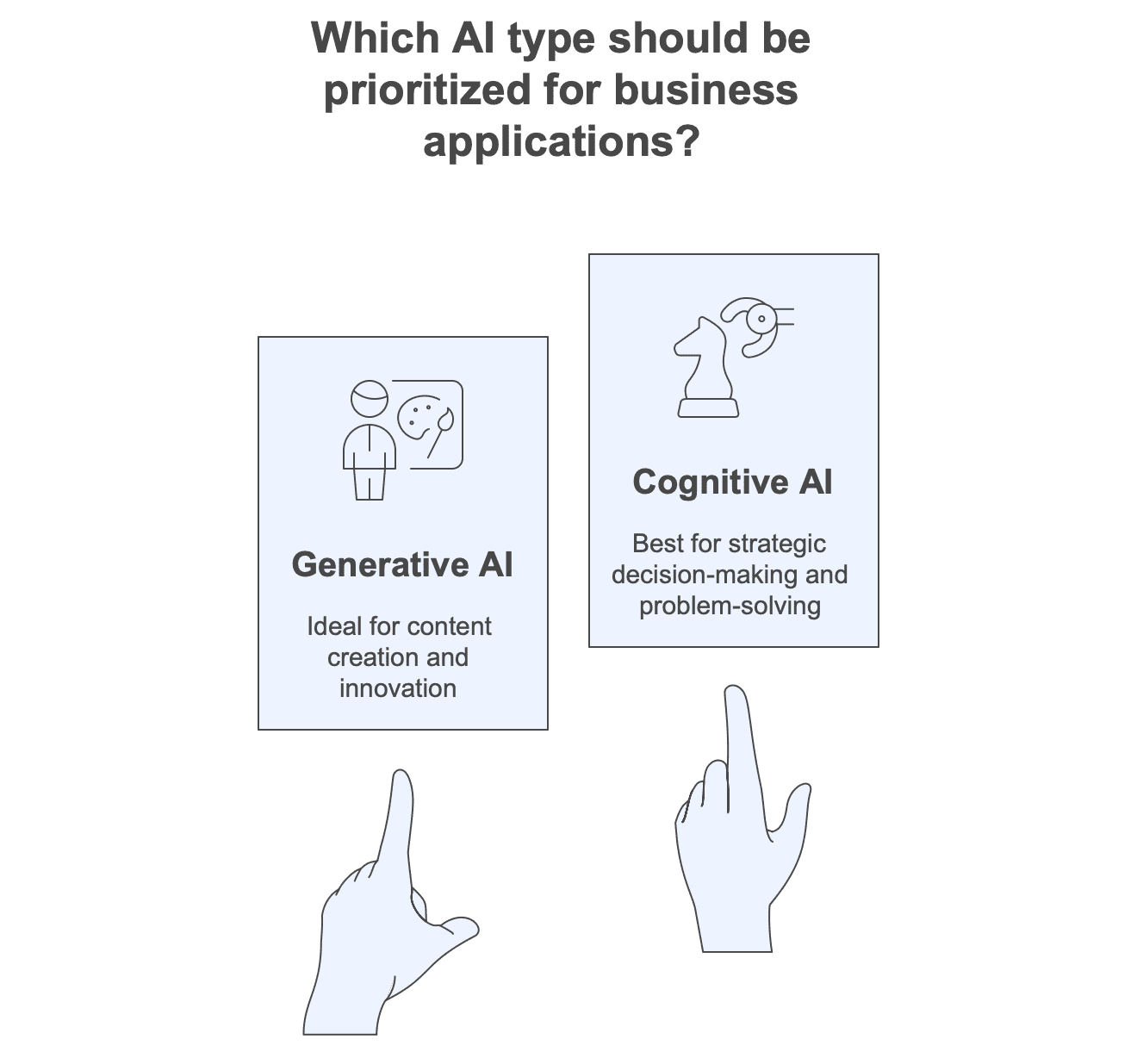
Both use machine learning, both try to mimic the human brain, human thought, and human decision-making processes. Below, we’ll explore each type of AI in detail.
What is generative AI?
Generative AI is a type of artificial intelligence that creates new information and new content. Based on the Deloitte Generative AI Report, people think of gen AI as a traditional AI system. The tech uses large language models (LLMs like GPT-4) that are trained on vast amounts of data, essentially a significant portion of the internet.
In this massive training data, these AI applications analyze patterns, relationships, and structures and learn grammar, human language, code, or visual art. You may already be familiar with this process, but when you give it a prompt, it uses this acquired knowledge for content creation. In the business context, generative AI’s primary strength is its speed and scale in ideation and drafting.
What is cognitive AI?
If generative AI is the creative specialist, cognitive AI is the strategist. This AI mimics humans through a process to understand, reason, learn, improve, and make decisions. The ultimate goal of cognitive systems is to replicate human cognition and solve complex problems. While both types of AI learn from vast datasets, cognitive AI systems can navigate uncertainty and dynamic environments.
For example, generative AI models use their knowledge for content generation, and cognitive artificial intelligence may use predictive analytics to forecast outcomes, choose the best course of action, learn from past mistakes, and improve. In the business context, the strength of cognitive AI is judgment and autonomous decision-making.
Generative AI vs Cognitive AI capabilities and use cases
Learning about each type of AI is essential to understanding the difference between them, but the comparison of the use cases gives you a better picture. Below, you’ll find a comparison table outlining capabilities and use cases of each type of AI (including the level of human intervention, ability to understand unstructured data, and other key differences):
| Generative AI | Cognitive AI | |
| Core Capability | Creation & Drafting Produces new, original content (text, code, images) by learning patterns from its training data. |
Reasoning & Decision-Making Analyzes complex data, understands context, and makes informed decisions or takes autonomous actions. |
| Primary Strength | Speed and scale in ideation and content generation. | Strategic judgment and managing dynamic, multi-step processes. |
| Key Limitation | Can “hallucinate” facts; lacks true reasoning; cannot explain its outputs. | Not designed for open-ended creation; requires clear objectives to function. |
| Best For These Tasks |
|
|
Generative vs Cognitive AI: When to Use?
Choosing the right AI isn’t about finding the best tech, but finding the right tool that suits your business needs. For many, the cognitive search vs generative AI battle may easily go to cognitive AI for its diverse capabilities, but some businesses only need gen AI features, and that’s essential to understand. Using generative AI for a task that requires deep reasoning is like using a marketing intern to run your logistics department, and using cognitive AI to write a catchy slogan is overkill.
We’ve prepared a framework to guide your decision:
Choose generative AI when your primary need is:
Creation or drafting, summarization, translation, brainstorming, ideation, and in general, content generation.
1. Creation and drafting: If you need to generate new texts, images, articles, emails, or form ideas, you can write a prompt and ask your gen AI tool to generate original content for you.
Example: “Draft five email subject lines for our Q3 campaign.”
2. Summarization and translation: Gen AI is great at summarizing large amounts of information and can also translate it into other languages (depending on the model).
Example: “Summarize the key points from this 50-page market research report in Spanish.”
3. Brainstorming: Gen AI has reportedly been mentioned as one of the best brainstorming and ideation tools. Whenever you need to explore a wide range of creative possibilities quickly, write a prompt and start brainstorming.
Example: “Generate 10 concepts for a new product launch.”
When it comes to cognitive AI vs generative AI in content creation, we always recommend going with gen AI capabilities.
Choose cognitive AI when your primary need is:
Reasoning and judgement, automating complex processes, personalized decision-making, and more.
1. Reasoning and judgement: When you need to analyze data, weigh your options, and make a decision to move forward, cognitive AI capabilities can assist you in this process, making it shorter and more informed.
Example: “Should we approve this loan application based on credit history, cash flow, and market risk?”
2. Automating complex processes: You have a multi-step workflow that requires adaptation and judgment? In cognitive AI vs generative AI, cognitive capabilities are the best for automation purposes.
Example: “Autonomously manage our supply chain, rerouting shipments in real-time based on weather, demand, and port delays.”
3. Personalized decision-making: If you need to provide a unique recommendation or action based on a complex set of individual circumstances.
Example: “Analyze this customer’s entire support history and product usage to diagnose the root cause of their issue and route them to the exact right specialist.”
When it comes to cognitive AI vs generative AI, cognitive capabilities are the best for automation, personalization, and workflow improvement.
Need Tech that Combines Cognitive Intelligence with Generative Power?
So now you’re left with a choice: Cognitive AI vs generative AI. Do you choose the creative power of gen AI, or the strategic reasoning of cognitive capabilities? Following our guide, it should be easy for you to decipher which tech suits your business needs the best, but if you want to experience the best of two worlds, CogniAgent is the best choice for you.
We built our platform on a simple, powerful premise: orchestrating both gen AI and cognitive AI to create truly intelligent agents.
CogniAgent is an cognitive AI agent builder that uses a robust cognitive AI to do the “thinking” part and enhances it with generative AI for “speaking” and “creating.” This means you can build agents that don’t just generate text, but understand, reason, act, and communicate autonomously.
Here’s what you can achieve with CogniAgent:
- Workflow Automation. CogniApps automate complex business operations with adaptive, event-driven workflows that combine AI flexibility, deterministic reliability, and seamless human collaboration across systems.
- Conversational AI. Delivers human-like, context-aware conversations across text and voice channels, managing natural dialogue flow, pauses, and topic shifts to boost engagement and resolution speed.
- Autonomous AI Agents. Intelligent agents decompose complex problems, integrate multiple data sources, and produce structured, insightful analyses for research-intensive and analytical tasks.
CogniAgent is the right choice for you if you need the reliability and strategic logic of cognitive AI, without sacrificing the communication and creative capabilities of generative AI. And the best news? You can start building your first agent in just a few minutes.
Start for free today and experience the best of two worlds.
FAQ
In the context of cognitive AI vs generative AI, which is better for automating our customer service?
The answer depends on the complexity of your services. Simple queries can be handled by a generative AI chatbot, but true automation that resolves complex issues is usually done with cognitive AI capabilities. When comparing cognitive AI vs generative AI, it’s always best to consider combining the two, but in customer service, we recommend conversational agents.
How does the cognitive AI vs generative AI debate address the accuracy and “hallucinations?”
Generative AI can hallucinate, because its primary goal is creation (not factual accuracy). Cognitive AI, however, is built to deliver reliable decision-making. In platforms like CogniAgent, the cognitive AI acts as the “fact checker,” using generative AI safely for communication under its supervision.
When evaluating cognitive AI vs generative AI for long-term strategic advantage, which one is more sustainable?
Generative AI offers speed, but cognitive AI provides a strategic advantage in operational intelligence. Both tech is suited for long-term goals, but a well-implemented cognitive AI system becomes a proprietary “digital brain” for your company.